Kennedy wants to limit CDC’s role to infectious diseases


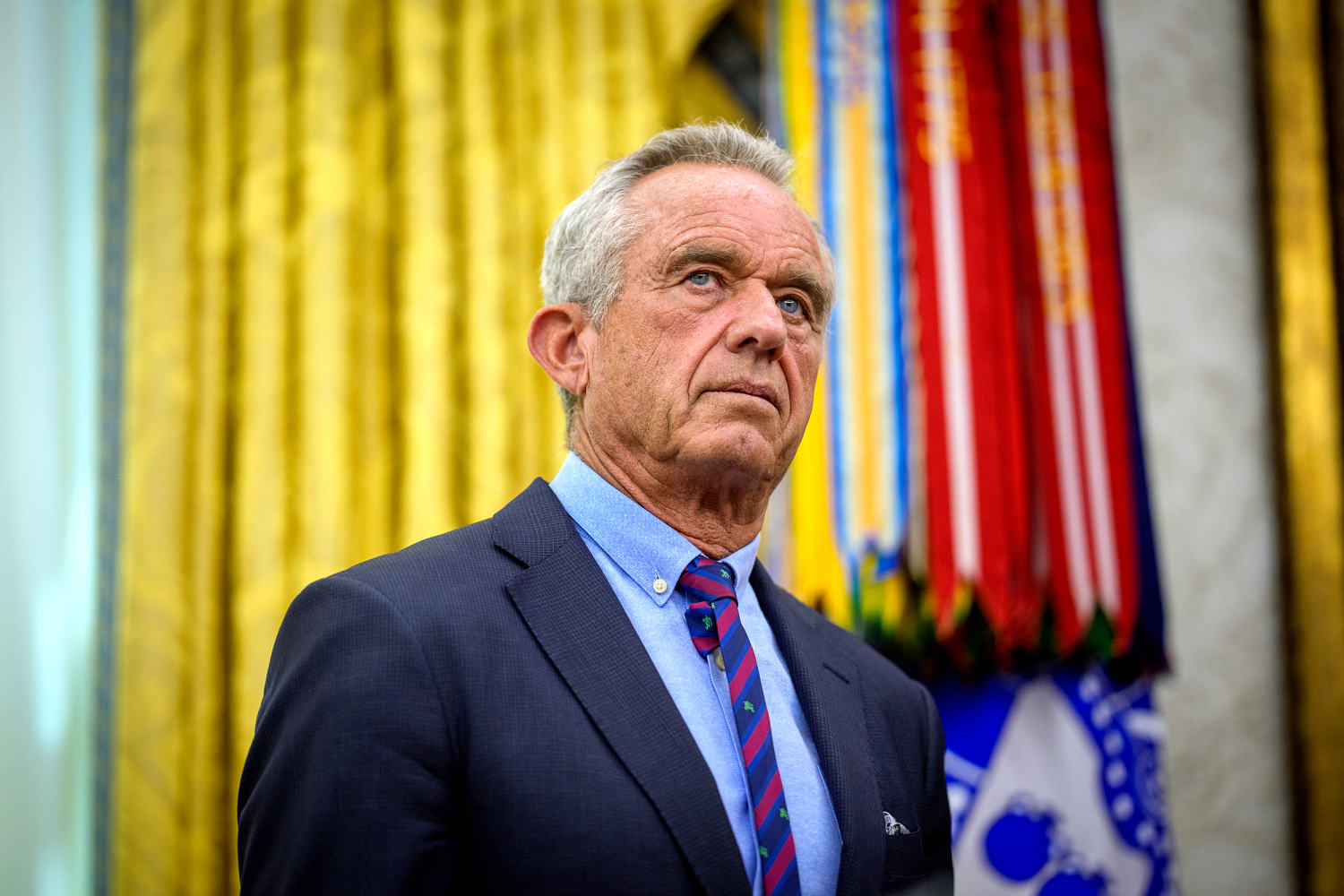
One day after nine former Centers for Disease Control and Prevention Directors wrote that the actions of the Health Secretary Robert F. Kennedy Jr. at the agency are “different from all that our country has ever known,” he repulsed in an editorial of the Wall Street Journal.
The CDC “was once the most reliable public health guard in the world,” wrote Kennedy on Tuesday. “His mission – protecting Americans from infectious diseases – was clear and noble. But over the decades, bureaucratic inertia, politicized science and the mission’s flipper corroded this goal and wasted public confidence. ”
He argues that the agency should return to its initial accent on infectious diseases, moving away from efforts to improve public health by moving on chronic disease programs such as diabetes or heart disease far from the CDC.
He described the nation’s response to the pandemic as a “failure”, claiming that public health officials have prioritized “fabric masks on toddlers, arbitrary distancing of 6 feet, boosters for healthy children, prolonged school closures, economies locking and the abolition of therapeutics with low cost in favor of experimental and ineffective drugs”. “”
“The CDC must restore public confidence-and this restoration has started,” he wrote.
The editorial of Kennedy follows a chaotic in recent weeks at the agency, starting with a shooting at the agency’s headquarters in Atlanta last month and the rejection of the director of the CDC, Susan Monarez. Monarez, who was appointed by President Donald Trump, only played the role for about a month.
His dismissal has led several senior CDC officials to resign to protest and triggered a back and forth between the lawyers of Monarez and the White House. He also fueled a staff demonstration in front of the agency’s headquarters in Atlanta last week and a scathing editorial at the New York Times of nine former directors on Monday, who called “dangerous” Kennedy.
In his editorial on Tuesday, Kennedy did not answer questions concerning the dismissal of Monarez or his recent actions on vaccines. Instead, he blamed the Biden administration for missteps during the pandemic and criticized the way in which the scope of the CDC has widened over the years.
The CDC was founded in 1946 by emphasizing the prevention of malaria to spread across the country. Over time, his work has expanded to include other infectious diseases – such as polio, smallpox and HIV – as well as public health problems such as chronic diseases, lead poisoning, bioterrorism, injury prevention and global health.
Kennedy argued in his editorial that the agency’s expansion role led to an “irrational policy” during the pandemic.
“The path to go is clear: restoring the accent put by CDC on infectious diseases, investing in innovation and reconstructing confidence by integrity and transparency,” he wrote.
Lawrence Gostin, director of the O’Neill Institute for the National and World Health Law of the University of Georgetown, said in an email that practically all public health agencies of state health services and in other countries have expanses beyond infectious diseases.
“The nation would lose precious knowledge and information if CDCs were forced to considerably reduce its work in chronic diseases,” wrote Gostin. “Overall, the secretary quickly transforms CDCs from a public and scientific health agency to a firmly controlled agency politically controlled.”
The opinion of Kennedy “Mistes” The role of the CDC during the pandemic, wrote Gostin. “The CDC does not have the power to order economic locks or school closures”, and at no time during the pandemic, tried it.
“These are purely state decisions,” he wrote.
Dorit Reiss, an expert in vaccination policy of the law of the University of California, San Francisco, called the opinion of Kennedy “deceptive” and “hypocrite”, taking into account his own action since he took office.
Kennedy takes advantage of public frustration in the face of the pandemic to justify larger changes that could weaken the agency, said Reiss.
His editorial calls on the agency to protect the public from infectious threats of diseases, to apply the “science of gold standards” and to support communities-but several CDC centers are already devoted to these initiatives, she said. Kennedy has repeated his call for the transmission of agency’s chronic disease programs to a new entity called “Administration for a healthy America”. (The Secretary of Health cannot create this agency by itself and would need the help of the Congress, added Reiss.)
Gostin criticized Kennedy’s “ironic and circular” reasoning in OP-ED, claiming that he first blamed the “CDC for the increase in chronic conditions while saying that the agency has no trade on chronic diseases”.
Reiss said: “Mr. Kennedy avoids CDC’s ability to respond to infectious diseases, works to undermine confidence and do nothing to improve confidence.”
During the summer, Kennedy dismissed all members of an influential panel for infant vaccinations and replaced them with his own members, some of whom are anti-vaccine activists.
Last month, he also announced that the Food and Drug Administration had reduced its approval for the couples of this fall, limiting it to people 65 and more and to those who have underlying medical conditions.
A spokesperson for the Ministry of Health and Social Services did not respond to a request for comments.
Kennedy is expected to testify on Thursday before the Senate finance committee, while he should face questions surrounding the CDC and his recent actions on the plans.
The nine former directors and the acting directors of the CDC who signed the editorial of the New York Times are: DRS. William Foege, William Roper, David Satcher, Jeffrey Koplan, Richard Besser, Tom Frieden, Anne Schuhat, Rochelle P. Walensky and Mandy K. Cohen.
They accused Kennedy of focusing on “unproven” treatments “while minimizing vaccines”.
Kennedy, they added, “the investments canceled in promising medical research that will leave us badly prepared for future health emergencies”.
Last week, Senator Bill Cassidy, R-La., Which was a key vote in Kennedy’s confirmation, called on the CDC to postpone its advisory committee on the meeting of vaccination practices this month in the middle of the upheaval and criticism of the Kennedy CDC.



.jpg.png?w=390&resize=390,220&ssl=1 "Your Weekly Horoscope: August 31 to September 6, 2025")