Lake Superior rocks reveal build up to giant collision that formed supercontinent Rodinia


About 1.1 billion years ago, the oldest and most tectonically stable part of North America – called Laurentia – quickly headed south to the equator. Laurentia finally slammed in the other land masses of the earth during Grenville orogenie To form the Rodinia supercontinent.
The path of Laurentia during this period is known, thanks to paleomagnetism. By Draw orientation and magnetism From the rocks of the lithosphere, scientists can approximate the relative position and the movement of Laurentia leading to the formation of Rodinia.
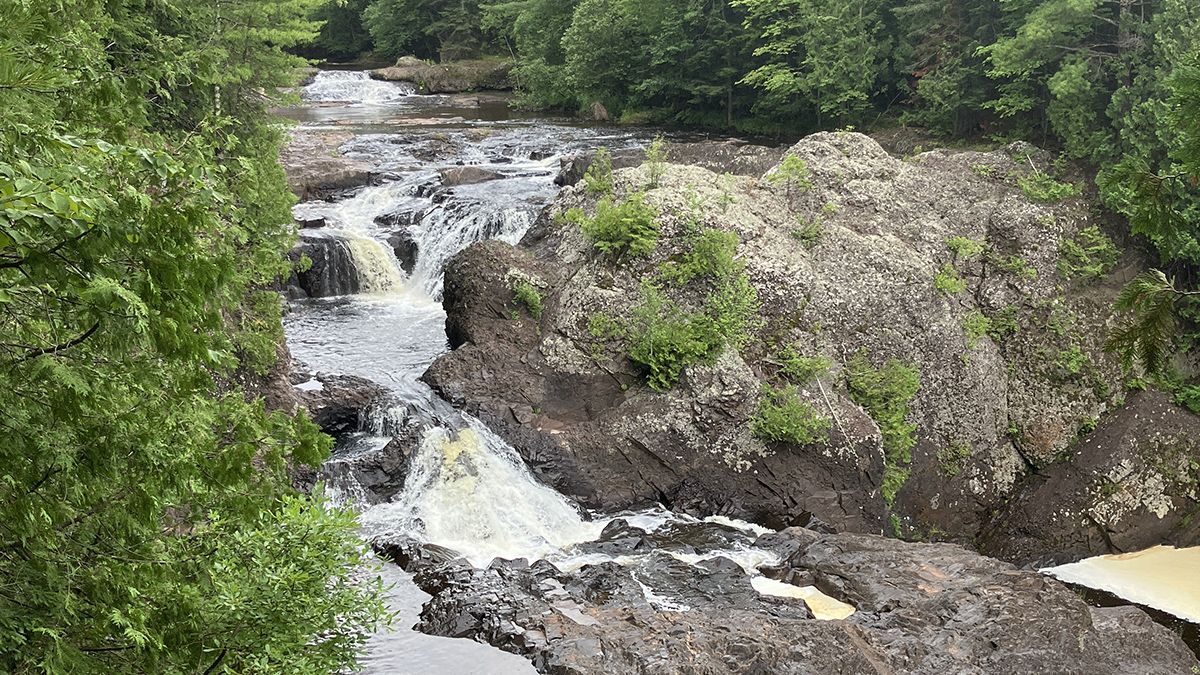
The rocks along Lake Supérieur in the north of Wisconsin and Michigan are particularly important to draw the movement of Laurentia. These rocks – dominated by red sandstones, siltones and minor conglomerates – were deposited during the extended sedimentation caused by the North American rift -continent and are plagued by iron oxides as hematite. Hematite can acquire magnetization when deposited, which records where the rock was compared to Earth poles at the time.
Unfortunately, the existing paleomagnetic file is spoiled by a gap between 1,075 million and 900 million years, limiting our understanding in the way, when and where Rodinia has formed.
To fill this data gap, Fuentes et al. collected new samples from the Freda training Near Lac Supérieur, which formed in environments of flooding plains approximately 1,045 million years ago. The authors combined this data with the modeling of stratigraphic age to estimate a new sedimentary paleopolyOr the position of the geomagnetic pole at some point in the past.
Previous studies indicate that for 30 million years, between 1,110 million and 1,080 million years, Laurentia went from around 60 ° N to 5 ° N at a rate of 30 centimeters (12 inches) per year – faster than the collision of the Indian plate with Eurasia Push the Himalayas. This study showed that during the following 30 million years, Laurentia’s progress slowed down to 2.4 centimeters (1 inch) per year when it crossed the equator.
The slowdown in the paleocontinent during the Freda training deposit coincides with the start of the Grenville orogenesis. The results confirm that a stagnation Code regime – in which the lithosphere behaves as a single continuous plaque rather than as multiple independent plates – was not in force during this interval.
This article was initially published on Eos.org. Read it original article.


