Latest Cretaceous Dinosaurs Lived in Vibrant, Regionally Distinct Communities


The most iconic mass extinction in Earth’s history occurred about 66 million years ago, as rapid environmental destruction caused the extinction of about 75% of species, including non-avian dinosaurs, and subsequently restructured terrestrial ecosystems. Debate centers on whether dinosaurs died out abruptly while they were diverse and thriving or whether they were in long-term decline before the end of the Cretaceous.
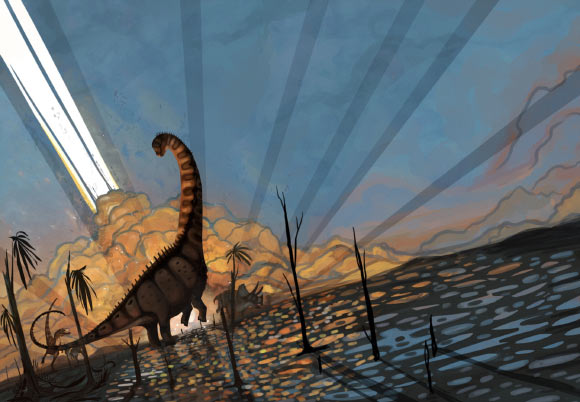
Flynn and others. analysis Alamosaurus fossils found in northwest New Mexico and discovered that these dinosaurs were very different but the same age as dinosaurs found further north in Wyoming and Montana. Image credit: Natalia Jagielska.
In northwest New Mexico, layers of rock preserve a hidden chapter of Earth’s history.
In the Naashoibito Member of the Kirtland Formation, Baylor University paleontologist Daniel Peppe and his colleagues discovered evidence of vibrant dinosaur ecosystems that thrived just before the asteroid impact.
High-precision dating techniques have revealed that the fossils in these rocks are between 66.4 and 66 million years old.
“The Naashoibito dinosaurs lived at the same time as the famous Hell Creek species in Montana and the Dakotas,” Dr. Peppe said.
“They weren’t in decline: they were vibrant, diverse communities.”
New Mexico fossils tell a different story than initially thought.
Far from being uniform and weakened, dinosaur communities across North America were regionally distinct and thriving.
Using ecological and biogeographic analyses, researchers discovered that dinosaurs in western North America lived in distinct bioprovinces, divided not by mountains or rivers, but by temperature differences between regions.
“Our new research shows that dinosaurs are not on the verge of mass extinction,” said Andrew Flynn, a researcher at New Mexico State University.
“They are doing very well, they are thriving and the asteroid impact seems to knock them out.”
“This runs counter to a long-held idea that there was a long-term decline in dinosaur diversity that led to a mass extinction, thereby making them more prone to extinction.”
“The asteroid impact ended the age of dinosaurs in an instant, but the ecosystems they left behind set the stage for what followed.”
“Less than 300,000 years after their extinction, mammals began to diversify rapidly, exploring new diets, new body sizes and new ecological roles. »
“The same temperature-driven patterns that shaped dinosaur communities continued into the Paleocene, showing how climate guided the recovery of life after catastrophe.”
“Surviving mammals still retain the same northern and southern biological provinces.”
“Northern and southern mammals are very different from each other, which is different from other mass extinctions where it seems to be much more uniform.”
The results appear today in the journal Science.
_____
Andrew G. Flynn and others. 2025. Late-surviving New Mexico dinosaurs illuminate the diversity and provinciality of the High Cretaceous. Science 390 (6771): 400-404; doi: 10.1126/science.adw3282


