Lenovo’s radical PC concepts imagine laptop screens that adapt to you


Lenovo previously showed a prototype display that can be aligned intelligently for optimal ergonomics. Now it also does something similar with a laptop stand.
During the IFA 2025 show in Berlin, Lenovo shows what he calls the concept of intelligent movement, a intelligent multidirectional laptop stand that can follow your face and optimize so that his alignment probably states little stress on your eyes and your neck. The company also shows what it calls a concept of “vetiflex”, which would allow a landscape screen of a laptop to turn in portrait mode and an intelligent “Magic Bay Tiko” screen.
Lenovo generally exhibits part of what his engineers worked in various salons, by reducing the days when IBM – which sold his business with laptops in Lenovo – would open the doors of his emblematic Almaden research laboratory in the foothills of San Jose. There, IBM would show some of his research, in sowing industry with new ideas while requesting comments.
At CES 2025 as well as the MWC 2025 show, Lenovo demonstrated the AI display, which has placed an NPU inside a screen both to add older PC capabilities, as well as to allow the monitor to rotate automatically, tilt and elevation. The idea was that in a shared joint workplace, where workers could cycle with laptops connected to mooring stations, AI display could automatically configure a new worker.
Before the home work movement took over, however, the municipal workspaces were also blocked with laptop stands, their exhibitions getting back into external monitors. The concept of intelligent movement does essentially the same as the AI monitor, aligning the laptop at the same time to minimize the eye effects as well as to position it and its camera for video calls. Analyst Olivier Blanchard of the Futurum group captured a video of the concept of intelligent movement in action, as he turned it and followed it.
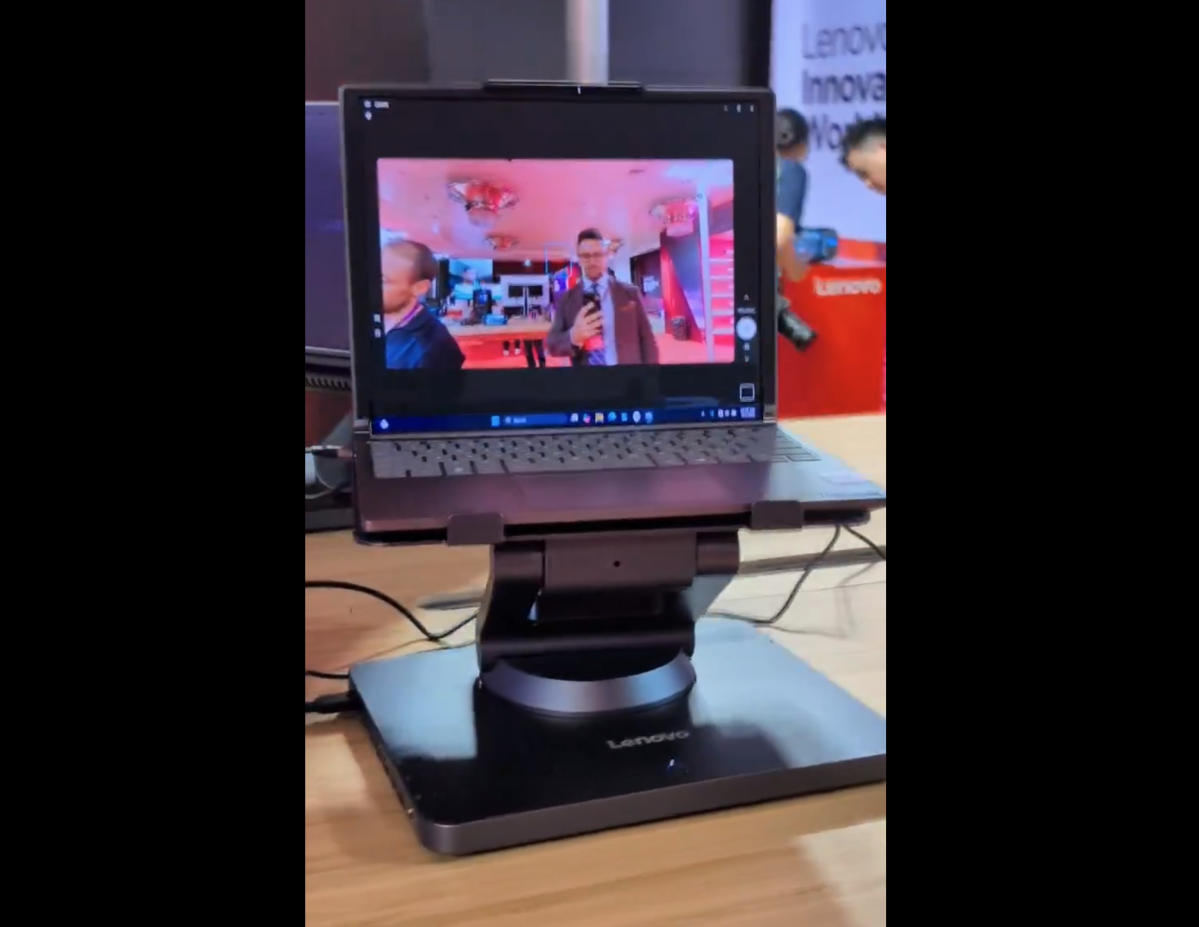
Olivier Blanchard / X
Lenovo also uses an AI ring to allow gestural controls from the whole configuration, said the company.
All of this is very reminiscent of webcams like the Obsbot Tiny 4k, which has a small cardan software and tracking to allow the webcam to twist and turn and follow your face when you move in the room.
Adjusting the display is also the theme of other Lenovo concepts.
The concept thinkbook vertiflex (upper image) imagines a traditional valve laptop whose 14 inch screen can be turned vertically in portrait mode. The laptop of 3.06 pounds is designed to go into portrait mode for use with the revision of documents or code writing. During his stay in portrait mode, Lenovo said he heard that a smartphone can connect to the laptop lying down with the back facing the part of the screen – although for charging or simply ergonomics is clear.

Lenovo
Lenovo has also shown what he calls a “naturasynth” screen, blue light being strangled at less than 1% to reduce eye fatigue and fatigue. The blue light controls are managed in the equipment, said Lenovo.
Finally, Lenovo has also shown (but has not announced) the Magic Bay Tiko concept, which is essentially another Small screen that can be attached to the back of your laptop. Lenovo positions the small rectangular display (the size of an old CD bridge mounted on a car) as a telepromitator and a second screen for loudspeakers without your eyes moving away too far from a webcam during a meeting.

Olivier Blanchard / X
Keep in mind that these are technically concepts, Lenovo also brings some of them. The last example? The Thinkbook more rolbler, a superb laptop with an expandable roller screen that started life as a concept, but Lenovo finally put on the market. Ironically, the roller -beating essentially vertiflex on the market by “dropping down” in portrait mode. Anyway, it’s great to see businesses try new things – and talk about it publicly.


