Lightning on Earth is sparked by a powerful chain reaction from outer space, simulations show


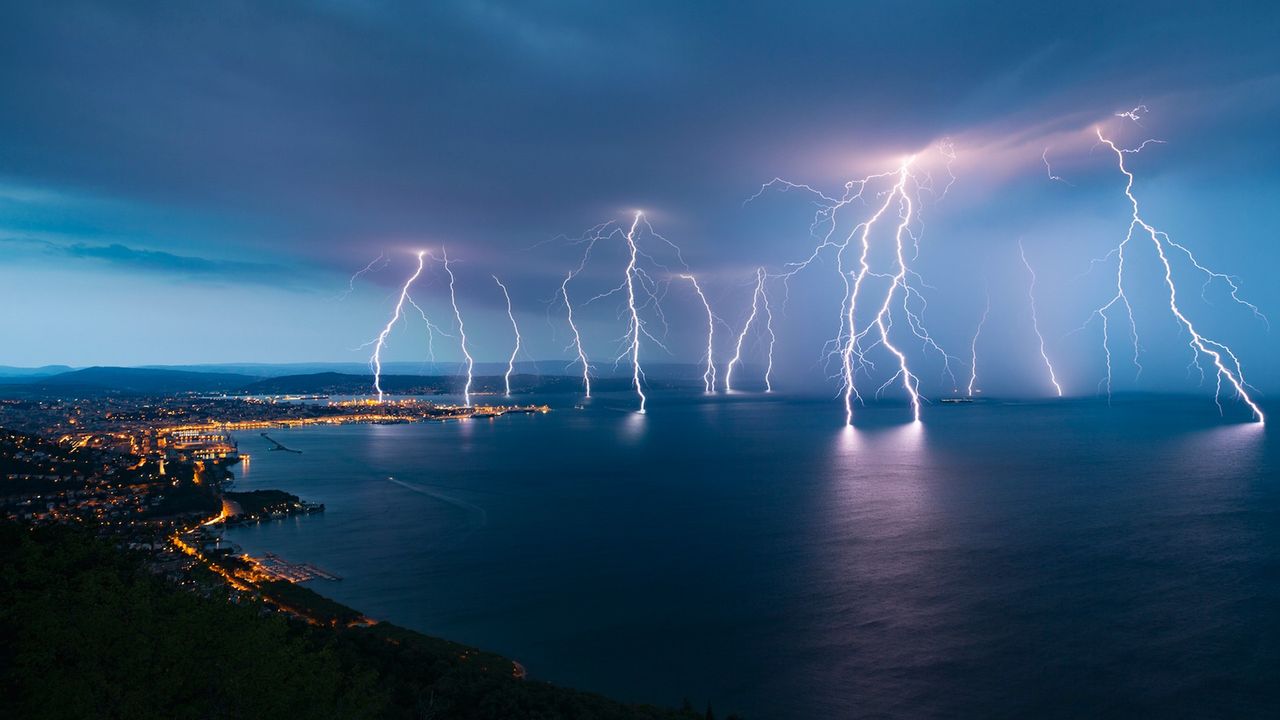
The energy necessary for thunderstorms could come from an avalanche of electrons seeded by extraterrestrial Cosmic raysA new study says.
Scientists already knew that lightning is an electrical discharge between the shots of thunder and the surface of the earth, but exactly how the storm clouds get an electric field powerful enough to launch a bolt has remained a mystery for centuries.
Now, a new study has used computer models to reveal that lightning strikes after a powerful chain reaction that begins in space. The researchers published their results on July 28 in the Journal of Geophysical Research: Atmospheres.
“Our results provide the first precise and quantitative explanation for the way in which lightning settles in nature”, the main author of the study Victor PaskoProfessor of electrical engineering at the Penn State School of Electrical Engineering and Computer Science, said in a press release. “It connects the points between the X -rays, the electric fields and the physics of the electronic avalanche.”
The electrical nature of Lightning was confirmed by Benjamin Franklin in 1752. Emblematic of Franklin, although Often distortedThe experience involved piloting a kite affixed to a thread of 1 feet long (0.3 meters) at one end and a string attached to one key with the other, which Franklin held with a silk ribbon. When a storm arrived, the kite has become electrified and the string has become wet, so that a small spark jumped from the key to its tense finger.
Despite this discovery, the data recorded by planes and weather balloons show that the electric field necessary for cascade electrons on earth are about 10 times higher that that has really measured inside the storm clouds.
In relation: The ‘Killer Electrons’ play the freak with spatial weather around the earth
There are two competing theories to explain how lightning actually occurs. The first atmospheric static electricity postulates that the friction between the ice tufts in the storm clouds separates the electrons charged negatively from the atomsmaking them accumulate until they ionize particles in the atmosphere below them, releasing enough electrons to run on the ground along several paths of forking.
In the second theory, this initial ionization is carried out by cosmic rays – high energy subatomic particles (mainly protons) from space that strikes the upper atmosphere. These rays come from the sun; stellar explosions called supernovas; Neutron stars turning quickly called pulsars; and other unknown sources. When the cosmic particles strike the atmosphere, they create a flavored electron failure which ends with a stifling cascade.
In the new study, the researchers brought together data from ground sensors, satellites and high altitude spy plans, and equaled the information to a mathematical model that simulated the conditions in a storm cloud preceding a strike.
The simulations of the model supported the theory of cosmic rays, showing that the electrons produced by high -speed protons have accelerated along the electric field lines and multiply when they have struck molecules in the atmosphere, such as nitrogen and oxygen. This leads to an avalanche of electrons, producing the high -energy photons that trigger lightning, according to the researchers.
Surprisingly, the model also explains why lightning of gamma rays – high energy photons – and X -rays occur before lightning strokes.
“In our modeling, the high energy X -rays produced by avalanches of relativistic electrons generate new electrons of seeds driven by the photoelectric effect in the air, quickly amplifying these avalanches,” said Pasko. “In addition to being produced in very compact volumes, this leakage chain reaction can occur with very variable resistance, often leading to detectable X -ray levels, while being accompanied by very low optical and radio emissions. This explains why these gamma lightning can emerge from source regions that seem optically weak and radio.”


