Like Kindergarten Buddies, Male Dolphins That Keep Friendships Can Live Longer


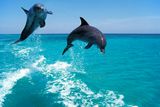
Dolphins age a bit like us. As they age, they experience increased lethargy, fading vision, and stiffer movements.
A new study, published in Communication biologysuggests that dolphins can slow down the march of time with the help of their friends.
Researchers studying a pod of dolphins in Shark Bay, a marine hotspot in Western Australia, found that male dolphins that formed strong social bonds with other males aged more slowly than their solitary peers.
Learn more: In a first, watch orcas team up with dolphins to boost their salmon-hunting success
Dolphin social groups
Socialization between dolphins is divided according to sex. Female dolphins form fluid bonds with other females by raising their offspring at the same time. Male dolphins, on the other hand, form permanent bonds with other males.
These animals hunt, swim, and even hang out together. Researchers have seen pairs of male dolphins playing and riding the waves for fun. Livia Gerber, a biologist at the University of New South Wales and co-author of the new research, said in a press release: “It reminds me of two kindergarten buddies who stay together through school, career and retirement and share all of life’s joys and challenges.” »
These strong bonds aren’t just for fun. Without a friend by their side, solitary dolphins have a harder time hunting and are more vulnerable to predators like sharks. These difficulties add up, making solitary life in the ocean more stressful.
Similarities Between Human-Dolphin Friendships
In dolphins, as in humans, ongoing stress is a key factor in the aging process. To study the relationship between socialization, stress and aging in their dolphin population, the researchers used a huge resource of behavioral data accumulated over 40 years of study. Dolphins that maintain close social bonds spend most of their time together. By recording the dolphins they saw hanging out together when they explored the bay on a boat, the team established a “who’s who” of dolphin relationships.
The team identified male dolphins for which they had precise age data. The team had skin tissue samples from 38 of these animals, allowing them to assess key markers of aging.
Previous animal research has found that social bonds help animals live longer, thereby extending their chronological age. Instead, the team studied biological aging by studying chemical markers in the dolphins’ DNA, called epigenetic markers. Biological aging provides a more complete picture of an animal’s health and physiology, but no previous research has assessed how it is affected by socialization.
Epigenetic markers have been used in humans to assess the effects of pollution, poor mental health and poverty on aging. Lee Rollins, a biologist at the University of New South Wales and lead author of the study, said in a press release: “We are also increasingly using epigenetic data to advance our knowledge of wild population ecology, including the epigenetic clocks used here.” »
Friends and long life
Epigenetic markers showed that well-socialized dolphins had a lower biological age than their more solitary peers born in the same year.
“The health benefits of friendship are not unique to humans, but are a fundamental biological principle in social mammals. This research should change the way we think about animal welfare and remind us that social needs are biological needs,” Gerber said.
The researchers believe future work will show that their findings apply to all animal species that form close, long-lasting social bonds. “I predict that we will discover that friendship is a natural anti-aging secret in social animals,” Gerber concluded.
Learn more: Dolphins in captivity are the loudest when playing and feeding – and it’s not just for socializing
Article sources
Our Discovermagazine.com editors use peer-reviewed research and high-quality sources for our articles, and our editors review the articles for scientific accuracy and editorial standards. See the sources used below for this article:


/https://tf-cmsv2-smithsonianmag-media.s3.amazonaws.com/filer_public/3e/b5/3eb5416d-c7f2-4b49-8d6a-2717a7a3292b/smithmag-article-kleptoplasty-0326-v5.jpg?w=390&resize=390,220&ssl=1 "These Sea Slugs Can ‘Eat’ Sunlight—but They’re No Astrophage. Here’s How the ‘Project Hail Mary’ Antagonist Has a Real-Life Analog in Earth’s Oceans")
