Lost mural reveals ancient Silk Road fire ritual


Nestled along the picturesque Zeravshan river in the rocky mountains of northwestern Tadjikistan is the ruins of an old and forgotten palace. The Monumental Royal Complex has already presided over a lively city along the Silk Road, not far from the border of modern Tajikistan with Uzbekistan. At its peak, the palace walls were covered with colored wall paintings and complex wooden sculptures, most of which have been lost in time – until now.
A study recently published in the Academic Review Antiquity Recreated and analyzes one of the most surprising wall paintings in the palace. The mural shows four priests accompanying a young boy in an altar of fire and looks like nothing discovered. For archaeologists of this new study, the representation raises many more questions than answers.
The great forgotten civilization of Tajikistan
For centuries, the palace was an impressive siege of the power of Sogdiana, the homeland of an ancient Iranian known as the Sogdians. One of the first sogdiana mentions was in the 5th century BC, when the land was a territory of one of the first empires in the world – the Achaemenid Persian Empire. At the beginning of the fourth century BCE, Alexandre le Grand conquered Sogdiana, absorbing the earth in its own massive but short -lived empire.
Seven hundred years after Alexander, the Sogdians reached their zenith. Capitalizing on their strategic location between Asia and Europe, they have become qualified merchants, exchanging Indian precious stones, Tibetan musks and luxurious furs of Asian steppes in the 4th century.
The Sogdian golden age persisted until the 8th century AD when Islamic forces took control of a large part of the region. Some Sogdians have converted to Islam, while others have assimilated themselves to Chinese culture or other civilizations. In several centuries, Sogdians had largely lost their distinct cultural identity.
The Royal Palace in Sanjar-Shar
Although a large part of the Sogdine culture can be lost in time, some of their structures are still held, including the ruins of a palace ornate hidden from the dry and rocky terrains in the northwestern Tajikistan. Known as the Royal Palace in Sanjar-Shar, its remains are about seven miles east of the modern panjake.
Built in the fifth century AD, the palace was a massive complex built to impress. There were many large reception rooms arranged asymmetrically along a central T -shaped corridor, a provision which reflects other official Sogdian residences. Visitors to the former palace were said to have been greeted by a treasure of goods from all ancient world, from Chinese mirrors decorated with golden belt loops.
But some 300 years after its construction, the illustrious palace burned on the ground. The peasants have moved to ruins, using the once noble palate as a utility storage space for at least another century.
Perplexed wall painting
In the late 1940s, Soviet archaeologists began to search the Royal Palace in Sanjar-Shar. During the decades that followed, many excavations took place on the site. Archaeologists found a multitude of goods which once decorated the sumptuous residence, including many fragments of murals.
A bright blue lotus flower formerly decorated the central corridor in the shape of the palace. Nearby, a hunting scene honored the walls of a small square room. The walls of a large rectangular room displayed a cavalry mounted on the sides of demonic figures with “curved eyes and raised eyebrows”, writes the main author of the study, Michael Shenkar of the Hebrew University of Jerusalem.
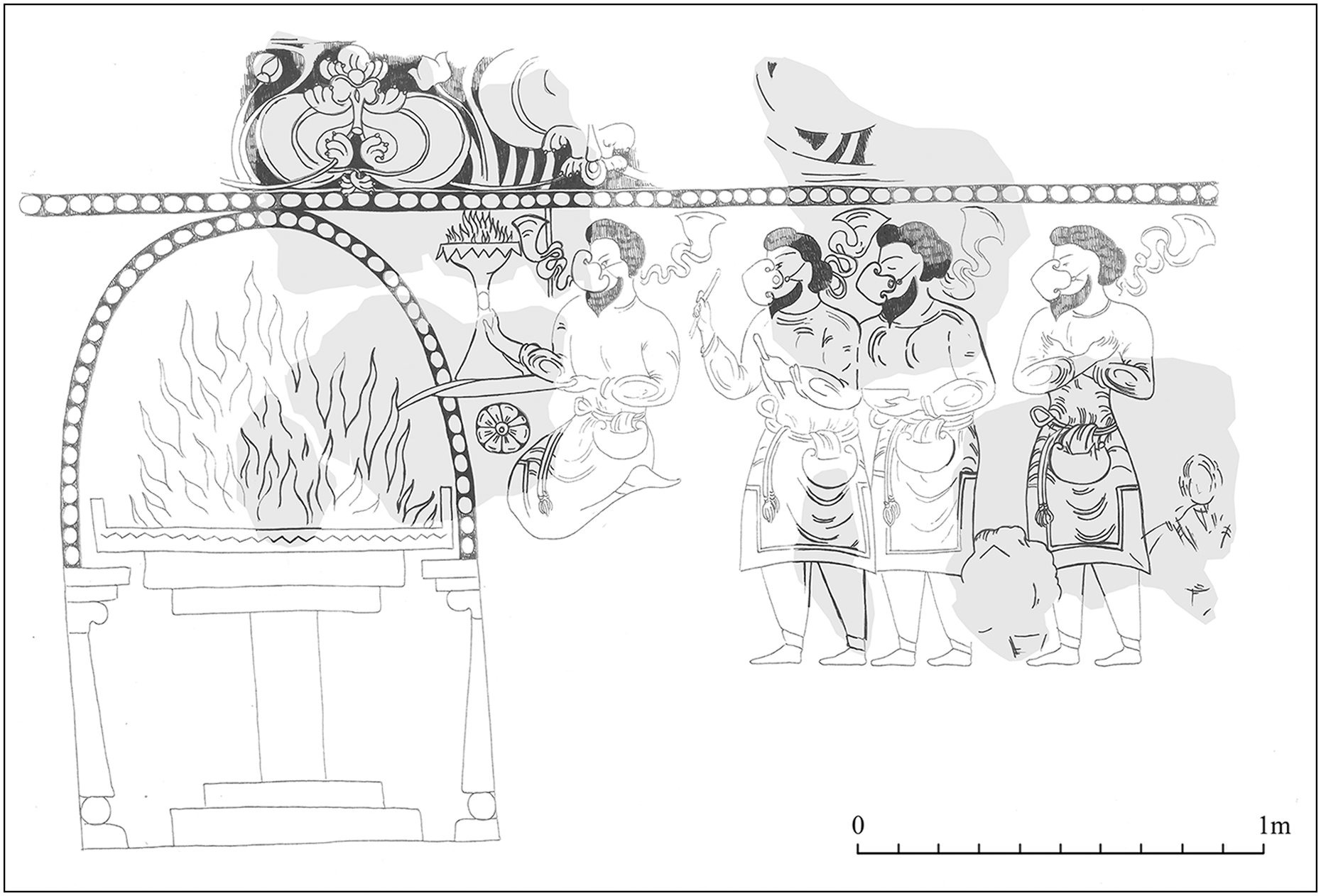
In the same room as the demons and the lines with large eyes, the most confusing wall fragments may have been discovered in 2022 and 2023. Reconstated for the first time by Shenkar and his team, the fragments show four priests, and perhaps a small child, approaching an altar of stationary fire. Representations like these have never been found only on ossuaries (chambers for the storage of human remains), and even then, these paintings generally show only two priests.
The priest at the front of the fresco procession was “obviously the most important”, but he is “also the most poorly preserved”, writes Shenkar. “He was probably represented on his knees on both knees, raising a small altar towards the largest and stationary – a common posture in Sogdian art, often showing faithful offering incense on a portable incense burner.”
However, offers like these were generally made to painted or carved deities, not to draw altars. Shenkar and others still determine what is exactly the connection between the incense offer and the cult of fire.
Meanwhile, “the second and third figures in the procession probably have objects”, but what exactly he owned is a mystery. The third figure also carries a padām“A ritual lid on the palate, still used today by Zoroastrian priests,” writes Shenkar. “The second figure may also have worn padāmWhile the ribbon extending from the back of its neck is an unusual characteristic, because these ribbons of Sogdian art generally accompany the deities and the kings. »»
Is the priest a kind of divinity or king, then? Perhaps this specific priest occupied a particularly important position of power? Researchers do not know. “The fire work scene is a rare addition to Sogdian visual culture,” writes Shenkar, offering unrivaled ideas on Sogdian society on the eve of their fall.
Today, scholars can only hope that Sogdians have left more clues to unravel this mysterious wall painting and other secrets of the illustrious royal palace in Sanjar-Shar.

More offers, reviews and purchasing guides