Major League Baseball Is Sanitizing Jackie Robinson’s Radical Legacy


This article is part of TPM Cafe, TPM’s home for opinion and news analysis.
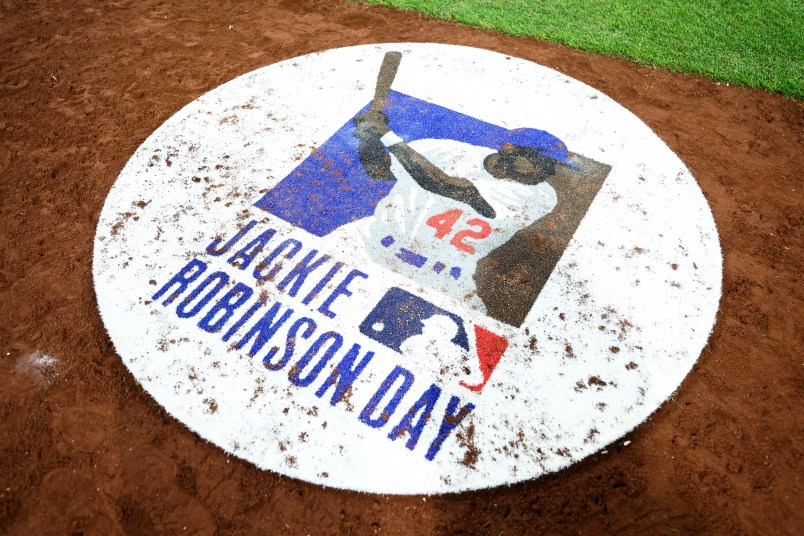
Major League Baseball (MLB) likes to congratulate itself for being a civil rights trailblazer. Jackie Robinson Day celebrations are held at every ballpark on April 15, the date Robinson first played for the Brooklyn Dodgers in 1947. Since 2009, all players, managers, coaches, and umpires wear Robinson’s iconic number 42 to commemorate his impact on the game and society. At every game played that day, teams feature on-the-field ceremonies and show clips of Robinson. Winners of the Jackie Robinson Foundation’s college scholarship program show up to discuss how his legacy changed their lives. It is a feel-good day for sport.
Though Robinson was a fierce competitor and an outstanding athlete, the aspect of his legacy that often gets glossed over on Jackie Robinson Day is that he was also a radical.
Baseball has had its share of iconoclasts, dissenters and mavericks who defied baseball’s and society’s establishment. But none took as many risks — and had as big an impact — as Robinson.
The celebrations of Jackie Robinson Day downplay his activism during and after his playing career. They don’t delve into the forces arrayed against Robinson — the players, fans, reporters, politicians and baseball executives who scorned his presence in a major league uniform and outspoken views on racial segregation. (In 1946, at least 14 of the 16 major league owners opposed ending baseball’s apartheid).
Major league baseball integrated at a snail’s pace after Robinson broke MLB’s color barrier. As late as 1951, only six of baseball’s 16 major league teams had a Black player. The Boston Red Sox were the final holdout, when Elijah “Pumpsie” Green joined the team in the middle of the 1959 season, 12 years after Robinson joined the Dodgers.
Black players in the major and minor leagues — particularly in the South but elsewhere, too — continued to face blatant racism long after Robinson retired from the Dodgers in 1956. They couldn’t eat in the same restaurants or stay in the same hotels as their white teammates. Even taxis were off-limits to many Black players. Fans, opposing players, and even some of their own teammates hurled racist epithets and made it harder for them to concentrate on the game. White managers used racist double standards in deciding which players would play, get promoted, or demoted.
Will this year’s festivities remind fans that last year the Department of Defense deleted a story on its “Sports Heroes Who Served” website highlighting Robinson’s military service as part of President Donald Trump’s efforts to purge references to diversity, equity and inclusion? The DOD restored the page in less than a day in response to numerous media stories and comments by members of Congress, Robinson’s relatives, the head of the Negro Leagues Baseball Museum, and some major league players. Conspicuously absent were any words from MLB Commissioner Rob Manfred, whose office coordinates the annual Jackie Robinson Day events.
In anticipation of this year’s Jackie Robinson Day, MLB announced that the number of Black players on major league rosters increased from 6.2% last year to 6.8% on Opening Day this season. It didn’t mention that the number had dropped from 18% in 1991, according to the Institute for Diversity and Ethics in Sport at the University of Central Florida. The Houston Astros’ Dan Brown is the only Black general manager on any team. There are no Black majority owners of any MLB team.
Although over one-quarter of all major league players are foreign born — most of them from Spanish-speaking countries – no MLB team has made a strong, explicit statement against the ICE raids of American cities during the Trump administration. Only a handful of players — the Dodgers’ Kiké Hernández, Atlanta Braves pitcher Spencer Strider, and two-time All-Star Sean Doolittle, now a Washington Nationals pitching coach — have spoken out against ICE.
Unlike today’s players, Robinson was a rebel before he played in the majors.
When he was a soldier during World War II, his superiors sought to keep him out of officer candidate school. He persevered and became a second lieutenant. But in 1944, while assigned to a training camp at Fort Hood in Texas, he refused to move to the back of an army bus when the white driver ordered him to do so.
Robinson faced trumped-up charges of insubordination, disturbing the peace, drunkenness, conduct unbecoming an officer and refusing to obey the orders of a superior officer. Voting by secret ballot, the nine military judges — only one of them Black — found Robinson not guilty. In November, he was honorably discharged from the Army.
Describing the ordeal, Robinson later wrote, “It was a small victory, for I had learned that I was in two wars, one against the foreign enemy, the other against prejudice at home.”
After his military service, he was barred from playing in the all-white major leagues. Instead, he played for the Kansas City Monarchs in the Negro Leagues. In 1945, Branch Rickey, the Dodgers’ general manager, selected Robinson to break the color barrier, not only because he was an outstanding player, but also because he was well-educated, religious, articulate, an army veteran, and had lived among and played with white teammates in Pasadena and as a four-sport athlete at UCLA. After a year with the Dodgers’ minor league team in Montreal, the Dodgers promoted him to the big-league team.
During his playing days — 1947 to 1956, all with the Brooklyn Dodgers — Robinson had a .311 lifetime batting average and led the Dodgers to six pennants. He was Rookie of the Year in 1947, Most Valuable Player in 1949, and elected to the Hall of Fame in 1962.
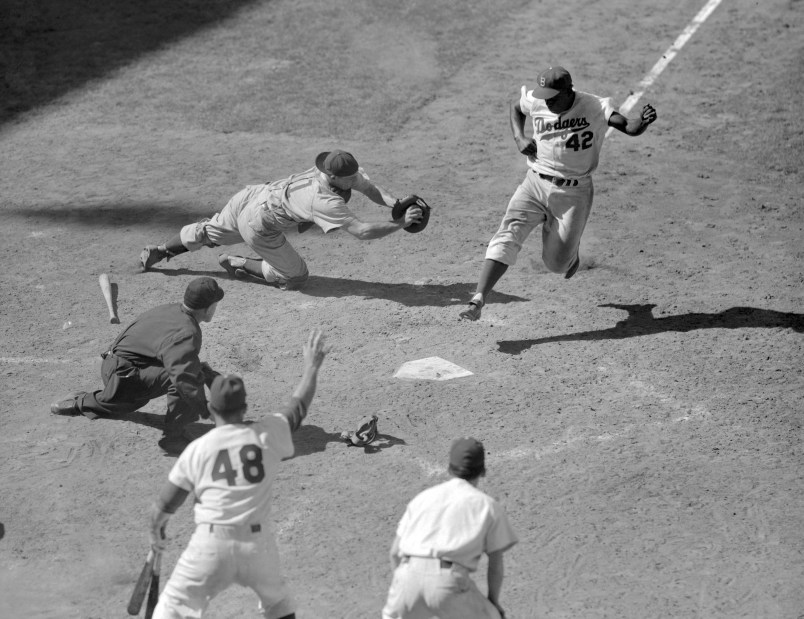
The sanitized version of the Jackie Robinson story goes something like this: He was a remarkable athlete who, with his unusual level of self-control, was the perfect person to break baseball’s color line. In the face of jeers and taunts, he was able to put his head down and let his play do the talking, becoming a symbol of the promise of a racially integrated society.
In fact, his success didn’t occur in a vacuum. It marked the culmination of more than a decade of protests to desegregate the national pastime. It was a political victory brought about by a persistent and progressive movement that confronted powerful business interests that were reluctant — even opposed — to bringing about change.
Beginning in the 1930s, the movement mobilized a broad coalition of organizations — the Black press, civil rights groups, the Communist Party, progressive white activists, left-wing unions and radical politicians — waged a sustained campaign to integrate baseball.
Robinson promised Rickey that – at least during his rookie year – he wouldn’t respond to the constant verbal barbs from fans, managers and other players.
His first test took place a week after he joined the Dodgers, during a game against the Philadelphia Phillies. Phillies manager Ben Chapman called Robinson the n-word and shouted, “Go back to the cotton field where you belong.”
Though Robinson seethed with anger, he kept his promise to Rickey, enduring the abuse without retaliating.
But after that first year, he increasingly spoke out against racial injustice in speeches, interviews and his regular newspaper columns for The Pittsburgh Courier, New York Post and the New York Amsterdam News.
Many sportswriters and most other players — including some of his fellow Black players — balked at the way Robinson talked about race. They thought he was too angry, too vocal.
A 1953 article in Sport magazine titled “Why They Boo Jackie Robinson” described the second baseman as a“pop-off,” “whiner,” “showboat” and “troublemaker.” A Cleveland paper called Robinson a “rabble rouser” who was on a “soap box.” The Sporting News headlined one story “Robinson Should Be a Player, Not a Crusader.”
Nonetheless, Robinson’s relentless advocacy got the attention of the country’s civil rights leaders.
The NAACP gave him its highest honor, the Spingarn Medal, in 1956 – the first athlete to receive that award. In his acceptance speech, he explained that although many people had warned him “not to speak up every time I thought there was an injustice,” he would continue to do so.
After Robinson hung up his cleats in 1957, he stayed true to his word, becoming a constant presence on picket lines and at civil rights rallies.
That year, he publicly urged President Dwight Eisenhower to send troops to Little Rock, Arkansas, to protect Black students seeking to desegregate its public schools. In 1960, impressed with the resilience and courage of the college students engaging in sit-ins at Southern lunch counters, he agreed to raise bail money for the students stuck in jail cells.
He initially supported Sen. Hubert Humphrey, a liberal Minnesota Democrat and civil rights stalwart, for president in 1960. When John F. Kennedy won the party’s nomination, Robinson worried he’d be beholden to Southern Democrats who opposed integration and endorsed Republican Richard Nixon. He quickly regretted that decision, remarking that “Nixon doesn’t deserve to win.” In February 1962, Robinson traveled to Jackson, Mississippi, to speak at a rally organized by NAACP leader Medgar Evers. Later that year, at King’s request, Robinson traveled to Albany, Georgia, to draw media attention to three Black churches that had been burned to the ground by segregationists. He then led a fundraising campaign that collected $50,000 to rebuild the churches.
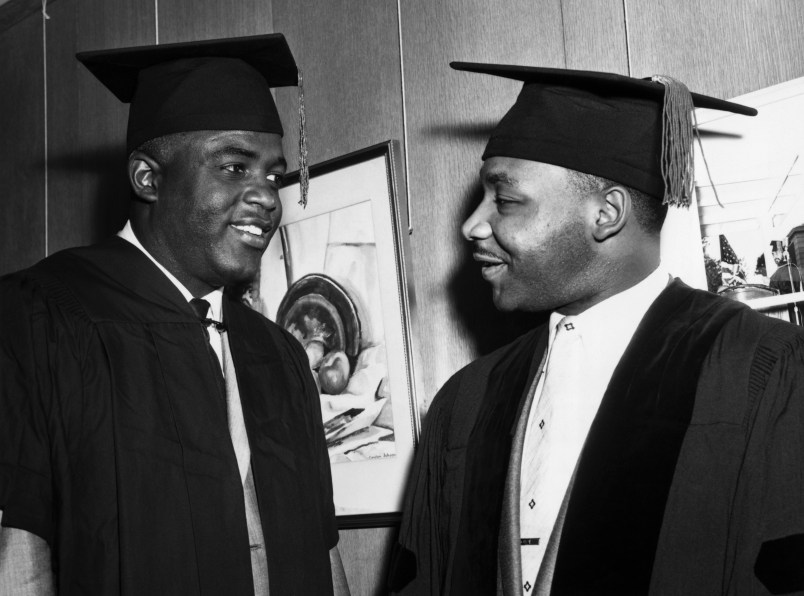
In 1963 he devoted considerable time and travel to support King’s voter registration efforts in the South. He also traveled to Birmingham, Alabama, as part of King’s campaign to dismantle segregation in that city.
“His presence in the South was very important to us,” recalled Wyatt Tee Walker, chief of staff of King’s Southern Christian Leadership Conference. King called Robinson “a sit-inner before the sit-ins, a freedom rider before the Freedom Rides.”
Robinson also consistently criticized police brutality. In August 1968, three Black Panthers in New York City were arrested and charged with assaulting a white police officer. At their hearing two weeks later, about 150 white men, including off-duty police officers, stormed the courthouse and attacked a group of Panthers and white supporters. When he learned that the police had made no arrests of the white rioters, Robinson was outraged.
“The Black Panthers seek self-determination, protection of the Black community, decent housing and employment and express opposition to police abuse,” Robinson said during a press conference at the group’s headquarters.
In 1968, he publicly supported Black track stars John Carlos and Tommie Smith’s first-raising protest at the Olympic Games in Mexico City He challenged banks for discriminating against Black neighborhoods and condemned slumlords who preyed on Black families. Concerned about his activism and influence, the FBI kept a file on Robinson.
And Robinson wasn’t done holding Major League Baseball to account, either. He refused to participate in a 1969 Old Timers game because he didn’t see “genuine interest in breaking the barriers that deny access to managerial and front office positions.” In 1970 he was one of three former ballplayers (along with Hank Greenberg and Jim Brosnan) to testify in federal court in support of Curt Flood’s challenge to baseball’s reserve clause, which kept players in indentured servitude to their teams. At his final public appearance, throwing the ceremonial first pitch before Game 2 of the 1972 World Series, Robinson observed, “I’m going to be tremendously more pleased and more proud when I look at that third base coaching line one day and see a Black face managing in baseball.”
It was Robinson’s strong patriotism that led him to challenge America to live up to its ideals. He felt an obligation to use his fame to challenge society’s racial injustice. However, during his last few years — before he died of a heart attack in 1972 at age 53 — he grew increasingly disillusioned with the pace of racial progress.
In his 1972 memoir, “I Never Had It Made,” he wrote: “I cannot stand and sing the anthem. I cannot salute the flag; I know that I am a Black man in a white world.”
It is unlikely that MLB will remind players and fans of those words on Jackie Robinson Day.