May Day and the Reclamation of the Jewish Radical Tradition


Activism
/
April 30, 2026
This year’s protests will be large and steeped in the politics of the Jewish Labor Bund.
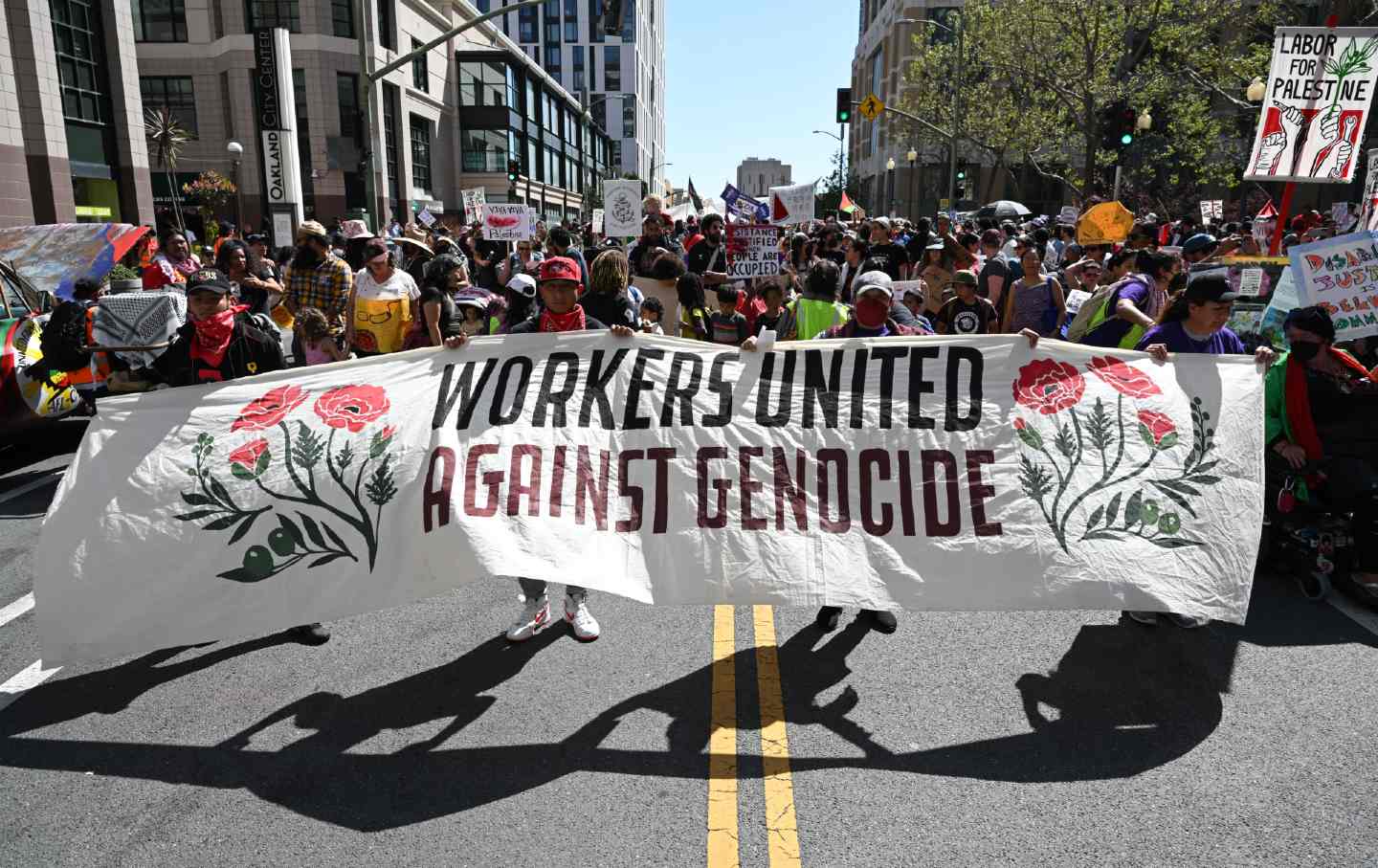
Pro-Palestinian demonstrators and workers gather in front of the federal building to protest Israeli attacks on Gaza on May 1 in Oakland, California, May 1, 2024.
(Tayfun Coskun/Anadolu via Getty Images)
In most countries around the world, May Day, May Day, is a major holiday celebrating the power and unity of the international working class. But in the United States, the leading capitalist power, this is generally not the case.
May Day was actually founded here in the United States, first sanctified on May 1, 1889 as part of the fight for the eight-hour day. It also commemorated the third anniversary of an American general strike that began on May 1, 1886. May Day was later exported around the world as a way to remember the Haymarket Martyrs: eight union leaders wrongly convicted of throwing a bomb at Haymarket Square in Chicago on May 4, 1886. Of the eight, four were executed, one committed suicide in prison, and three were eventually pardoned. Before being hanged for conspiracy to commit murder, August Spies memorably said: “If you think that by hanging us you can eradicate the labor movement – the movement from which the oppressed millions, the millions who work and live in want and misery – the wage slaves – await salvation – if that is your opinion, then hang us! Here you will step on a spark, but there, and there, and behind you and before you, and everywhere, the flames will light up. It’s an underground fire. You can’t put it out.
In other words, May Day is as American as apple pie. And yet, unions, the media and local government are either not paying attention or have actively obscured its history. It speaks to a country, as Howard Zinn’s book so beautifully expresses it. A People’s History of the United Stateswhich has a harrowing history of class struggle but continues to suffer from the absence of a mass labor or social democratic party as well as low union density. As a result, the public is little informed about the worker struggles that periodically shake this country.
And yet, even without official sanction, mass organizing, or public celebration, activists in this country have kept alive the tradition of May Day as an occasion for popular protest. This year, given these troubled times, the May 1 protests will be particularly important. As labor journalist Mike Elk wrote in his Payday Report newsletter, “We found that unions will stage walkouts in at least 65 [now up to 100, according to Elk’s latest] cities across the United States. Hundreds of unions are involved, and the list is growing as groups like Indivisible lend their support to the movement.
The National Education Association — hardly the IWW — even has a May Day toolkit in which it writes: “On May 1, 2026, educators will join workers, parents, students, and community members to stand up for dignity, justice, and public investment in our lives, not in the profit margins of billionaires. This toolkit provides tips to help you join the Strong National May Day Day of Action and to make a bold impact on our schools and communities.”
While the NEA’s broad call for protests focuses on the economic oligarchs who are pillaging the country, May 1 will be driven on the ground by those protesting the problems of our time: the wars waged by the United States and Israel against Iran and Lebanon and the ongoing ethnic cleansing of Gaza.
Current number
Into this mix of workers’ rights and May Day anti-imperialism come the anti-Zionist Jewish organizations that have recently innovated on the dry left of the United States. Members of these groups tell me that they view May 1 as a time not only to cry out against the war, but also to recall and reclaim the radical Jewish labor tradition with which they identify. Max Ewart, an organizer with the DC-Maryland-Virginia chapter of the International Jewish Labor Bund told me: “Jews are not seen as workers, either by non-Jews or by other Jews. There are many reasons why this is the case. Assimilation, anti-Semitism, and Zionism have all played a role in this loss of identity. This has not always been the case, however. In Europe, the Jewish working class was huge and proud. The Jewish Labor Party The Bund organized May Day rallies, attended by over 100,000 people. Jews should march on May 1, because we always have and because only through class solidarity can we see a world free of capitalism.
The Jewish Bund and its anti-Zionist and socialist past are experiencing a revival in the wake of Molly Crabapple’s bestselling book on the Bund, Here, where we are, is our home. It uncovers a proud Jewish tradition of self-organized groups seeing their liberation as inextricably linked to the labor movement and radical struggle. Over the past 80 years, various factors have buried this story. Upward mobility and assimilation of the children and grandchildren of Jewish immigrants has been a factor, but the main problem has been that the politics of solidarity across religious, racial, and ethnic lines runs counter to what has become the dominant trend in Jewish politics: the ethnonationalist pessimism and unconditional support for the apartheid state of Israel demanded by Zionism.
Sara Katz, a union organizer who also works with the DC Metro chapter of Jewish Voice for Peace, told me, “I draw inspiration from my ancestors…Two remarkable women were Clara Lemlich, who led 20,000 garment workers on strike in 1909, and Rose Schneiderman, who helped raise awareness among garment workers of the dangerous working conditions endured after the Triangle Shirtwaist Fire in 1911.”
Katz then took a broader view, saying, “Our collective values as anti-Zionist Jews fighting for the liberation of all compel us to always stand in solidarity with working-class struggles in the United States and around the world alongside our organization for a Free Palestine. Only by building strong community networks and organized workplaces can we ensure that we all have what we need to thrive.”
The working-class struggles of the Jewish people are not only a nod to the past, but they are also at the center of the union work of the JVP-DC-metro. Organizer Jacob Zionts told me about Maryland’s fight for a statewide divestment campaign targeting the state’s pension and pension system’s investment of more than $60 million in Israeli bonds. These bonds “function as unrestricted loans that enable Israel’s ongoing genocide of Palestinians. Maryland chooses to invest the money of its workers, including our members, in dispossession and death…. In the case of this campaign, organized workers are workers better equipped to break the ties that unjustly tie their civic work to genocide and war by demanding that their retirement and pensions not be invested in Israeli bonds.”
Stefanie Fox, the executive director of the JVP, also pointed out that “of course there will be thousands of anti-Zionist Jews in the streets on International Workers’ Day! Our organizing work for a free Palestine is deeply linked to hundreds of years of radical Jewish labor organizing… This legacy is not just historical: more than 20 percent of JVP members today are union workers. All of our struggles are connected, and now is the time to act on it and step up get up together.”
Expect the May Day protests to be large, reflecting a country where 50 percent of the population “strongly opposes” the president’s erratic, violent and authoritarian leadership. The presence of anti-Zionist Jewish radicalism means that young Jews are ready to re-embrace their radical roots – roots that have been poisoned by the smog of Zionism for far too long. Or as one organizer told me as happily as the child who finds the afikomen at Passover: “I’ll see you in the streets.” »
From the illegal war against Iran to the inhumane fuel blockade against Cuba, from AI weapons to crypto corruption, we live in a time of staggering chaos, cruelty and violence.
Unlike other publications that reproduce the opinions of authoritarians, billionaires and corporations, The nation publishes stories that hold the powerful accountable and center communities too often denied voice in national media – stories like the one you just read.
Every day, our journalism weeds out lies and distortions, contextualizes developments that are reshaping politics around the world, and advances progressive ideas that fuel our movements and incite change in the halls of power.
This independent journalism is only possible with the support of our readers. If you would like more urgent coverage like this, please donate to The nation Today.


