Mexico demands answers after CIA employees killed in car crash following drug lab raid: “We were not informed”


Mexican President Claudia Sheinbaum told reporters Tuesday that federal prosecutors are investigating potential national security violations following a car crash in the northern state of Chihuahua that killed two Mexican officers and two US government agents.
The two Americans killed in the crash were employees of the Central Intelligence Agency, several people familiar with the matter told CBS News. The CIA declined to comment.
“We are investigating what these people were doing and what agency they were working for,” Sheinbaum said.
Sheinbaum said any collaboration between the local government and the United States without federal authorization would be a violation of Mexican law.
This accident, which followed an operation aimed at destroying a clandestine drug laboratory in a rural area, has reignited the debate on the extent of the United States’ involvement in Mexican security operations. Speculation was only fueled by the fact that Sheinbaum, local officials and the U.S. Embassy appeared to contradict each other and sometimes themselves, and provided few details about the deceased U.S. officials.
“This was not an operation that the security cabinet was aware of,” Sheinbaum told reporters. “We were not informed; it was a decision of the government of Chihuahua.”
It comes at a key time for relations between the two neighboring countries, as Mexico faces increasing pressure from President Trump in cracking down on cartels and Sheinbaum emphasizes Mexico’s sovereignty.
Sheinbaum said his government would investigate the incident to ensure no laws were broken following Sunday’s deaths, adding that state governments must have permission from the Mexican federal government to collaborate with the United States and other foreign entities “as established by the Constitution.”
A car accident on the side of a mountain
Chihuahua Attorney General César Jáuregui said Sunday that those responsible died while returning from the operation to destroy the laboratories of criminal groups. They were driving in the middle of the night through rugged mountainous territory connecting Chihuahua to the state of Sinaloa, when the truck “appears to have skidded at some point and fallen into a ravine, exploding.”
He said the four people who died were two local Mexican investigators and two U.S. Embassy instructors who were participating in routine “training work.”
In a press release, the State Attorney General’s Office identified two of the victims of the accident: the first commander of the national investigative agency, Pedro Román Oseguera Cervantes, and officer Manuel Genaro Méndez Montes.
The U.S. Embassy declined Monday to identify who the U.S. officials were or what U.S. government entity they worked for, but said the officials “support the efforts of Chihuahua state authorities to combat cartel operations.” U.S. Ambassador Ronald Johnson expressed his condolences on social media, but he and other officials provided few details about the incident.
“We honor their dedication and tireless efforts to tackle one of the greatest challenges of our time,” Johnson said. “This tragedy is a solemn reminder of the risks faced by Mexican and American officials dedicated to protecting our communities.
Jáuregui said the operation followed months of investigation by state prosecutors and Mexico’s federal military, indicating there was at least some level of involvement in the operation by Sheinbaum’s security forces. Hours later, Mexico’s security cabinet confirmed that the military and the state prosecutor’s office carried out a joint operation over the weekend in Chihuahua to dismantle drug laboratories in the same location, Morelos.
Chihuahua State Investigation Agency 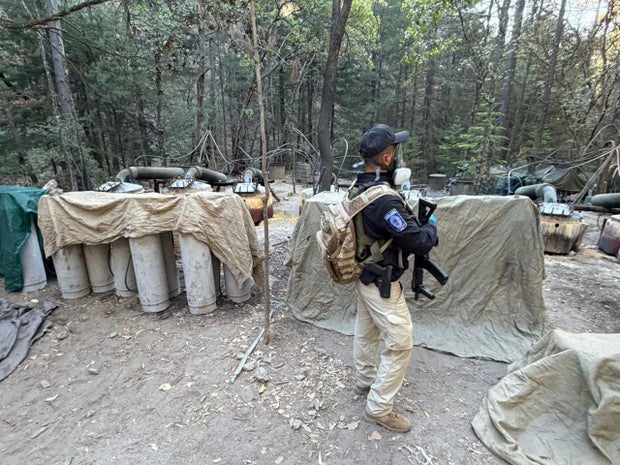
After locating the laboratories using drones, authorities found tons of equipment for making drugs but no people, who were probably alerted beforehand and fled, the prosecutor added.
The local official then backtracked and clarified to the press that “there were no U.S. agents in the operation to secure the narco-laboratory,” and said that embassy officials had joined the group after the operation and were several hours away from where the action took place.
Jáuregui called the laboratories “one of the largest sites in the country where chemical medicines were produced.”
A debate resurfaces
Sheinbaum said his government would provide more information when it had more details, but insisted Monday that “there are no joint operations on land or in the air” in Mexico. She said there was only information sharing between her government and the United States, carried out within a “well-established” legal framework.
Although the training of Mexican security forces by U.S. officials is common, their presence on Mexican territory is the subject of ongoing debate, which has intensified after Mr. Trump’s military actions in Venezuela and Iran.
Mr. Trump has repeatedly proposed taking action against Mexican cartels, an intervention Sheinbaum called “unnecessary.” The Trump administration has already launched joint military operations in Ecuador, a country plagued by drug gang violence in recent years.
Last year, Sheinbaum said the United States conducted surveillance drone flights at Mexico’s request after a series of conflicting public statements on the issue, also sparking concern among observers.
The most recent controversy surfaced in January over the detention in Mexico of former Canadian athlete Ryan Wedding, one of the most wanted fugitives in the United States. While Mexican authorities say he surrendered to the U.S. embassy, U.S. officials described his capture as the result of a binational operation.
The recent debacle comes at a pivotal moment in U.S.-Mexico relations. The second round of U.S.-Mexico negotiations on the U.S.-Mexico-Canada Free Trade Agreement, USMCA, was scheduled to begin in Mexico City. The US delegation is led by Trade Representative Jamieson Greer, who was scheduled to meet with the president on Monday.
The same day, the Trump administration also announced it was imposing visa restrictions on members of the Sinaloa Cartel families.
Mexico has announced the dismantling of numerous drug laboratories in recent months after Mr. Trump threatened possible military action to combat cartels in the country.
In February, Mexican Navy soldiers discovered a hidden drug laboratory in the Durango area and “neutralized” it 5,000 pounds of meth. In January, authorities announced more than 1,500 books of methamphetamine were seized in clandestine laboratories in the states of Durango, Sinaloa and Michoacán.