‘Miracle’ photo captures Comet Lemmon and meteor seemingly entwined over Earth


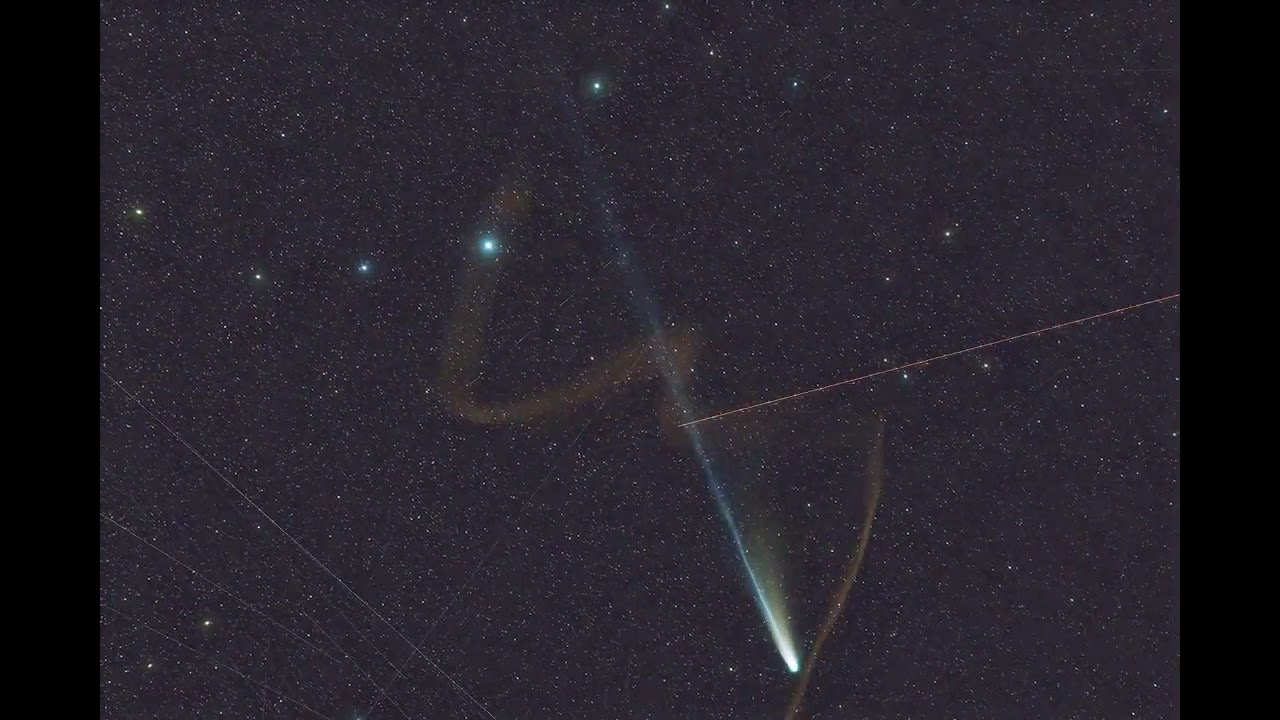
An astronomer recently pointed his telescope above Manciano, Italy, and captured something incredible: a bright comet seemingly enveloped in the corkscrew trail of a meteor, glistening in the same part of the sky like a cosmic barbershop pole.
With millions of kilometers separating the foreground meteor and the background comet, the chances of capturing such a chance shot were (excuse the pun) astronomically low.
“In this photograph, the meteor’s afterglow appears to wrap around the comet’s ion tail – a pure miracle of perspective,” the astronomer said. Gianluca Masifounder of the Virtual Telescope Project and photographer who captured this stunning photo, wrote in a statement. “The first is an atmospheric effect induced by the meteor, while the comet itself was about 100 million kilometers away [62 million miles] far.”
The comet seen here is C/2025 A6 (Lemon) – one of the three comets storming the solar system at the moment, with Comet R2 (SWAN) and the interstellar visitor 3I/ATLAS. Comet Lemmon, which reached its closest point to Earth on October 21, is the brightest of the group and remained visible enough to be seen through simple telescopes And binoculars for stargazing for the following days.
Masi spotted the comet on the night of October 24. Its long blue tail – the product of ionized gas vaporized from the comet’s surface and carried away by the solar wind – was clearly visible. But for several minutes during Masi’s observations, another streamer-like structure became visible near the comet: the wispy remains of an ion trail left by a meteor plunging through Earth’s atmosphere.
Seen here as a golden line spiraling around the comet; The meteor trail evolved constantly during Masi’s observations, appearing briefly as part of the comet itself. In reality, the trail is the result of chemical reactions in the atmosphere triggered by the meteor’s ultrafast passage.
“The phenomenon is associated with the ionization of molecular oxygen in the atmosphere caused by the meteoric event, followed by its recombination, which produces the emission of light at this wavelength,” Masi said.
While meteors typically travel at more than 100,000 mph (160,000 km/h), their trails can linger in the sky for several minutes. according to NASA. Meanwhile, winds blowing at different altitudes can sculpt these trails into winding streamers like the one seen here. Masi too posted a time-lapse video of the meteor event on YouTube showing how the light trail traveled across the sky in front of the comet for several minutes.
Look on it
The phenomenon of spiral meteor trails has not been studied extensively, but they are considered relatively rare. A series of papers published in the 1980s and 1990s It is estimated that only 0.5% of observed meteors leave a non-linear trail. However, this figure is far from certain and may have been skewed by suboptimal settings of the camera used at the time to record meteor trails.
The annual Orionid meteor shower – an event triggered by debris from Halley’s Comet – reached its peak on October 20 and 21, the same night Comet Lemmon was at its peak. Although the rain subsides, it will last until November 7, meaning more “shooting stars” like the one captured by Masi are possible at night. Keep your eyes glued to the sky and maybe you’ll spot your own “miracle.”


