Moldovans to vote in critical parliamentary election fraught with Russian interference claims

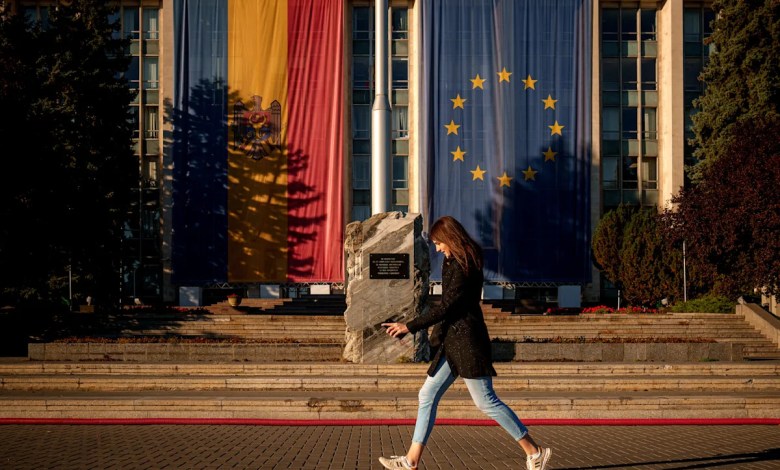
Chisinau, Moldova (AP) – The Moldovans are heading for the ballot boxes on Sunday to make ballots during a tense parliamentary election charged with claims of Russian interference. The vote could decide on the country’s geopolitical future: a brutal choice between the East and the West.
Landed between Ukraine and Romania in the European Union, Moldova has spent the last years on a path to the West to the EU. The Sunday’s ballot to elect a new Parliament of 101 seats will determine whether this continues or if the country of around 2.5 million people is reduced to the orbit of Moscow.
The race opposes the action party and the pro-Western solidarity in power, which has held a large parliamentary majority since 2021, against several key opponents adapted to Russia, but no viable pro-European partner, leaving a lot of uncertainty on the potential results in the pivot ballot.
If the step fails to gain a majority on Sunday, “it would mean the end of the integration of the EU,” said Igor Grosu, the head of the Pas and President of the Parliament, to the Associated Press. “This would mean dependence, the end of all justice reforms, infrastructure projects, everything … There is no intermediate option.”
“All our efforts and our messages are to mobilize to win a parliamentary majority,” he added.
Race to counter the alleged “hybrid war” of Russia
In addition to the electoral participation, the result of the Sunday voting ballot in high issues could depend on the effectiveness of the Moldovan authorities in their cat and mouse race to go beyond the alleged “hybrid war” of Russia – the aim of what they say is to derail the path of the EU of the country.
The Prime Minister of Moldova, Dorin Recean, warned that Russia spent hundreds of millions of euros to try to “grasp power in Chisinau” in a campaign he described as “increasingly radical”.
The alleged plans include a large -scale voting purchase operation, cyber attacks on critical government infrastructure, a plan to encourage mass riots around elections and an online sprawling disinformation campaign to influence voters.
The Modovan authorities have tried to repress by performing hundreds of raids in recent weeks, in which scores have been held. President Moldavian Maia Sandu said this week in a public allowance that the Kremlin “has accomplices here in Moldova”, describing them as people “arranged to sell their country for money”.
Moscow has repeatedly denied interference in Moldova. In a statement on Thursday, the Russian Ministry of Foreign Affairs rejected allegations of Russian interference in the Moldova elections as Animussians and “uninized”.
Sunday’s vote will also take place less than a year after the Moldavians voted closely in favor of the country’s EU way guarantee, the same day, Sandu won a second term during a separate vote. But these votes were also overshadowed by generalized allegations of Russian interference and a massive program for the purchase of votes, which Moscow denied.
Voters are faced with high inflation and poverty
In recent years, when the country has gone from the crisis to the crisis, the Moldavians have faced rampant inflation, the increase in life costs and high poverty rates, which could have reduced the support of the pro-Western government in power.
To relieve tension, Brussels provides Moldova up to 1.9 billion euros ($ 2.2 billion) between 2025 and 2027, of which 270 million euros were published in July for projects such as a new hospital and helping to reduce energy bills.
Eugen, a 41 -year -old artist in Chisinau, who did not want to give his surname because of the tense political climate, told AD that he favors a path to the EU, but recognizes that voters are tired of “high expectations and expect miracles”.
“We must have more patience in our course to the European Union,” he said, adding that the block of 27 countries is “stability is human rights … A kind of unity, a kind of prosperity and meritocracy”.
The opposition adapted to Russia requires abuse
A key opponent of the AP in Sunday elections is the patriotic electoral block favorable to Russia, or BEP, a group of political parties who want “friendship with Russia,” permanent neutrality “and a” state that serves the people, not the civil servants “.
Friday, the Central Electoral Commission prohibited in the heart of Moldova, which was part of the BEP, to participate in the race. The action of the commission was based on a decision one day earlier by the Chisinau Court of Appeal, which restricted party activities for 12 months. Earlier this month, the raids on party members led to allegations of corruption of voters, illegal party funding and money laundering.
Irina Vlah, head of the heart of Moldova, condemned “the abusive decision” and described it as “political spectacle, concocted a long time ago” by the ruling party. Vlah was also prohibited Thursday to enter Latvia, Estonia and Poland, which accused it of “helping the Russian Federation” of interfere in parliamentary elections.
Igor Dodon, a former pro-Russian president and the leader of the Socialist Party, who is also part of the BEP, denounced Sandu and the step in power, affirming that “the days are counted”.
“They understand that their end is close, so they have recourse to abuse our colleagues in the block,” said Dodon in an article on Facebook. “We will win the elections, and together we will defend our victory.”
Later the same day, the Central Electoral Commission also excluded the Moldava Mare Party from the race, citing illegal funding, unconcluded foreign funds and the purchase of votes. The chief of Moldava Mare, Victoria Furtuna, was sanctioned by the EU in July for having received “significant support” from the pro-Russian fugitive oligarch Ilan Shor.
The diaspora could play a decisive role
The Great Diaspora of Moldova should play a decisive role in Sunday results. During the presidential runoff of last year, a record number of 327,000 voters voted abroad, of which more than 82% favored the pro-Western President Sandu, which finally obtained his re-election.
Most local polls do not include the country’s diaspora, and they also indicate that around a third of voters remain undecided, which leaves a large question mark on the vote. During the legislative elections in 2021, the participation rate was just over 48%.
“Moldova now has a clear path to become a member of the European Union,” said Iulian Groza, executive director of the Institute for European policies and reforms the reflection group. “Russia considers these elections as their ultimate battle – which is why the issues are very high.”
Disinformation could have a disproportionate impact
Valeriu Pasa, president of the Think Tank watchdog, based in Chisinau, told the AP that the economic climate has extinguished certain voters from the step, the intensity of Russian interference and disinformation would have exacerbated decreasing support.
“On the one hand, there is the economic situation and the non-perfect quality of governance, and in addition, it is a Russian disinformation,” he said. “For example, if normally, due to the (high) prices, you should lose 3%, when submerged by Russian propaganda, you will lose 9%.”
PASA added that during the electoral cycle last year, Russia used more “sophisticated stories, conspiracies, these complex ideas”, but resorted to flooding the information space.
“Now, it’s just a large amount of counterfeits, content generated by AI,” he said. “We did not get rid of the Soviet heritage of Soviet propaganda, which had an impact on many people.”


