Moss Can Survive Long-Term Exposure to Elements of Space, New Experiments Show


A team of Japanese researchers tested protenemes (juvenile mosses), brood cells (specialized stem cells that emerge under stressful conditions), and sporophytes (encapsulated spores) of the moss model species. Physcomitrium patens in simulated space environments, identifying the spores as the most resilient and then exposing them to the space environment outside the International Space Station (ISS). After nine months in space, more than 80% of the spores survived, retaining their ability to germinate. These results demonstrate the remarkable resilience of Physcomitrium patens spores in space and reveal the potential of terrestrial plants to withstand extreme environments.
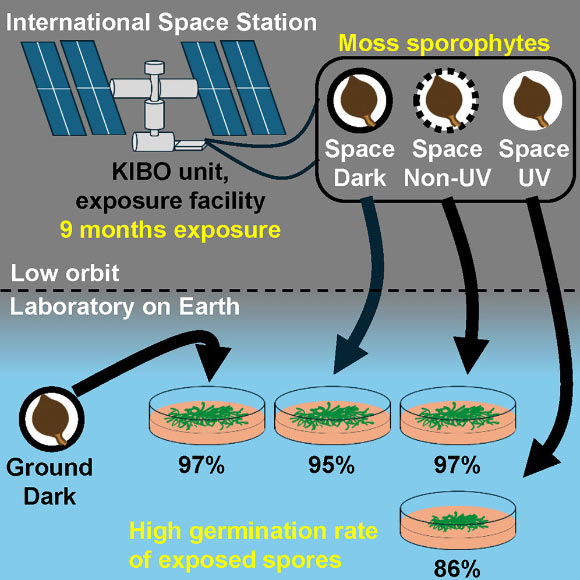
Physcomitrium patens spores survive simulated space conditions with high resilience. Image credit: Maeng and others., doi: 10.1016/j.isci.2025.113827.
As the Earth’s environment undergoes rapid change in recent years, it has become increasingly important to explore new possibilities for the survival of life beyond our planet.
Understanding the resilience of Earth-born organisms in extreme and unknown conditions, such as the space environment, is a crucial step toward expanding human habitats other than Earth, such as the Moon or Mars.
Studying the survival limits of living organisms in terrestrial and space environments will not only improve understanding of their adaptability, but also help us prepare for challenges related to the sustainability of ecosystems.
“Most living organisms, including humans, cannot survive, even briefly, in the vacuum of space,” said Dr. Tomomichi Fujita, a researcher at Hokkaido University.
“However, the moss spores retained their vitality after nine months of direct exposure.”
“This provides striking evidence that life that evolved on Earth has, at the cellular level, intrinsic mechanisms to withstand the conditions of space.”
In their study, Dr. Fujita and colleagues submitted Physcomitrium patensa well-studied foam commonly known as earth moss that spreads, to a simulated space environment, including high levels of UV radiation, extremely high and low temperatures, and vacuum conditions.
They tested three different structures of Physcomitrium patens — protonemas, brood cells and sporophytes — to find out which ones had the best chance of surviving in space.
“We predicted that the combined stresses of space, including vacuum, cosmic radiation, extreme temperature fluctuations and microgravity, would cause far greater damage than any single stress alone,” Dr Fujita said.
The researchers found that UV radiation was the most resistant element to survival and that the sporophytes were by far the most resilient of the three parts of the moss.
None of the juvenile moss survived high UV levels or extreme temperatures.
The brood cells had a higher survival rate, but the enclosed spores had 1,000 times greater tolerance to UV light.
The spores were also able to survive and germinate after being exposed to minus 196 degrees Celsius for over a week, as well as after living in 55 degrees Celsius heat for a month.
Scientists have suggested that the structure surrounding the spore serves as a protective barrier, absorbing UV rays and covering the internal spore both physically and chemically to prevent damage.
This is likely an evolutionary adaptation that allowed bryophytes – the group of plants to which mosses belong – to transition from aquatic to terrestrial plants 500 million years ago and survive several mass extinction events since then.
In March 2022, the authors sent hundreds of sporophytes to the ISS aboard the Cygnus NG-17 spacecraft.
Once arriving, the astronauts attached the sporophyte samples outside the ISS, where they were exposed to space for a total of 283 days.
The foam then hitchhiked back to Earth aboard SpaceX CRS-16 in January 2023 and was returned to the laboratory for testing.
“We expected almost zero survival, but the result was the opposite: most of the spores survived,” Dr. Fujita said.
“We were truly amazed by the extraordinary durability of these tiny plant cells.”
More than 80% of the spores survived their intergalactic journey, and all but 11% of the remaining spores were able to germinate in the laboratory.
The team also tested the spores’ chlorophyll levels and found normal levels for all types, except for a 20% reduction in chlorphyll a, a compound particularly sensitive to changes in visual light, but this change did not appear to impact the health of the spores.
“This study demonstrates the astonishing resilience of life native to Earth,” said Dr. Fujita.
Curious about how long the spores could have survived in space, the researchers used data collected before and after the moss was shipped to create a mathematical model.
They predicted that the enclosed spores could have survived for up to 5,600 days, or about 15 years, in space conditions.
However, they emphasize that this figure is only a rough estimate and that a larger data set is needed to make more realistic predictions about how long the moss could survive in space.
“Ultimately, we hope that this work will open a new frontier toward building ecosystems in extraterrestrial environments such as the Moon and Mars,” Dr. Fujita said.
“I hope our research on moss will serve as a starting point.”
The results are described in a journal article iScience.
_____
Chang Hyun Maeng and others. Extreme environmental tolerance and spatial survivability of foam, Physcomitrium patens. iSciencepublished online November 20, 2025; doi: 10.1016/j.isci.2025.113827


