Muslims begin the annual Hajj : NPR

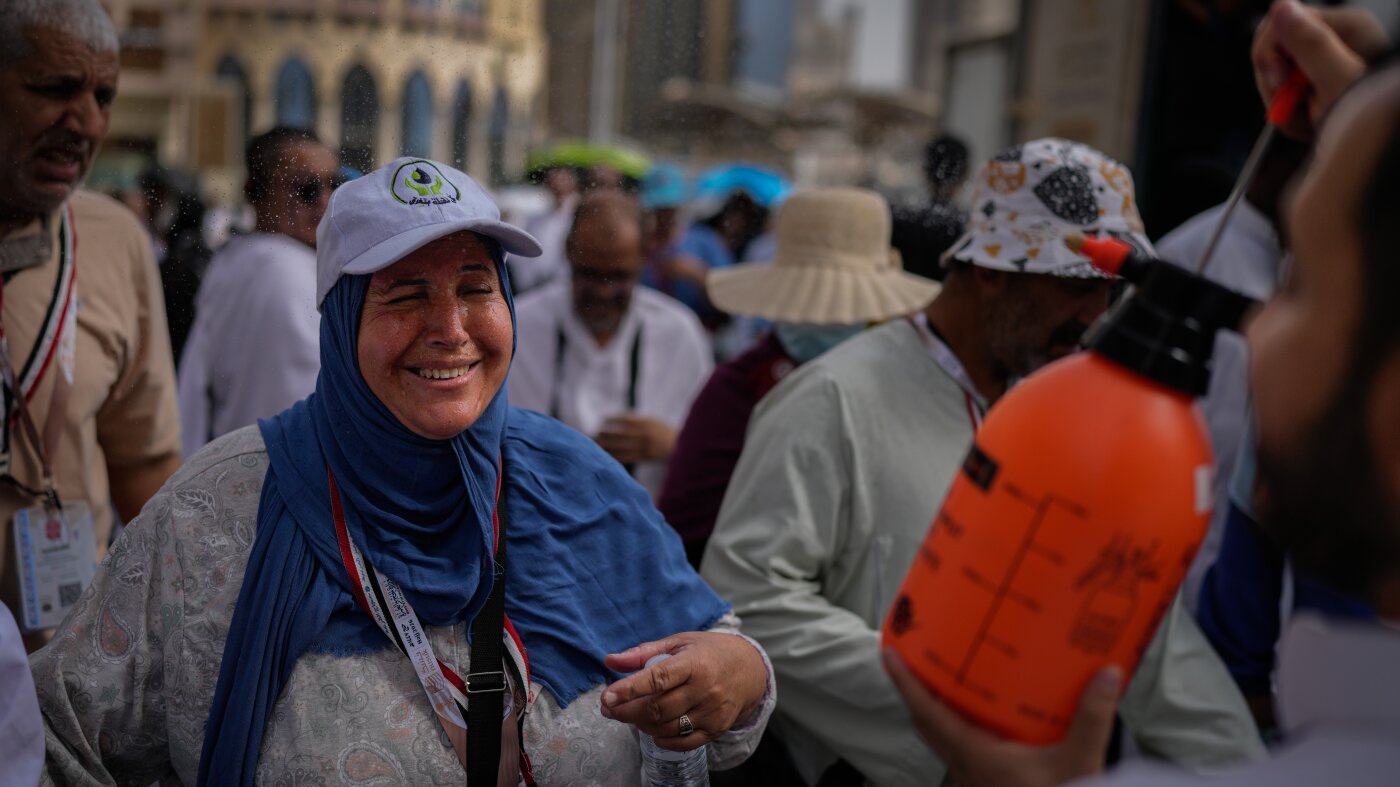

A Muslim pilgrim reacts as a volunteer sprays water to cool him outside the Grand Mosque during the annual hajj pilgrimage in the holy city of Mecca, Saudi Arabia, Sunday, May 24, 2026.
Altaf Qadri/AP
hide caption
toggle caption
Altaf Qadri/AP
MECCA, Saudi Arabia — The annual Hajj pilgrimage, one of the five pillars of Islam, officially began Monday.

More than 1.5 million pilgrims have arrived in Saudi Arabia from outside the country, Saleh bin Saad Al-Murabba, commander of the Hajj Passport Force, said on Friday. Worshipers flocked to the country for the Hajj amid a tenuous ceasefire in Iran’s war and resulting regional tensions and uncertainties.
Egyptian pilgrim Samya Abdul Moneim said she was grateful to God for being able to go to the Hajj, which is obligatory once in a lifetime for every Muslim who has the means and is physically able to do so.
“I am in a state of blessing and happiness,” she said in Mecca on Sunday. “It’s really an indescribable feeling. I mean, thank God I’m in a blessing.”
Typically, on the first day, many pilgrims from Mecca converge on a large tent camp in the nearby desert. Before that, pilgrims circled the cube-shaped Kaaba in the Grand Mosque in sweltering temperatures. For pilgrims, the Hajj can be a deeply moving spiritual experience and a chance to seek God’s forgiveness and the erasure of past sins. Pilgrims perform the Hajj rituals for several days.

This photograph taken with a slow shutter speed shows Muslim pilgrims circumnavigating the Kaaba, Islam’s holy site at the Grand Mosque, during the annual Hajj pilgrimage to Mecca, Saudi Arabia, on Sunday, May 24, 2026.
Altaf Qadri/AP
hide caption
toggle caption
Altaf Qadri/AP
Pilgrims brave intense heat
Some spend many years hoping and praying to one day perform the Hajj or saving money and waiting for a permit to undertake the journey.
As they brave the intense heat to perform religious rituals, many pilgrims use umbrellas for protection and carry hand fans. Volunteers hand out bottles of water to help them stay hydrated and large fans spray fine mist of water.
On Saturday, US President Donald Trump said a war deal with Iran, including the opening of the Strait of Hormuz, had been “extensively negotiated” after calls with Israel and other regional allies. He described it as a “Memorandum of Understanding on PEACE” that has yet to be finalized by the United States, Iran and other countries participating in the calls. It caps a week in which the United States considered a new round of attacks against Iran.
Ahead of the Hajj journey, some said they leaned on their faith as they undertook the journey amid tensions and felt immense gratitude for the opportunity to go.
The Hajj brings together large numbers of Muslims of various races, ethnicities, languages and economic classes, creating a sense of unity for many.
Regional tensions and Hajj travel plans
Amid heightened global uncertainty and concern, authorities in Indonesia, home to the world’s largest Muslim population, have, as the Hajj season approaches, emphasized contingency planning for the pilgrimage and issued instructions to ensure that additional travel costs are not passed on to Indonesian pilgrims.
In India, home to a large Muslim minority, planning for pilgrimages has proceeded largely as normal, but high fuel prices have driven up travel costs for pilgrims.
A reopening of the strait would begin to ease a global energy crisis triggered by U.S. and Israeli attacks on Iran on Feb. 28, which led Tehran to effectively close the waterway. Prices of oil, gas and several related products have skyrocketed, shaking the global economy. The United States has been blockading Iranian ports for more than a month and Trump said Sunday that the blockade “will remain in full force until an agreement is reached, certified and signed.”
In response to the US-Israeli attacks, Iran launched retaliatory strikes and the conflict widened; a fragile ceasefire was then reached in April.
In Saudi Arabia, pilgrims have been making the ritual circuit around the Kaaba since arriving in Mecca in recent days. Pilgrims heading to Mina will camp in the vast tent city and pray and worship.
On Tuesday, which is considered the culmination of the pilgrimage, pilgrims will stand in the Arafat Plain, where they will praise God, beg for forgiveness and make supplications. Many carry prayer requests from loved ones and raise their hands in worship, tears streaming down their faces.


