Mysterious 300,000-year-old Greek cave skull was neither human nor Neanderthal, study finds


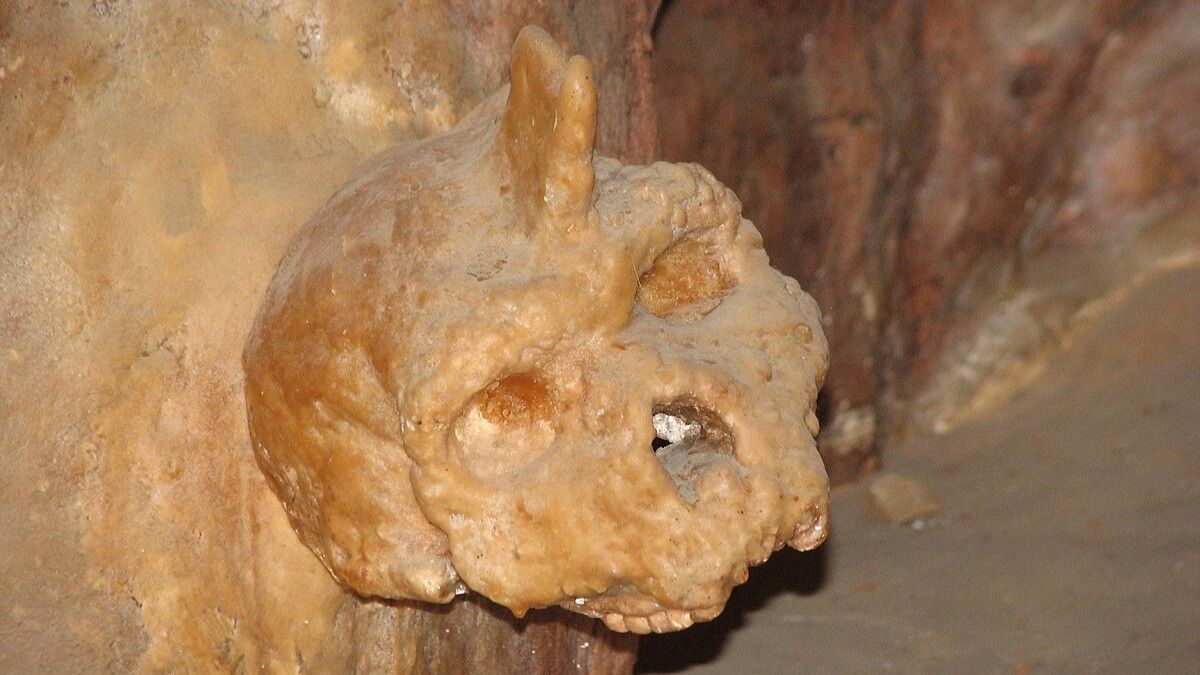
A mysterious skull with a stalagmite that comes out of his head has about 300,000 years and neither human nor human NeanderthalA new study reveals.
The skull would have been discovered attached to the wall of the Petralona cave in the north of Greece in 1960. Researchers have since discussed its position on the human family tree And had trouble determining his age – so far.
In the new study, published online on August 14 in the Journal of Human EvolutionThe researchers came out with calcite (a mineral form of calcium carbonate often found in the caves) which came out of the skull to find that it was at least 277,000 years. They do not know precisely how long the skull was in the cave before it begins to acquire calcite, but the new estimate helps reduce previous attempts to go out with the skull, which varied from 170,000 to 700,000 years.
The results support the previous suggestions that the individual of Péralona lived Pleistocene-era Europe alongside Neanderthals, but was part of a different human group, widely called Homo heidelbergensis.
PetrCalona fossil is distinct from H. Sapiens and Neanderthals, co-author of the study Chris StrangerA paleoanthropologist at the Natural History Museum in London, told Live Science, “and the estimate of the New Age supports the persistence and the coexistence of this population alongside the evolved Neanderthal line in the last average pleat of Europe”.
In relation: “ It makes no sense to say that there was only one origin of Homo sapiens ”: how the evolutionary file of Asia complicates what we know of our species
The skull of Petralona, sometimes called “Petralona Man”, was almost certainly men based on the size and robustness of the fossil, according to Strunger. He also said that the skull teeth had moderate wear, so it probably belonged to a young adult.
While the recordings of the discovery of the skull are mediocre, Stranger noted that there is evidence to support the idea that it was stuck to the wall by inlays of calcite – the same genre that came out of the skull.
To estimate the age of calcite, the researchers used a method called Dating of the Uranium series. Calcite contains a small amount of uraniumwhich disintegrates in another radioactive element called Thorium over a fixed period. This fixed rate of disintegration means that researchers can calculate ages as a function of the uranium / thorium calcite ratio. Calcite of the skull dates back to around 286,000 years, with a high degree of confidence which he is at least 277,000 years old.
Research with meetings also suggested that calcite has increased fairly quickly in the cave. Stringer noted that it probably did not take long in the skull to acquire his first layer of calcite, which would mean that the skull is about 300,000 years old. However, the skull could be over 300,000 years old if the calcite took longer to train.
The 300,000 -year estimate corresponds to the analysis by Stringer and his colleagues from a similar fossil of Zambia in Africa known as Kabwe skull. Their 2019 study dated from the Kabwe skull, which is often assigned to H. Heidelbergensisat 299,000 years.
“This fossil is closely comparable to that of PetrCalona, and I would classify them both as Homo heidelbergensisSaid Stranger.


