NASA and ESA Track Record-Breaking 19-Day Solar Radio Burst


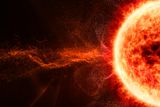
For almost three weeks, a strange radio signal appeared around the sun. One spacecraft watched the signal disappear, then another elsewhere in the solar system detected it a few days later, as the sun rotated. Instead of disappearing like most solar radio bursts, the signal kept coming back. By the time it finally faded in September 2025, the burst had lasted 19 days, making it the longest Type IV solar radio burst on record. The previous record only lasted about five days.
The event was attended by several NASA missions, including Parker Solar Probe, Wind and STEREO, as well as the joint ESA-NASA Solar Orbiter mission. The results, published in Letters from the astrophysical journaldiscover how the sun was able to maintain the radio burst for so long.
A magnetic structure near the Sun could have kept the radio burst alive
Type IV radio bursts form when fast-moving particles become trapped in the sun’s magnetic fields. Researchers believe this 19-day-old signal may have survived near a helmet, a region of looped plasma extending above the sun’s atmosphere.
Radio waves themselves are harmless, but the same solar flares can also throw charged particles into space that interfere with satellites, spacecraft and communications systems.
During the event, three coronal mass ejections (huge eruptions of solar plasma and magnetic fields) exploded from the same region of the Sun. These flares may have repeatedly delivered new particles into the structure, allowing the radio burst to continue longer than normal. The study describes the system as a possible “co-rotating electron reservoir,” essentially a rotating magnetic trap filled with energetic particles.
The signal also pulsed every 45-60 minutes. These repetitive pulses can come from magnetic waves undulating through the structure, almost like vibrations echoing through a taut cable.
Learn more: Solar flares are amazing but are they dangerous? Here’s what you need to know
The rotation of the Sun allows multiple spacecraft to follow the signal
Solar Orbiter first detected the signal when the source region was still hidden from Earth’s perspective. Nearly two weeks later, NASA’s Wind and Parker Solar Probe captured it as the sun’s rotation propelled the burst into a more favorable viewing angle. A day later, STEREO-A also detected it.
As the event unfolded, the signal slowly shifted to lower radio frequencies and narrowed over time, suggesting that the magnetic structure itself was changing shape.
Additionally, the radio waves appeared larger by the time they reached the spacecraft than they likely did at the source. Turbulence from the solar wind could have scattered and scrambled the signal as it traveled through space, in the same way that Earth’s atmosphere can distort starlight.
Event could help researchers better track solar activity
To analyze the event, the team developed a new method to estimate the origins of solar radio bursts using measurements from a single spacecraft. The technique allowed them to trace the source to a region millions of miles above the sun, near the helmet’s streamer.
Long-lasting Type IV bursts remain extremely rare, and researchers still don’t fully understand how magnetic structures can hold energetic particles for so long. But as the Sun goes through one of the most active phases of its roughly 11-year cycle, events like this become increasingly important to study.
Learn more: The Sun shows increased and most intense solar flare activity yet in 2025
Article sources
Our Discovermagazine.com editors use peer-reviewed research and high-quality sources for our articles, and our editors review the articles for scientific accuracy and editorial standards. See the sources used below for this article: