NASA Artemis II astronauts say thank you to the world


April 16, 2026
2 min reading
 Add us on GoogleAdd SciAm
After their historic mission to the Moon, the Artemis II astronauts say thank you to the world
Astronauts Reid Wiseman, Victor Glover, Christina Koch and Jeremy Hansen reflected on the highs and lows of their lunar mission, the first of its kind in more than 50 years.
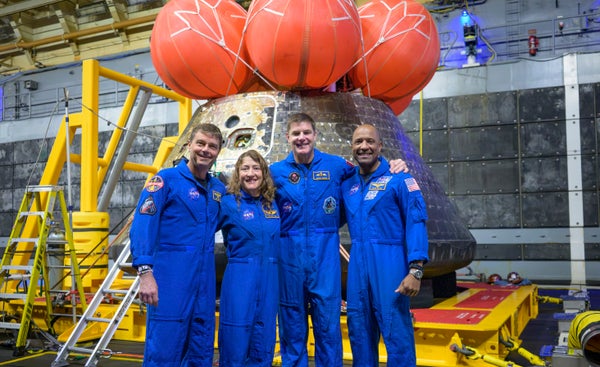
On April 1, NASA launched four astronauts on a pioneering journey around the Moon: the Artemis II assignment. Read our coverage here.
from NASA Artemis II The astronauts returned to Earth less than a week ago and already, the four members of the crew are reflecting on the magnitude of their feat: the first human mission to the Moon in more than 50 years.
“We’re just going to start by thanking the world,” mission commander Reid Wiseman said at a news conference Thursday. “When we returned home, we were shocked by the global outpouring of support, pride and ownership of this mission. »
Wiseman, Victor Glover, Christina Koch and Jeremy Hansen completed a 10-day round trip around the Moon that saw them travel further from Earth than any human has before. The mission, Artemis IIwas a test flight of the space agency’s Space Launch System rocket and Orion crew capsule. During their trip, the astronauts tested the capsule’s manual piloting capabilities as well as other capabilities for future Artemis missions, including Artemis III, a crewed orbital test planned for next year.
On supporting science journalism
If you enjoy this article, please consider supporting our award-winning journalism by subscription. By purchasing a subscription, you are helping to ensure the future of impactful stories about the discoveries and ideas shaping our world today.
Their flight was a resounding success for NASA, but it also wasn’t without challenges, Wiseman said. “When you look at your screen and you see 212,000 miles, and the miles go up, I mean your awareness is heightened all the time,” he noted.
Among the major problems that arose were components of the mission’s signature toilet: Their vent lines did not work as expected, even though the toilet “worked great,” Wiseman said. And the smoke detector went off on the penultimate day of the mission, triggering an automated ventilation shutdown process that was “tense,” he said.
“You want to get someone’s attention very quickly, set off the fire alarm on your spaceship while you’re still 80,000 miles from home,” Wiseman added. Mission pilot Glover emphasized that throughout his work on the mission, the crew had mental health support. Aside from those issues, Wiseman said, one likely needed improvement would be to rearrange the cabin to make it easier to perform daily tasks such as eating lunch.
Since their return to Earth, the astronauts have had very little respite. They performed medical and physical tests, participated in scientific analyzes and debriefings with the myriad of NASA teams who worked on Artemis II and who wait impatiently Artemis III and future lunar missions.
Mission Specialist Koch said that since returning to Earth, she has been moved to see how the flight has touched so many people around the world. “In the beginning, three years ago, we were being celebrated for something we didn’t do,” she said, referring to the announcement of the Artemis II crew in 2023. “And after working and seeing the successes of our team, I think we are ready to share that inspiration and celebrate it.”
“We wanted to go out and try to do something that would bring the world together, unite the world,” Wiseman said.
It’s time to defend science
If you enjoyed this article, I would like to ask for your support. Scientific American has been defending science and industry for 180 years, and we are currently experiencing perhaps the most critical moment in these two centuries of history.
I was a Scientific American subscriber since the age of 12, and it helped shape the way I see the world. SciAm always educates and delights me, and inspires a sense of respect for our vast and beautiful universe. I hope this is the case for you too.
If you subscribe to Scientific Americanyou help ensure our coverage centers on meaningful research and discoveries; that we have the resources to account for decisions that threaten laboratories across the United States; and that we support budding and working scientists at a time when the value of science itself too often goes unrecognized.
In exchange, you receive essential information, captivating podcasts, brilliant infographics, newsletters not to be missed, unmissable videos, stimulating games and the best writings and reports from the scientific world. You can even offer a subscription to someone.
There has never been a more important time for us to stand up and show why science matters. I hope you will support us in this mission.


