NASA astronaut joins Russian cosmonauts for Thanksgiving Day ride to International Space Station


American astronomer turned medical physicist and now NASA astronaut Chris Williams joined two Russian cosmonauts aboard a Soyuz ferry on Thursday for a Thanksgiving flight to the International Space Station.
With Commander Sergey Kud-Sverchkov at the controls of the Soyuz MS-28/74S spacecraft, flanked on his left by flight engineer Sergey Mikaev and on his right by Williams, the crew’s Soyuz 2.1a booster roared to life at 4:27 a.m. EST and moved smoothly away from the Russian-leased Baikonur Cosmodrome in Kazakhstan.
Nine minutes and 45 seconds later, the Soyuz spacecraft was released from the upper booster stage, its two solar wings deployed, and the crew began pursuit of the space station. If all goes well, the automated two-orbit rendezvous will conclude with a docking with the lab’s Earth-facing Rassvet module at 7:38 a.m. Eastern Time.
Roscosmos/NASA 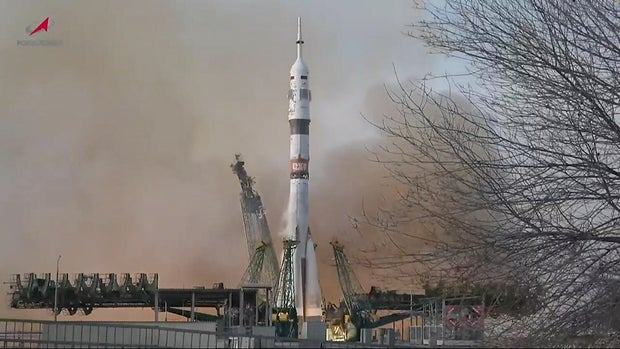
Williams, a former volunteer firefighter and emergency medical technician who later earned a Ph.D. in astrophysics from MIT, was a certified medical physicist at Harvard Medical School when he was selected to join NASA’s astronaut corps in 2021.
He and flight engineer Mikaev were making their first spaceflight on Thursday, while Kud-Sverchkov is a seasoned veteran who spent 185 days aboard the space station in 2020-2021.
Roscosmos/NASA 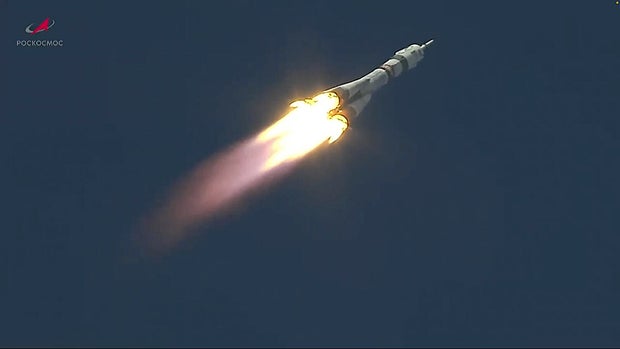
“It’s a really great crew,” Williams said in a NASA interview. “Both Sergey and Sergey are absolutely wonderful people, really nice, super interested, super intellectually curious, which is really fun. We’ve had a lot of really, really good discussions, just talking and talking about things.
“It’s been wonderful to spend time with them in Star City, and also to be able to spend time with them in Houston through our training.”
NASA 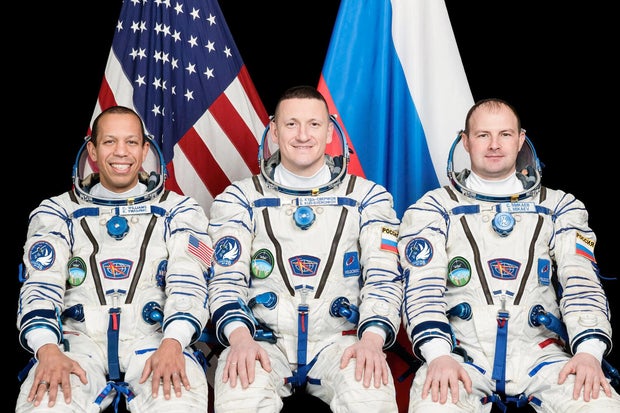
The Soyuz MS-28 crew replaces Soyuz MS-27/73S commander Sergey Ryzhikov, flight engineer Alexey Zubritsky and NASA astronaut Jonny Kim, who were launched to the space station last April. They plan to return to Earth on December 9 to conclude their eight-month stay on the ISS.
Also on hand to welcome Williams and her crewmates aboard the station were NASA Crew 11 Commander Zena Cardman, Michael Fincke, Japanese astronaut Kimiya Yui and cosmonaut Oleg Platonov. They were launched atop a SpaceX Falcon 9 rocket last August and plan to return home in February or March, after their replacements – Crew 12 – arrive.
The station’s 11 pilots planned to gather for a traditional welcome-on-board video call to mission leaders and their families returning to Moscow before a safety briefing and the start of familiarization with the space station’s complex systems.
Williams, an Eagle Scout with a private pilot’s license, stands out among the super achievers.
After earning a bachelor’s degree in physics from Stanford University, he was researching radio astronomy toward a doctorate. and, “down the street from me there was a volunteer fire department. And I thought, oh, that looks like something that might be fun and interesting to do.”
“So I started volunteering. I trained as an EMT and a firefighter, and I started doing it sort of on a volunteer basis. And I found that I really enjoyed it. I got a lot of satisfaction knowing that…at the end of my shift, I would have really made a very direct and immediate positive impact on someone’s life.”
He kept this throughout his higher education. Then, while finishing his doctorate in astrophysics, Williams said he met a doctor he knew at a party who told him there was “a great need for physicists in medicine, particularly in radiation oncology, where we use radiation to treat cancer.”
NASA 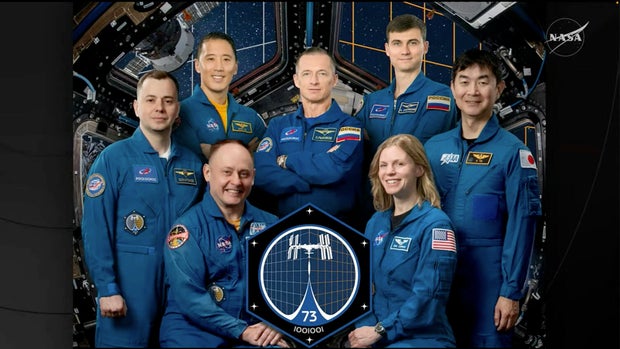
He spoke with a few other people, including one who had been an astronomer before turning to medical physics, and “I was struck by how much of what I knew and what I had learned as an astronomer would actually be useful and apply very directly to medicine.”
“A lot of the math behind (medical) imaging is exactly the same that you use in a radio telescope to create an image,” Williams said. “It was pretty interesting to see that the image processing techniques I had used as a (radio astronomer) were translating directly into medicine.”
At the time of his selection as an astronaut, Williams was on staff at Harvard Medical School as a clinical physicist and researcher. He is the second member of the 2021 class of astronauts to fly in space, being assigned to the Soyuz MS-28 mission shortly after completing his astronaut candidate training.
He said launch training on a Russian spacecraft was difficult, mainly because of the travel required. He credited his wife, Aubrey, with keeping the family’s life on an equal footing.
As for what he’s looking forward to during his eight-month stay in space, Williams repeated a familiar theme.
“I have a lot of different goals, but I think the most important one, and what I’m most excited about, is being able to actually put my training into practice and do a really good job of advancing the science and research that we do on the space station.”
“I think it’s incredibly important. I think it’s incredibly interesting and incredibly inspiring, and I feel really lucky to have the opportunity to contribute to it.”


