NASA exoplanet probe tracks interstellar comet 3I/ATLAS to gauge its spin

When you purchase through links on our articles, Future and its syndication partners may earn a commission.

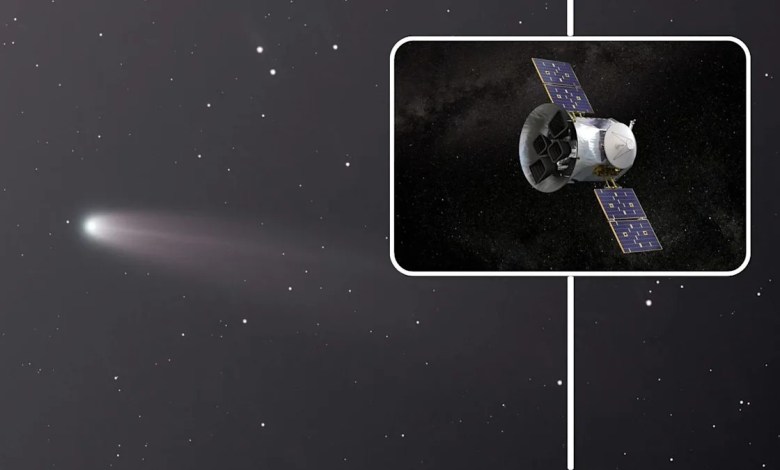
NASA’s Transiting Exoplanet Survey Satellite (TESS) planet-hunting spacecraft recently sighted the interstellar comet 3I/ATLAS. | Credit: TESS insert by NASA/comet background by Enrico Bellodi from Pexels/assembled by Kenna Hughes-Castleberry via Canva pro
NASA’s planet-hunting TESS spacecraft recently observed a very different type of cosmic object: the interstellar comet 3I/ATLAS.
During a special observation route from January 15 to 22, the Transiting Exoplanet Survey Satellite (TESS) observed several times comet 3I/ATLAS as he left our solar system. With its wide field of view, TESS recorded the comet as a bright, fast-moving dot, trailing a faint tail through a crowded star field.
Using data from some January observations, Daniel Muthukrishna of the Massachusetts Institute of Technology (MIT) compiled the images into a 28-hour video showing the trajectory of comet 3I/ATLAS. Unfortunately, TESS observations were interrupted when the spacecraft entered “safe mode” after encountering a problem with his solar panels, the video therefore includes a time jump from January 15 to January 18.

Interstellar comet 3I/ATLAS (circled) is a bright spot with a tail crossing a star field in this video from NASA’s Transiting Exoplanet Survey Satellite (TESS). The sequence uses 28 hours of full-frame TESS images collected on January 15 and January 18-19. The time jump from January 15 to January 18 occurs 11 seconds into the video. | Credit: NASA/Daniel Muthukrishna, MIT
Scientists like Muthukrishna hope to use the dataset to study the comet’s activity and rotation, clues that reveal how vigorously it sheds dust and gas and how fast its core spins.
TESS measurements place the brightness of comet 3I/ATLAS at around 11.5 inches apparent magnitudeabout 100 times fainter than what we can see with the naked eye, but accessible via telescopes.
from NASA TESS mission was designed to find exoplanets via the transit methodin which a distant star dims slightly as a planet in its system passes in front of it. But TESS’s wide field of view and constant monitoring also make it useful for detecting and tracking closer objects, including comets and planets. asteroidsfor longer periods.
This ability helped astronomers spot Comet 3I/ATLAS before they even knew it was there. TESS observed by chance a comet in May 2025, two months before 3I/ATLAS has been discovered. By examining all the data and compiling multiple observations, astronomers could filter the interstellar visitor through the noise and track its movements. While this unfortunately doesn’t tell us where the comet came from, it does give us other key details.
The January TESS observations are now publicly available and can be viewed on the Mikulski Archives for Space Telescopes. It is during these precious hours that astronomers can discover repeating brightness patterns that reveal further secrets about our brief interstellar visitor.


