NASA Webb Finds Young Sun-Like Star Forging, Spewing Common Crystals


Astronomers have long searched for evidence to explain why comets on the outskirts of our own solar system contain crystalline silicates, because the crystals require intense heat to form and these “dirty snowballs” spend most of their time in the ultracold Kuiper Belt and the Oort Cloud. Now, looking outside our solar system, NASA’s James Webb Space Telescope has provided the first conclusive evidence linking how these conditions are possible. The telescope clearly showed for the first time that the hot inner part of the disk of gas and dust surrounding a very young, actively forming star is where crystalline silicates are forged. Webb also revealed a strong flow capable of transporting the crystals to the outer edges of this disk. Compared to our own fully formed and mostly dusted solar system, the crystals would form approximately between the Sun and Earth.
Webb’s sensitive mid-infrared observations of the protostar, cataloged EC 53, also show that powerful winds from the star’s disk are likely catapulting these crystals to distant locations, such as the incredibly cold edge of its protoplanetary disk where comets could possibly form.
“The layered flows of EC 53 could lift these newly formed crystalline silicates and transfer them outward, as if they were on a cosmic highway,” said Jeong-Eun Lee, lead author of a new paper in Nature and a professor at Seoul National University in South Korea. “Webb not only showed us exactly what types of silicates are found in the dust near the star, but also where they are found before and during an explosion.”

The NIRCam 2024 image from NASA’s James Webb Space Telescope shows the protostar EC 53 circled. Researchers using new data from Webb’s MIRI have shown that crystalline silicates form in the hottest part of the disk of gas and dust surrounding the star and can be thrown toward the edges of the system.
Image: NASA, ESA, CSA, STScI, Klaus Pontoppidan (NASA-JPL), Joel Green (STScI); Image processing: Alyssa Pagan (STScI)
The team used Webb’s MIRI (Mid-Infrared Instrument) to collect two sets of highly detailed spectra to identify specific elements and molecules and determine their structures. Then, they precisely mapped where everything is, both when EC 53 is “silent” (but still gradually “nibbling away” at its disk) and when it is more active (what’s called an explosion phase).
This star, studied by this team and others for decades, is highly predictable. (Other young stars have erratic outbursts, or their explosions last for hundreds of years.) Roughly every 18 months, EC 53 begins a 100-day explosive outburst phase, picking up the pace and absolutely devouring nearby gas and dust, while ejecting some of its supply in the form of powerful jets and outflows. These expulsions could throw some of the newly formed crystals to the outskirts of the star’s protoplanetary disk.
“Even as a scientist, I’m amazed that we can find specific silicates in space, including forsterite and enstatite, near EC 53,” said Doug Johnstone, co-author and research director at the National Research Council of Canada. “These are common minerals on Earth. The main ingredient on our planet is silicate.” For decades, research has also identified crystalline silicates not only on comets in our solar system, but also in distant protoplanetary disks around other, slightly older stars – but could not determine how they got there. Thanks to Webb’s new data, researchers now better understand how these conditions might be possible.
“It’s incredibly impressive that Webb can not only show us so much, but where everything is,” said Joel Green, co-author and instrument researcher at the Space Telescope Science Institute in Baltimore, Maryland. “Our research team has mapped how crystals move through the system. We have effectively shown how the star creates and distributes these ultrafine particles, each significantly smaller than a grain of sand.”
Webb’s MIRI data also clearly shows the star’s narrow, high-speed jets of hot gas near its poles, as well as the slightly cooler, slower outflows that come from the innermost, hottest area of the disk that powers the star. The image above, taken by another Webb instrument, NIRCam (Near-Infrared Camera), shows a set of winds and scattered light coming from EC 53’s disk as a white semicircle tilted to the right. Its winds also blow in the opposite direction, roughly behind the star, but in near-infrared light this region appears dark. Its jets are too small to be spotted.
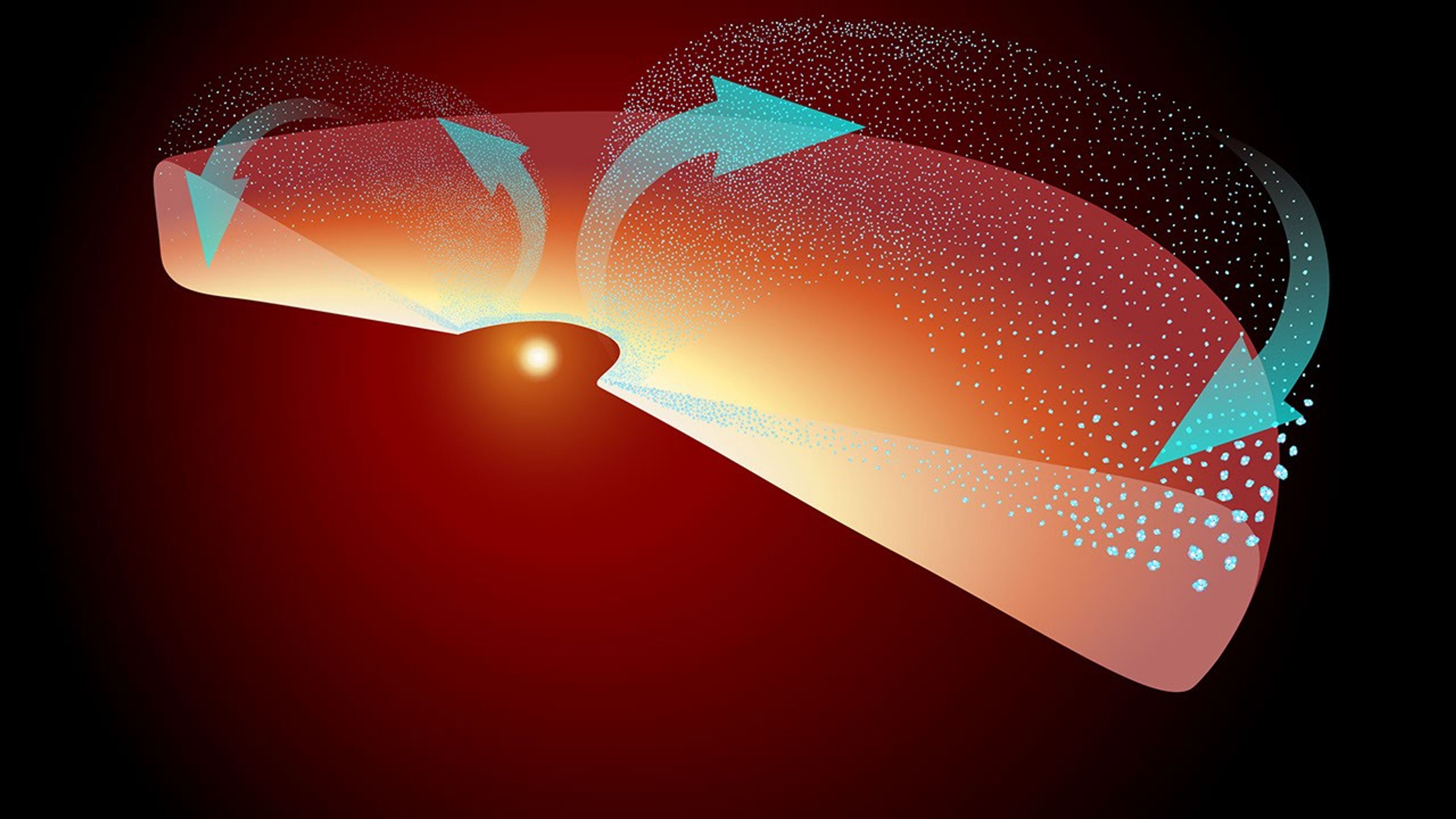
This illustration depicts half of the disk of gas and dust surrounding the protostar EC 53. Stellar explosions periodically form crystalline silicates, which are thrown toward the edges of the system, where comets and other icy rocky bodies may eventually form.
Illustration: NASA, ESA, CSA, Elizabeth Wheatley (STScI)
EC 53 is still “shrouded” in dust and could last another 100,000 years. Over millions of years, as a young star’s disk becomes heavily populated with tiny dust grains and pebbles, countless collisions will occur that could slowly form a series of larger rocks, ultimately leading to the formation of terrestrial planets and gas giants. As the disk stabilizes, the star itself and any rocky planets will finish forming, the dust will largely clear away (no longer obstructing the view), and a Sun-like star will remain at the center of a clear planetary system, with crystalline silicates “littered” everywhere.
EC 53 is part of the Serpens Nebula, located 1,300 light years from Earth and full of actively forming stars.
The James Webb Space Telescope is the world’s first space science observatory. Webb solves the mysteries of our solar system, looks beyond distant worlds around other stars, and probes the mysterious structures and origins of our universe and our place in it. Webb is an international program led by NASA with its partners, ESA (European Space Agency) and CSA (Canadian Space Agency).
To learn more about Webb, visit:
https://science.nasa.gov/webb
The following sections contain links to download the images and videos in this article in all available resolutions, followed by related information links, media contacts, and, if available, research materials and Spanish translation links.


