NASA’s Artemis II crew readies for Monday’s lunar flyby : NPR

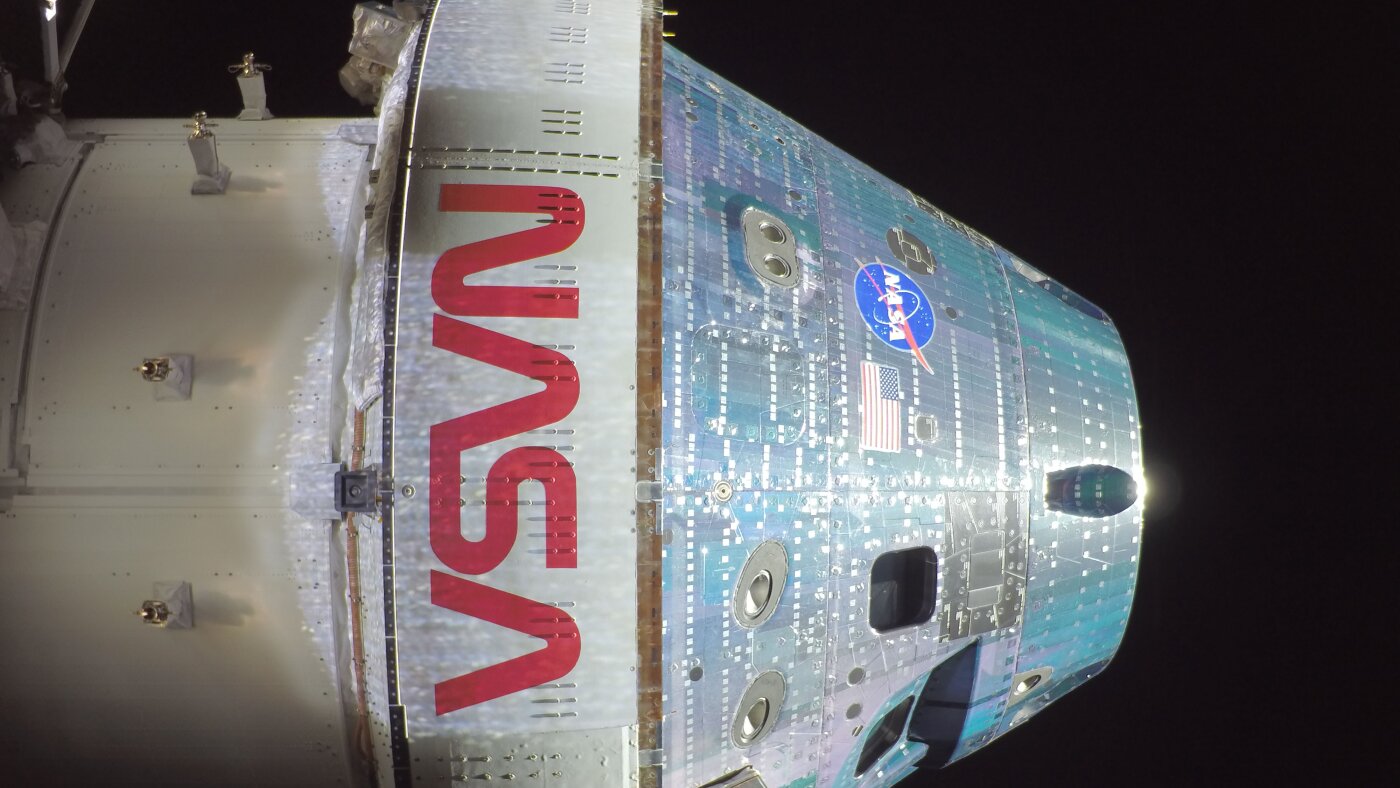

A photo of NASA’s Orion space capsule taken by a remote camera mounted on one of its solar panels as it headed toward the Moon. The four astronauts will circle the Moon on Monday and also venture further into space than any human has before.
NASA via Getty Images
hide caption
toggle caption
NASA via Getty Images
NASA’s Artemis II crew will make its closest approach to the Moon on Monday afternoon following its launch from the Kennedy Space Center last week.
It’s a crucial milestone for the agency’s Orion space capsule, which is sending humans on a mission to the Moon for the first time in more than 50 years. As the capsule circles the Moon, astronauts will reach farther into space than humans have ever dared.
The Orion spacecraft is now within the lunar sphere of influence, meaning the Moon’s gravity exerts more of a pull on the vehicle than on Earth. At 1:46 p.m. ET, the crew will surpass the record for the farthest distance traveled from Earth by humans, set by the Apollo 13 mission at 248,655 statute miles from Earth. At 2:45 p.m., the crew will begin observing the Moon’s surface during the flyby.
As the vehicle circles the far side of the Moon, communication with Earth should be blocked for approximately 40 minutes. At 7:02 p.m., the crew is expected to have reached the mission’s maximum distance from Earth, 252,760 statute miles.
The flyby is expected to end at 9:20 p.m., then the crew will return home, with a planned water landing in the Pacific Ocean off the coast of San Diego, California, on Friday at 8:07 p.m.
During the Artemis II flyby, the crew will fly over two previous human lunar landing sites: Apollo 12 and 14.
Lunar scientific observations
During the lunar flyby, Orion will come closest to the moon’s surface at 4,070 miles. From this distance, the crew will have a unique view of the Moon as a complete disk – and the ability to take observations never before seen by the human eye.
NASA scientists have identified about 35 geological features for the crew to observe. Working in pairs, they will take photos of the sites and describe them in real time to Mission Control scientists at Johnson Space Center in Houston.
“They’re going to be absolutely buzzing,” Kelsey Young, Artemis II’s lunar science manager, said Sunday. The team will monitor observations and provide advice to the crew.
“The scientific team will immediately get to work, sort of synthesizing these [observations]then we will transmit the rest of the descriptions overnight, before a crew conference we will have the next morning to continue the scientific discussion. »
Artemis II has ten science objectives for the flyby. The first is to observe color variations on the lunar surface. Color changes can indicate the composition of the minerals on the surface. These changes are difficult to detect with satellite images.
“It’s something that human eyes are incredibly good at teasing out nuance,” Young said.
Satellites like the Lunar Reconnaissance Orbiter, launched in 2009, have allowed scientists to better understand the lunar surface. Observations by the Artemis II crew will build on this knowledge.
“We understand, you know, what it’s made of. We understand the topography, but we don’t know what the crew is going to see in these specific lighting conditions from a scientific standpoint,” Young said. “And it’s exciting.”

NASA astronaut and Artemis II mission specialist Christina Koch looks out one of the Orion spacecraft’s main cabin windows, looking back at Earth Saturday, as the crew heads toward the Moon.
NASA via Getty Images/Getty Images North America
hide caption
toggle caption
NASA via Getty Images/Getty Images North America
The observations will help future landing missions. One of the target sites is a potential future landing zone for an uncrewed payload mission. The crew will also get a glimpse of the lunar south pole, where humans could land as early as 2028.
The mission so far
Artemis II is more than halfway through its mission to slingshot around the Moon and back. This is a test flight of the Orion space capsule, carrying a human crew for the first time.
“Our mission continues to go incredibly well,” said Lori Glaze, who leads NASA’s Artemis program.
Tests include manual control of the Orion spacecraft. Mission pilot Victor Glover practiced the capsule’s maneuverability for future rendezvous with lunar landing vehicles.

The crew tested the spacecraft’s life support systems, like carbon dioxide scrubbers, and donned their spacesuits mid-flight – something future astronauts may have to do in an emergency.
The Artemis II mission is also testing the first space toilets. NASA’s Universal Waste Management System is stored in Orion’s floor and allows the crew to use the toilet privately. So far the equipment has had a few issues (not having enough water in the bowl and, at another time, not being able to throw waste overboard due to a frozen line), but those appear to be resolved.
“We continue to continue the mission and use the restrooms on a nominal basis,” said Artemis II flight director Rick Henfling, meaning the crew is allowed to use the restrooms on board.


