NASA’s Artemis II moon mission heads to launch


April 1, 2026
2 min reading
 Add us on GoogleAdd SciAm
Live: that of NASA Artemis II the lunar mission will be launched
The US space agency plans to send four astronauts on Wednesday evening on what could be a record-breaking trip around the Moon. Watch the spaceship live.
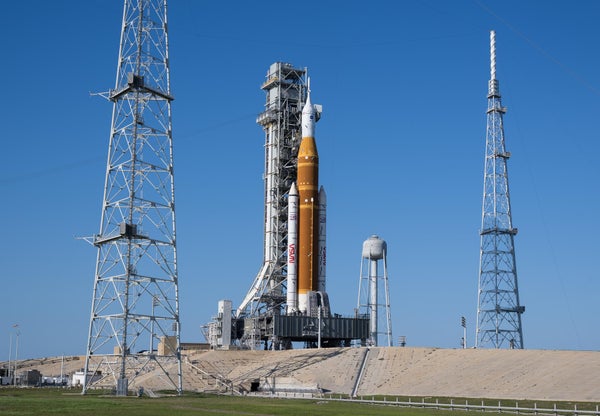
NASA is preparing to launch four astronauts on a pioneering journey around the Moon: the Artemis II assignment. Follow our coverage here.
from NASA Artemis II The lunar mission is set to launch Wednesday evening for a journey around the far side of the Moon that could take humans further away from Earth than ever before.
At 9:25 a.m. EDT, the Artemis II The astronauts – Reid Wiseman, Christina Koch, Victor Glover and Jeremy Hansen – began what will be a long day of preparation before the lunar launch. NASA engineers had already begun loading the mission’s Space Launch System (SLS) rocket with liquid propellant. This process will be closely monitored, as the SLS had suffered from technical problems such as fuel leaks in the past, which had delayed the launch several times. These problems also affected the mission’s predecessor, Artemis I. The agency is confident it has resolved the problem, officials said.
A live stream from NASA Artemis II spaceship on the launch pad.
On supporting science journalism
If you enjoy this article, please consider supporting our award-winning journalism by subscription. By purchasing a subscription, you are helping to ensure the future of impactful stories about the discoveries and ideas shaping our world today.
At 12:23 p.m., NASA announced that it had filled the core and upper stage of the SLS rocket with liquid fuel, a major step in preparing for its launch.
NASA is currently planning a launch no earlier than 6:24 p.m. from Launch Pad 39B at the Kennedy Space Center in Florida. The 212-foot-tall SLS is topped by the Orion crew capsule, a space about the size of two minivans, where the four crew members will spend the 10-day mission.
On this journey, they hope to circle the Moon and return to Earth, a journey that would take humans further into space than anyone before – more than 250,000 miles from Earth and 4,000 miles beyond the moon. They will also observe parts of the far side of the Moon that humans have only seen through satellite photographs. At the same time, they will conduct several tests of the spacecraft and other technologies that will ultimately inform NASA’s future moon base ambitions.
In March, NASA announced a new lunar mission plan that will see humans land on the Moon in 2028 – the first time since 1972 – in what would be a first foray of many, with the goal of establishing a staffed research base on the Moon within the next decade.
Editor’s Note (04/01/26): This is a developing story and will be updated.
It’s time to defend science
If you enjoyed this article, I would like to ask for your support. Scientific American has been defending science and industry for 180 years, and we are currently experiencing perhaps the most critical moment in these two centuries of history.
I was a Scientific American subscriber since the age of 12, and it helped shape the way I see the world. SciAm always educates and delights me, and inspires a sense of respect for our vast and magnificent universe. I hope this is the case for you too.
If you subscribe to Scientific Americanyou help ensure our coverage centers on meaningful research and discoveries; that we have the resources to account for decisions that threaten laboratories across the United States; and that we support budding and working scientists at a time when the value of science itself too often goes unrecognized.
In exchange, you receive essential information, captivating podcasts, brilliant infographics, newsletters not to be missed, unmissable videos, stimulating games and the best writings and reports from the scientific world. You can even offer a subscription to someone.
There has never been a more important time for us to stand up and show why science matters. I hope you will support us in this mission.


