NASA’s Artemis III will pit SpaceX against Blue Origin


April 14, 2026
5 min reading
 Add us on GoogleAdd SciAm
Artemis III Sets up high-stakes test for rival lunar landers
In 2027 Artemis III mission, the space agency aims to test two challengers, SpaceX or Blue Origin, for a moon landing mission
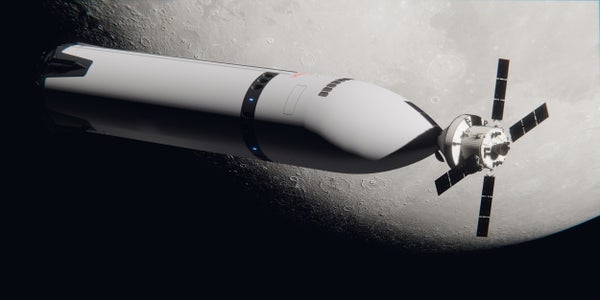
Artist’s concept showing SpaceX’s Starship Human Landing System (HLS) docking directly with an Orion spacecraft.
NASA launched four astronauts on a pioneering journey around the Moon: the Artemis II assignment. Follow our coverage here.
THE Artemis II The mission’s landing Friday was an important milestone in the new space race between the United States and China. But the next step in this race for NASA…Artemis III, now planned for 2027, will see a different, more local competition between SpaceX and Blue Origin.
Only announced in March, this upcoming Artemis mission will pit the two aerospace companies against each other as they compete to be the first to flight test their crewed lunar landers under development. The mission would involve launching a crewed Orion capsule into Earth orbit where, if all goes as planned, the Artemis III astronauts would attempt to meet and dock Orion with a lunar lander variant of SpaceX’s Starship vehicle and, separately, Blue Origin’s Blue Moon Mark 2 lunar lander.
The plan moves a real crewed moon landing to the Artemis IV mission in 2028, according to NASA Administrator Jared Isaacman. This should help solidify the space agency’s extremely ambitious timetable, which culminates with the proposal for a $30 billion moon base by 2036. Artemis IIIIsaacman said, is modeled after the Apollo program test flights of the 1960s, particularly the Apollo 9 mission of 1969. During Apollo 9, which occurred just five months before the historic event Apollo 11 During the crewed lunar landing, the astronauts remained in Earth orbit, where they moved into and maneuvered in a lunar module before returning to a command capsule and then back to Earth.
On supporting science journalism
If you enjoy this article, please consider supporting our award-winning journalism by subscription. By purchasing a subscription, you are helping to ensure the future of impactful stories about the discoveries and ideas shaping our world today.
Slow and steady simply won’t win the race to the Moon with China in the 21st century, Isaacman said during his unveiling. Artemis III during the space agency’s March event. “We are long past the days of Word and PowerPoint,” he said, lamenting “billions wasted, years wasted, hardware delivered non-compliant, programs that were never launched.” [and] fewer flagship science missions” in NASA’s past decades due to the space agency’s standard, highly cautious approach.
But the need for speed doesn’t mean NASA’s replanning isn’t methodical or unnecessarily risky, says Lori Glaze, acting associate administrator for the agency’s Exploration Systems Development Mission Directorate. Artemis IIIOrion’s demonstration of docking with either SpaceX or Blue Origin’s lunar landers (or even both if they’re ready in time) is “absolutely critical to reducing some of the risk” of subsequent moon landings, she says. “Whichever lander is ready to go, we will choose it.” And although Artemis II’s triumphant lunar flyby captivated the world, keeping its successor closer to our planet is the reasonable thing to do. “In Earth orbit, where we are closer to home, if there are problems, we can come back quickly, instead of doing that first docking maneuver on the Moon,” she says.
Representatives for neither Blue Origin nor SpaceX responded to Scientific AmericanRequests for comment on the current status of their respective landers.
Manufacturing Artemis III a mission to test lunar landers in Earth orbit “is a great idea,” says Scott Pace, director of the Space Policy Institute at George Washington University. “NASA is wisely seeking to create more options in lunar architecture.” It’s not just about creating competition, he says, but also about ensuring safe and redundant capabilities by having two different lunar landers.
And they are different. The current lander, SpaceX’s Starship Human Landing System (Starship HLS), will be built on the upper stage of the rocket company’s Starship spacecraft, a 172-foot-tall reusable tower intended to land upright on the moon. According to SpaceX, it could transport up to 100 tons of cargo to the Moon. Astronauts would descend to the lunar surface via a side-elevating platform. Last October, SpaceX said it had completed 49 milestones in the design of its Starship HLS, including testing the airlock, rockets and elevator. But the company hasn’t updated its progress since. In February, Musk said SpaceX had “shifted its focus to building a self-sustaining city on the Moon” rather than Mars, its longtime goal.
Blue Origin’s Mark 2 human lander, a 52-foot-tall, four-foot canister, is also reusable but outwardly more closely resembles Apollo-era hardware. It would carry up to 22 tons of cargo, less than the SpaceX lander could carry. In October 2025, the company presented some updates at a meeting of the American Astronautical Society, revealing that it was building the life support systems in-house.
Getting either lander to the Moon will require refueling in Earth orbit, a barely tested procedure carried out on a dozen additional flights of fuel-filled orbital tankers. Only after overcoming this significant obstacle could the lander travel to the Moon to meet and dock with the astronauts, who would arrive there in an Orion capsule much like Artemis II‘s. In lunar orbit, Orion would encounter the lander, with two of the four crew members boarding to descend to the lunar surface.
For now, all eyes will be on SpaceX’s upcoming test launch of its giant Starship rocket from Texas, which was recently postponed until May. This would be the maiden flight of a new and improved Version 3 model and the first attempt to place the Starship upper stage into Earth orbit. The decision to delay the test launch came shortly after SpaceX announced plans to sell its shares to the public, with an estimated valuation of $1.75 trillion, making the launch event very important to Wall Street as well as NASA.
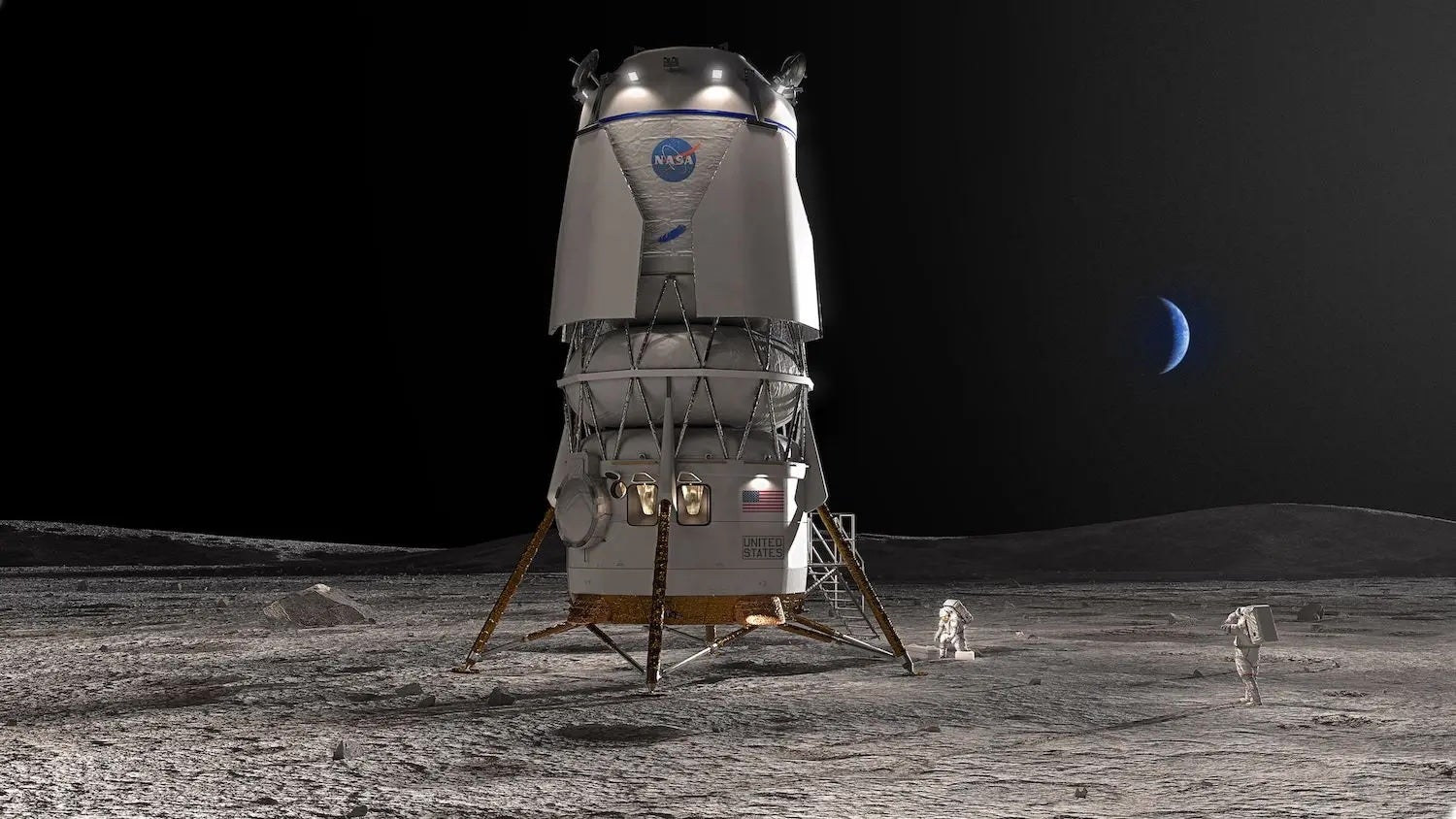
A depiction of a Blue Origin Mark 2 lunar lander.
Meanwhile, Blue Origin’s “Pathfinder” mission, a test landing of the Mark 1 cargo-only version of its moon lander, has been proposed for later this year. That lander is completing vacuum chamber testing at NASA’s Johnson Space Center, Isaacman said at the space agency’s March event. According to NASA, if the mission is successful, another Mark 1 lander will transport, by the end of 2027, the scientific rover VIPER (Volatiles Investigating Polar Exploration Rover) to the lunar south pole, where it will explore water ice.
Internally, the space agency itself is now carefully monitoring the mobile launcher repairs needed for liftoff of its massive Space Launch System rocket to Artemis III.
Even after Artemis III, either or both competing space companies must also demonstrate an uncrewed landing and successful return of their lander before astronauts can use it in 2028. Necessary preparation before NASA’s human moon landing would also include two dozen launches of precursor rovers and other equipment. Achieving this rapid cadence of lunar launches will be key to whether NASA can meet its lunar baseline schedule, the agency’s Carlos Garcia-Galan said in an interview with Scientific American during the March event. “The thing we need to address early on is cadence, that is, how many assets, launches and landers we will need to develop,” he added. Another milestone to watch out for is the development of an Axiom Space spacesuit that was intended for the original. Artemis III mission to the Moon and recently passed a technical review at the space agency.
NASA hopes to have more details on the Artemis III mission once SpaceX and Blue Origin have had time to officially respond to the plan for the new lunar base, according to Glaze. The exact question is which Earth orbit the mission will target: a lower orbit around our planet could save a booster rocket needed for later missions, Ars Technica reported in April, when a higher one could more closely mimic a lunar orbit.
“Part of what we’re doing now is trying to accelerate and make them absolutely ready in 2028” for human landings on the Moon, Glaze says. “What is clear is that the imperative is to land in 2028. They took this very seriously, both [SpaceX] and Blue Origin. »


