NASA’s twin Voyager spacecraft are very low on power after nearly 50 years. How long can they keep going?

When you purchase through links on our articles, Future and its syndication partners may earn a commission.
The pioneering Voyager probes may only have a few years left to explore interstellar space, and that’s assuming a planned and risky maneuver in 2026 goes well.
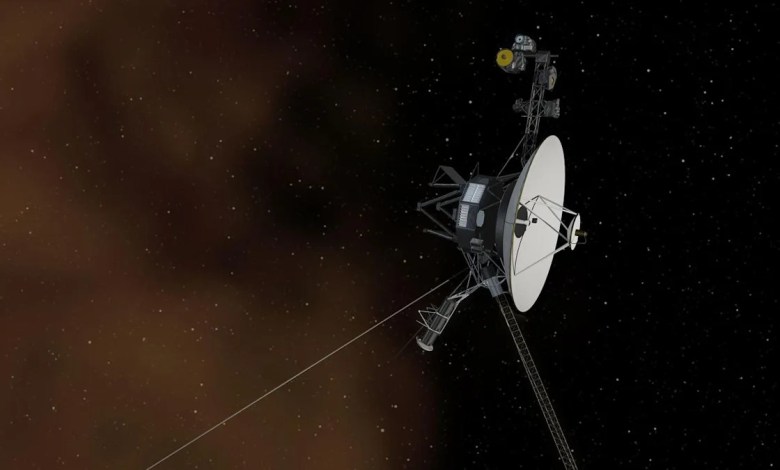
NASA’s twin Traveler 1 And Traveler 2 spacecraft, both powered by nuclear energy, now only have access to part of the 470 watts of energy they generated immediately after their launches in 1977. Originally tasked with exploring the giant planets of our solar system, the two men are long past their expected lifespans and are still transmitting data, far from home.
Voyager 1 entered interstellar space in 2012, and Voyager 2 followed suit six years later. For years, NASA has been turning off probe instruments one by one as their power supply dwindles. They still lose about four watts of power per year. But NASA Jet Propulsion Laboratory (JPL) in Southern California has an idea, which will be tested soon, to give them a little more time.
What’s spinning? What is not?
Both Voyager probes were launched with the same 10 operational instruments. Voyager 1 turned off its subsystem to watch cosmic rays (high-energy particles) in February, then did the same with its LECP (Low-Energy Charged Particles) instrument. in April.
Only two Voyager 1 instruments appear to be on at the moment, according to a JPL list: a magnetometer to observe magnetic fields, and an examination of gases via its plasma wave subsystem instrument. Voyager 2 has three operating instruments: the cosmic ray subsystem, the magnetometer, and the plasma wave subsystem.
The JPL listing suggests that the spacecraft’s other instruments are turned off, or at least partially turned off, due to power requirements. The active instruments’ days are numbered, but a spokesperson told Space.com that the mission team aims to extend their operational lives soon.
“An upcoming engineering activity – nicknamed the “Big Bang” “- on NASA’s sister Voyager spacecraft will continue the agency’s efforts to maximize the mission’s science outcomes,” the spokesperson said in an email.
“Voyager engineers will turn off three devices on the spacecraft that were used to keep the propellant fuel lines from freezing – and turn on three other devices that will keep the fuel lines warm, but will use a total of nearly 10 watts less power,” the spokesperson continued.
“If successful, this could delay the need to turn off a scientific instrument aboard every spacecraft by at least a year. The engineering team will test and implement the program on Voyager 2 in May and June. Based on the results, the mission plans to do the same on Voyager 1 this summer.”
JPL did not respond to follow-up questions about the possible impact on partially powered down instruments, the current power levels of both spacecraft and how long each Voyager is expected to continue operating, among other power-related questions.
How long could Voyager continue?
Every Voyager is so far from Earth that it is necessary almost a day to send a signal to the distant spacecraft. Power continues to decline as the spacecraft approaches its 50th anniversary in space next year, but it appears mission managers expect things to continue for a while.
“We don’t know how long the mission will last, but we can be sure that the spacecraft will offer even more scientific surprises as it moves further from Earth,” said Suzanne Dodd, project manager for Voyager at JPL. a 2022 laboratory declaration.
The same year, Dodd told Space.com that there was only five to six watts of power margin available on each spacecraft. Some basic equipment is also power-hungry: “It takes about 200 watts, or so, to run the spacecraft’s transmitter, so it can send signals back to Earth,” she said.
Dodd added that she was impressed by how well the remaining instruments performed in the cold of interstellar space. “If we were really lucky, and maybe operating below certain thresholds, maybe we could get to the 2030s,” she said.
Alan Cummings, co-investigator on Voyager, said to an audience in October 2024 that, technically, the power of the probes will never run out because nuclear energy always has a half-life. But in terms of the power needed to operate the spacecraft, he said it’s decreasing: The spacecraft might only have about 230 watts each to use, with much of it gobbled up by transmission equipment.
“It’s interesting because Voyager is coming to its end gracefully, in a sense, because different things are trying to kill it,” he mused during a recorded event at the California Institute of Technology, where he is a senior scientist.
The Voyagers’ thruster lines are on the verge of freezing and clogging, he noted. Their telescopes, which were already “destroyed” by radiation when they flew nearby Jupiterthe volcanic moon Io in the 1970s, continue to degrade under the influence of deep space particles. Computers have backups, but those also age.
Cummings praised the original mission team for allowing Voyagers to continue for so long: “There’s so much redundancy on these spacecraft. It’s incredible, and they built it in.”
In August 2022, Dodd was questioned during a JPL livestream how far she thought the Voyagers would go. She predicted that each spacecraft would “definitely” reach the 50th anniversary in 2027 – which still seems possible from today’s perspective – but added that she had a “goal to achieve” assuming that goal is achieved.
Ideally, Dodd said she would like to see the spacecraft reach 200 astronomical units (AU; Earth-Sun distances) from our planet, which would happen around 2035. (At the moment, Voyager 1 is about 169.8 AU from Earth, and Voyager 2 is about 143.1 AU.)
“It’s going to take a lot of luck, good fortune and good engineering,” she said. “But no one would have thought Voyager would last 45 years [to 2022]. So, what’s another 15?”


