Netanyahu Is Destroying Trump’s Flimsy Peace Plans


World
/
December 29, 2025
Talk of a new Middle East is belied by Israeli attacks on Gaza, Lebanon, Syria and Iran.
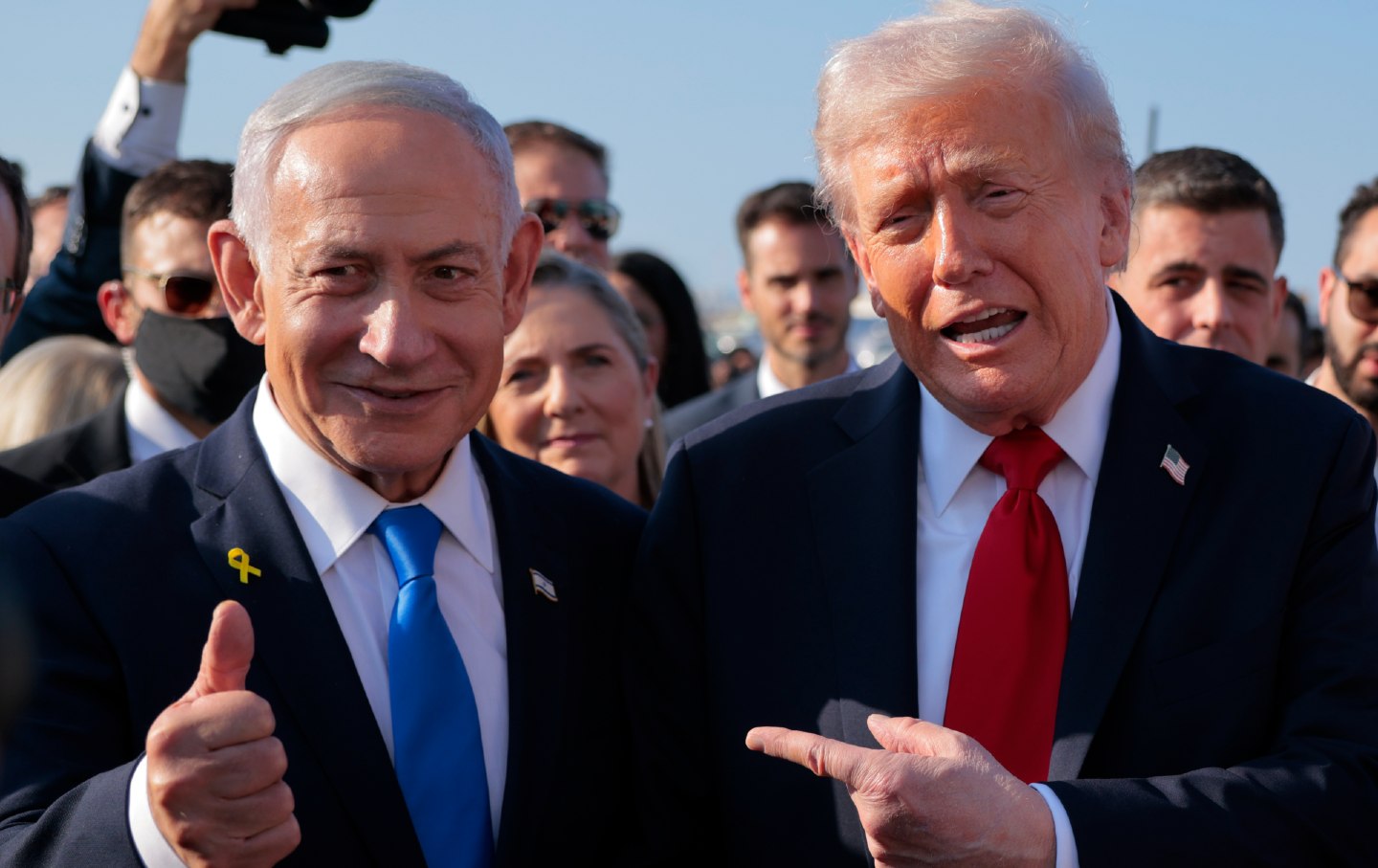
President Donald Trump speaks to Israeli Prime Minister Benjamin Netanyahu at Ben Gurion International Airport before boarding his plane to Sharm el-Sheikh, October 13, 2025, in Tel Aviv, Israel.
(Chip Somodevilla/Getty Images)
No foreign leader has easier access to President Donald Trump than Israeli Prime Minister Benjamin Netanyahu, whose planned meeting today at Mar-a-Lago will be the fifth time he has rubbed shoulders with the U.S. president in the past ten months. In February, Netanyahu was the first foreign dignitary to visit the White House during Trump’s second term, and the year now ends with another meeting. Few foreign leaders have buttered up Trump with the aplomb of Netanyahu, who describes Trump as Israel’s “greatest friend.”
During Trump’s first four years in office, these enthusiastic words were more than deserved. As Al Jazeera noted: “During his first term, Trump further pushed U.S. policy in favor of Israel’s right-wing government. He moved the U.S. embassy to Jerusalem, recognized and claimed Israeli sovereignty over Syria’s occupied Golan Heights, and cut funding to the United Nations Palestinian refugee agency (UNRWA).”
The situation during Trump’s second term is more complicated. Minor but significant disagreements have emerged between Israel and the United States. Trump’s push for a more Western Hemisphere-focused foreign policy — which includes bombing alleged drug-trafficking boats and threatening regime change in Venezuela — depends on shifting military resources from Europe and the Middle East. In the November National Security Strategy statement, the Trump administration asserted that the Middle East is “emerging as a place of partnership, friendship and investment.” Ironically, Trump’s desire to distance himself from the Middle East is a continuation of the unsuccessful efforts made by his predecessors Barack Obama and Joe Biden to lighten the American footprint in the region.
Trump’s peace plans for the region seem like pipe dreams. This would involve the United States relocating its military presence while promoting closer integration of its Arab allies with Israel and the emergence of a new government in Gaza. As Roger Cohen, head of the Paris office for The New York Timesdryly noted: “Such optimism, based largely on the Gaza peace agreement signed in Sharm el-Sheikh, Egypt, on October 13, seems exaggerated, as does President Trump’s assertion that day that it took 3,000 years to achieve a breakthrough of this kind. »
Current number

One of the biggest obstacles to Trump’s vision of a new Middle East is that Israel doesn’t care. While Trump touts his ceasefire, Israel continues to bomb Gaza, Lebanon and Syria. During his meeting with Trump, Netanyahu is also expected to promote a new bombing campaign against Iran.
Netanyahu has no interest in the Middle East becoming a place of “partnership, friendship and investment.” The Israeli leader’s strategy is rather clearly to maintain regional hegemony by promoting chaos. This is the tried and tested imperialist method of divide and rule.
The conflicting goals of the United States and Israel are most clearly visible in Syria. Cohen says there is reason to hope for an end to Syria’s civil war, with a unified nation being rebuilt under the leadership of President Ahmed al-Sharaa, a former jihadist who has pursued a policy of reconciliation. As Cohen noted:
But remarkable progress has also been made in one year. Mr. al-Sharaa has gained support from the United States, Russia and China. He obtained the lifting of economic sanctions. He remained stable in the face of Israel’s repeated military provocations and began to lay the foundations of state institutions. He was welcomed by Mr. Trump and introduced into the White House last month.
Unfortunately, while Israel and its Arab allies support Syrian reconstruction, Netanyahu’s government seeks security by keeping Syria divided. On December 23, a Washington Post Report says Israel has armed Druze militiamen in Syria who want a separate state. According to the report, “some Israeli and American analysts say Israel’s aggressive use of military force in Syria and its covert efforts to promote Druze separatism were counterproductive and undermining relations at a time when Sharaa appeared eager to achieve diplomatic détente.” »
Dana Stroul, a former senior Pentagon official, told the Washington Post:
“There has been growing frustration in Washington because Israeli actions were rolling back something that most of Washington and everyone in the Middle East would like to see succeed: a stabilized, unified Syria. The basic argument for Israel is this: Look, you actually have leaders in Damascus who are willing to say the word ‘Israel’ and talk about a potential future with normalized relations, and yet you continue to bomb or look for a substitute to work with.”
Trump presents himself as a first American nationalist. There is every reason to oppose Israel’s bellicose foreign policy, both from the perspective of American national interest and international peace. It is difficult to find any rational benefit for the United States in returning Syria to chaos or in bombing Iran. Furthermore, criticism of Israel’s belligerence is growing not only among liberals but also within the MAGA right, with voices such as Marjorie Taylor Greene and Tucker Carlson warning of the dangers of new wars in the Middle East.
Despite this changing political landscape, there is no reason to believe that Trump will stand up to Netanyahu. Everything about Trump’s past indicates that his handling of foreign policy is fundamentally ill-considered and that he is easily swayed by the hawkish voices that remain powerful within the Republican Party. While there are points of disagreement between Netanyahu and Trump, the most crucial difference lies in how each invests in his policy preferences. Netanyahu is heavily invested in his vision of Israel as a hegemonic power in the Middle East ready to sow chaos to repel any potential enemies. Trump, by contrast, lacks deep political commitments, making him vulnerable to persuasive pressures from Netanyahu and the pro-Israel lobby. Trump’s peace plans are a fragile house of cards, which Netanyahu could easily topple.
In this time of relentless, often unprecedented cruelty and lawlessness, I am grateful for Nation readers like you.
Many of you took to the streets, organized in your neighborhood and with your union, and showed up at the polls to vote for progressive candidates. You prove that it is possible – to paraphrase the legendary Patti Smith – to redeem the work of the fools who run our government.
And as we head towards 2026, I promise that The nation will fight like never before for justice, humanity and dignity in these United States.
At a time when most news outlets are either cutting budgets or cozying up to Trump by bringing in right-wing propagandists, The NationWriters, editors, editors, fact-checkers, and illustrators confront head-on the administration’s deadly abuses of power, blatant corruption, and deconstruction of government and civil society.
We could not accomplish this crucial work without you.
Until the end of the year, one generous donor will match all donations to The Nationindependent journalism up to $75,000. But the end of the year is only a few days away.
Time is running out for your donation to double. Don’t wait, donate now to ensure our newsroom has the full $150,000 to start the new year.
Another world is truly possible. Together we can and we will win!
Love and Solidarity,
John Nichols
Editor-in-chief, The Nation


:max_bytes(150000):strip_icc()/Health-GettyImages-1356253187-f9df3f8d765341adbd43811aaa4fa7b6.jpg?w=390&resize=390,220&ssl=1 "Coffee Can Lower Your Risk of Death—But Only If You Drink It This Way")