New Eruption in the Bismarck Sea


It is a truism among oceanographers that there is more precise mapping of the surface of the Moon and Mars than of the ocean floor. This is particularly true for the Bismarck Sea, a relatively deep body of water in northern Papua New Guinea. It is an ocean basin with a geologically complex seafloor replete with faults, volcanic features, faults, scarps, and active subduction and expansion zones at depth that make high-resolution sonar mapping difficult.
When satellites detected signs of an unexpected underwater volcanic eruption in the central Bismarck Sea on May 8, 2026, volcanologists were faced with the reality that no high-resolution maps of the region were available and relatively little is known about the deep-sea setting of the eruption. The new eruption is believed to be occurring along the Titan Ridge, about 16 kilometers (10 miles) southeast of the site of an underwater eruption in 1972. However, there is little clarity or consensus among scientists on the precise nature of the volcano that might erupt, the original depth of the currently active vent, or the date of its last eruption.
“The good news is that there are enormous opportunities for exploration and learning using government and commercial satellite platforms already in orbit,” said Jim Garvin, chief scientist at NASA’s Goddard Space Flight Center.
What is known is that seismometers detected a small swarm of earthquakes on May 8, followed shortly thereafter by clear signs of an underwater eruption in satellite observations. Starting May 9, NASA’s Aqua and Terra satellites captured optical images of steam-rich white volcanic plumes rising into the atmosphere, while the ocean color sensor on NASA’s PACE (Plankton, Aerosol, Cloud, Ocean Ecosystem) satellite revealed discolored and disturbed water surrounding the eruption site.
Other satellites observed plumes of ash rising several kilometers into the atmosphere. Higher resolution images from the European Space Agency’s Sentinel-2 and NASA/USGS Landsat 9 (top) satellites, acquired on May 10 and 11, respectively, captured detailed views of activity near the water’s surface. The right image at the top of the page shows the same scene in false color (bands 7-6-5), with the inset highlighting the infrared signature of the eruption. On May 12, the Suomi Nuclear Power Plant’s VIIRS (Visible Infrared Imaging Radiometer Suite) detected thermal anomalies spanning approximately seven square kilometers.
“There must be a lot of hot material near the surface to generate this many thermal anomalies,” said Simon Carn, a volcanologist at Michigan Tech. “This suggests a fairly shallow eruption vent, much shallower than implied by existing bathymetry, which shows water depths of several hundred meters or more.”
Optical satellite imagery shows intense activity in near-surface waters, including large plumes of discolored water and widely distributed steam and ash vents. Medium- and high-resolution sensors, from both government sources and commercial satellite companies, have in recent days captured images of vast rafts of pumice (floating volcanic rocks) forming long bands in surface currents.
“We are now looking forward to seeing if a new island is about to be born, something we have rarely been able to observe with satellites,” Garvin said. If a new island emerges, volcanologists will monitor it closely to see how it evolves. It could build a tuff cone with a long-lived vent crater, or it could collapse and erode quickly. The eruption could also take a much more explosive turn if seawater enters the shallow magma chamber that has risen within the growing underwater structure.
To date, the eruption has been much less explosive than other recent submarine eruptions, such as Hunga Tonga-Hunga Ha’apai in 2022 and Fukutoku-Okanobain in 2021. It seems unlikely that this event would become highly explosive because it appears to be associated with a volcanic ridge near the junction of a transform fault and a back-arc spreading center, Carn said. “Spreading centers are associated with less explosive activity, while the most explosive eruptions typically occur along subduction zones and involve large stratovolcanoes.”
It is unclear how long the current eruption will persist. The 1972 event in this general region lasted only four days, while another underwater eruption about 100 kilometers away in St. Andrews Strait in 1957 lasted almost four years.
Garvin and scientists at other institutions are closely monitoring developments. He plans to analyze radar data from the NASA-ISRO NISAR satellite and the Canadian Space Agency’s RADARSAT Constellation mission to map the contours of any new land that emerges and track how its shape changes over time. If a permanent island forms, Garvin also sees opportunities for researchers, or “islanders,” to visit the area and study how the nascent island responds to plant and animal colonization, precipitation, chemical weathering and other erosive forces, just as happened after the Hunga Tonga-Hunga Ha’apai eruption.
“This new flare could present an even better opportunity for ‘island’ exploration as we prepare to return to the Moon with women and men via Artemis IV,” he said.
NASA Earth Observatory images by Michala Garrison, using Landsat data from the US Geological Survey and MODIS data from NASA EOSDIS LANCE and GIBS/Worldview. Story by Adam Voiland.
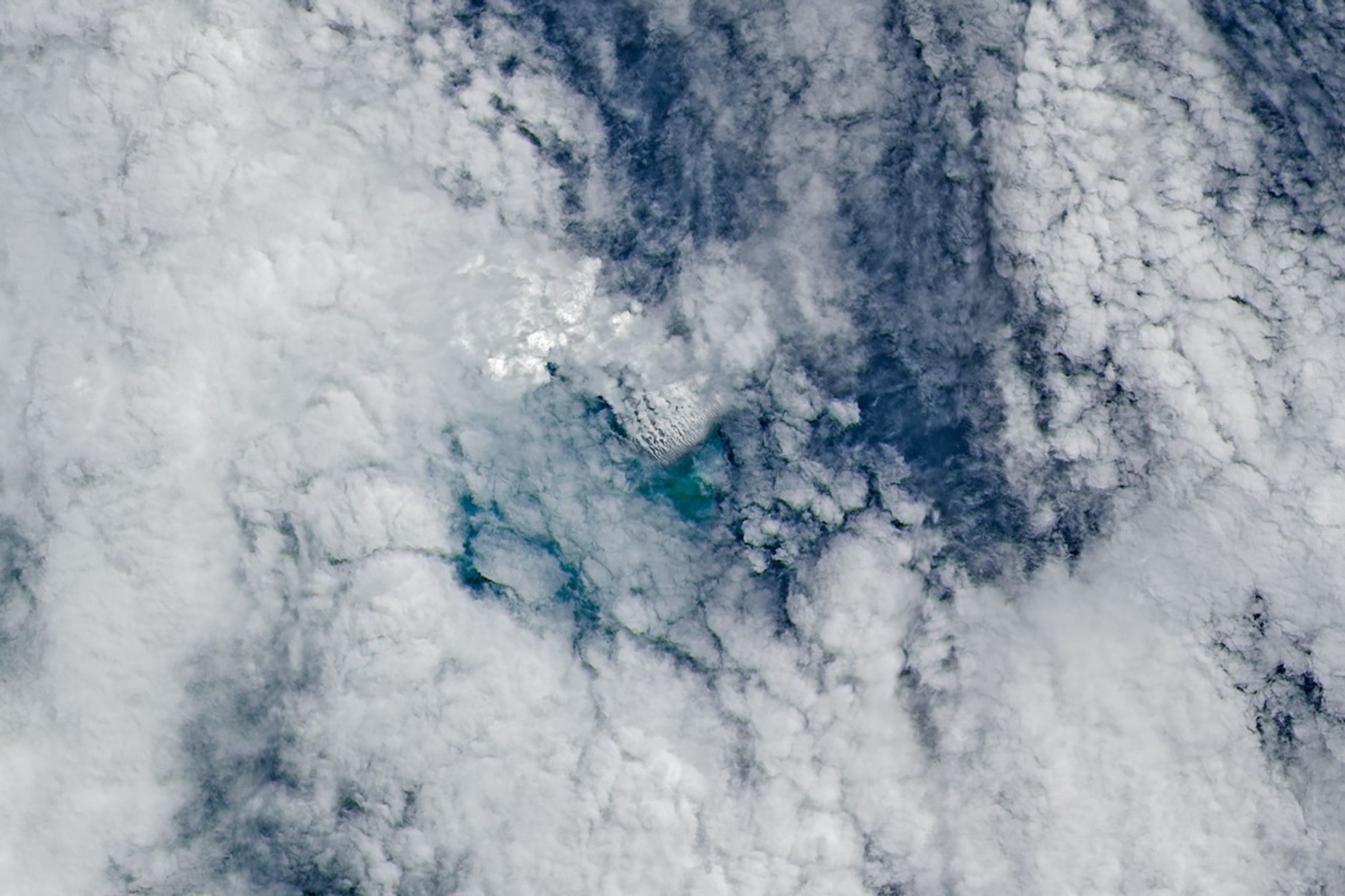
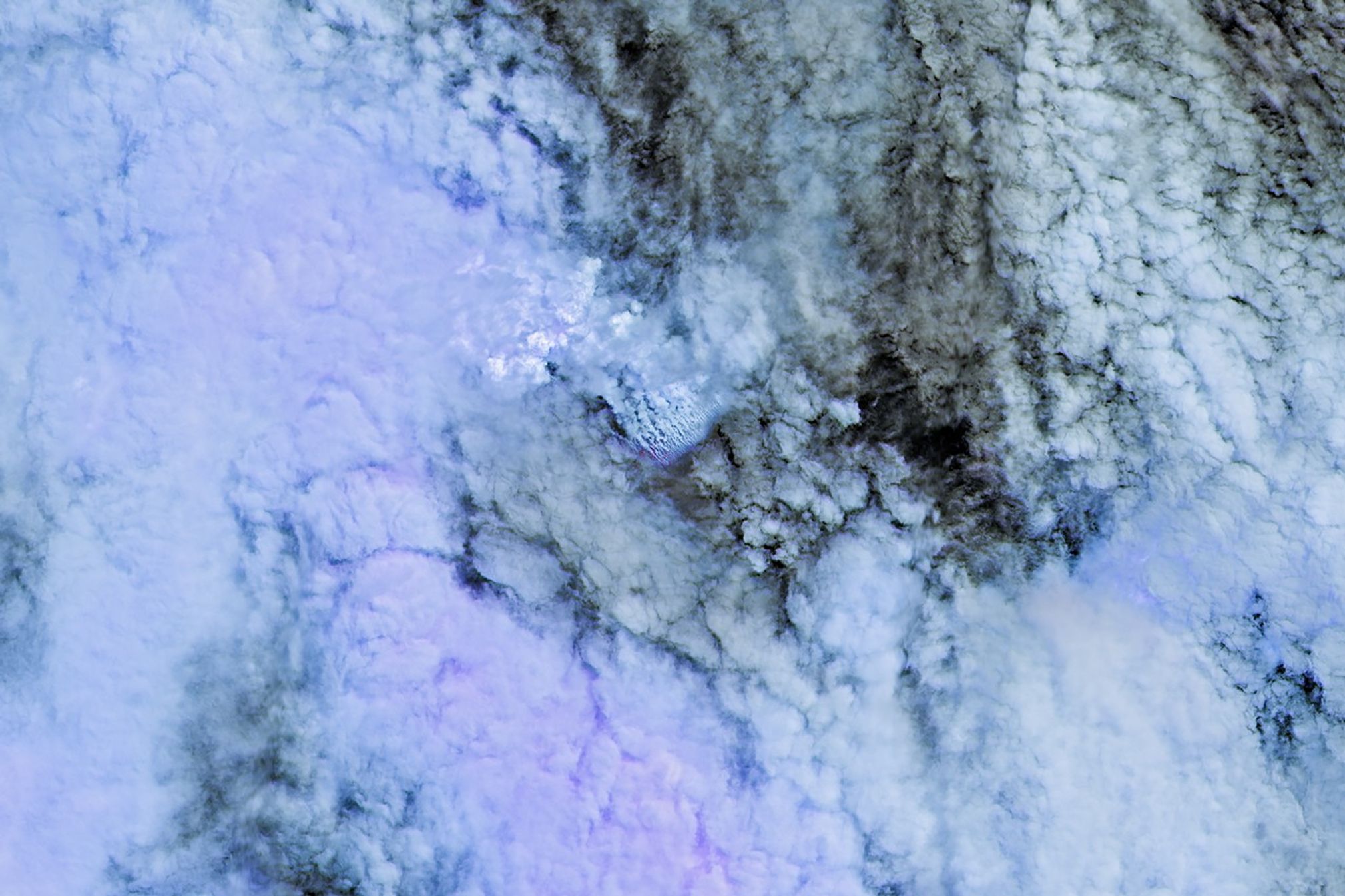
May 11, 2026 (false color)
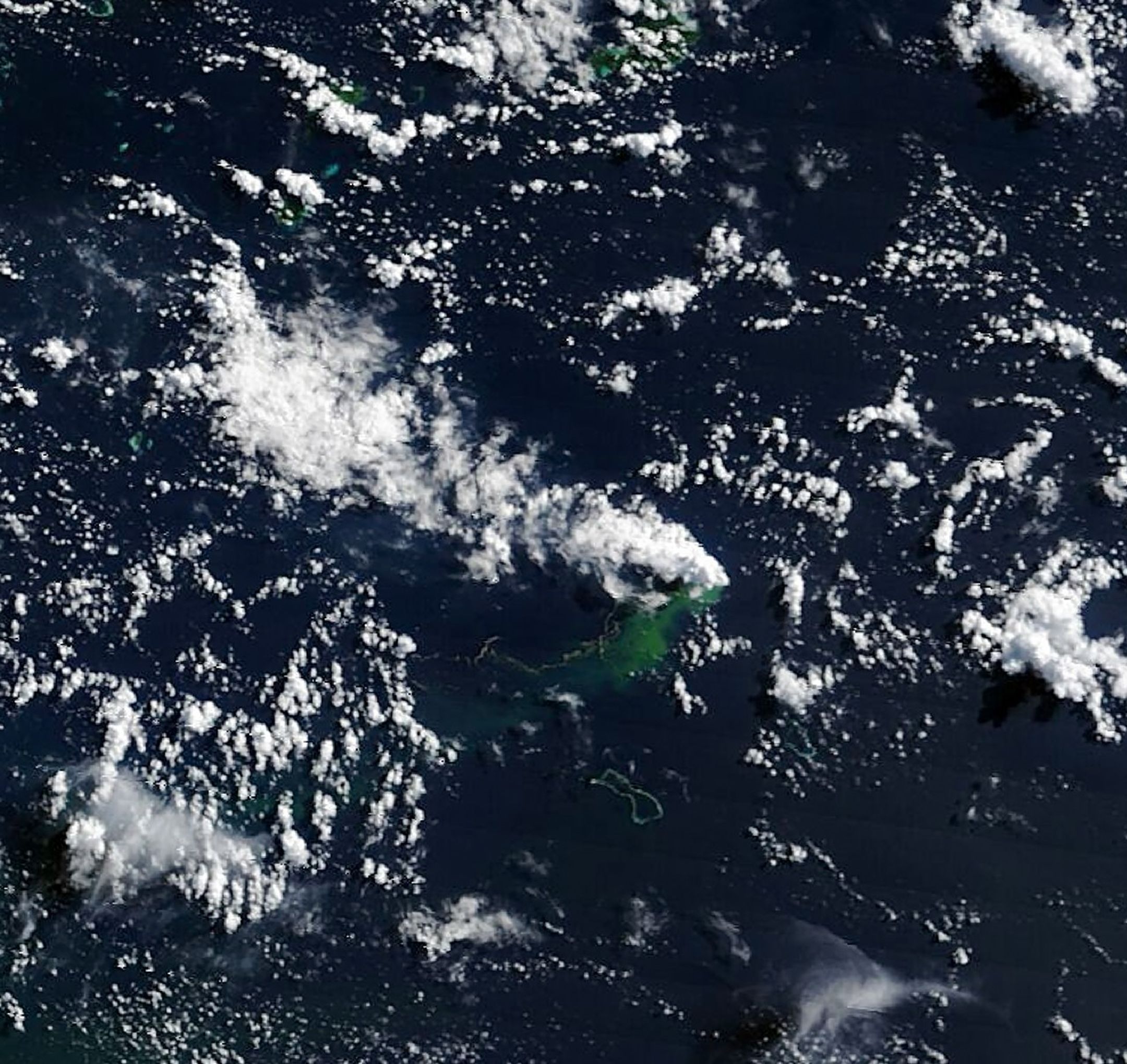
- ABC (May 19, 2026) An undersea volcano erupts in Papua New Guinea’s Bismarck Sea, sparking tsunami concerns. Accessed May 20, 2026.
- Bureau of Meteorology (2026) Darwin Volcanic Ash Warning. Accessed May 20, 2026.
- Carn, S., via Bluesky (May 12, 2026) New underwater #volcanic #eruption in the central Bismarck Sea. Accessed May 20, 2026.
- Global Volcanism Program (May 13, 2026) Central Bismarck Sea. Accessed May 20, 2026.
- Ikegami, F., via Bluesky (May 19, 2026) Another wonderful photo has been published. Accessed May 20, 2026.
- NASA (2026) Volcanoes. Accessed May 20, 2026.
- PNG Bulletin (May 20, 2026) Underwater volcano eruption in Bismarck Sea under close watch. Accessed May 20, 2026.
- RNZ (May 20, 2026) Could PNG’s rare erupting underwater volcano explode? Accessed May 20, 2026.


