New flu virus mutation could see ‘worst season in a decade’


James GallagherHealth and science correspondent

 Getty Images
Listen to James read this article
The flu hits every winter, but this year something seems different.
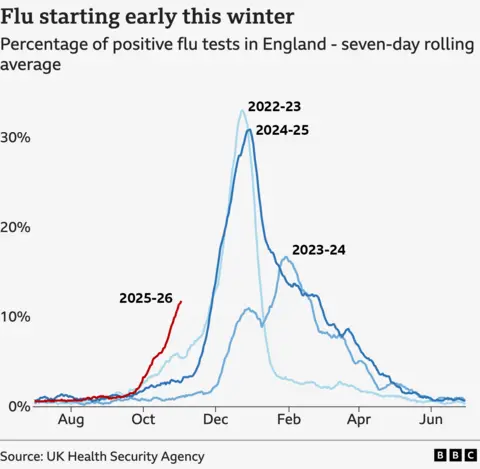
A seasonal flu virus suddenly mutated over the summer. It appears to evade some of our immunity, triggered a flu season more than a month earlier, and is a type of flu that history suggests is more serious.
The NHS has now launched a ‘flu SOS’ as fears grow it will result in a brutal winter.
There’s a lot of nuance and uncertainty, but leading flu experts told me they wouldn’t be shocked if this was the worst flu season in a decade.
“We haven’t seen a virus like this for a while, this dynamic is unusual,” says Professor Nicola Lewis, director of the World Influenza Center at the Francis Crick Institute.
“It absolutely concerns me,” she adds. “I’m not panicking, but I’m worried.”
So what’s going on? And what can we do?
Scientists track flu viruses because they are constantly mutating, and the seasonal flu vaccine must be updated every year to keep up.
This evolution occurs in a rhythm known as “shift and drift.”
Most of the time the virus drifts by making minor changes, then every now and then there is a sudden, sudden change when the virus mutates significantly.
This happened in June of this year.
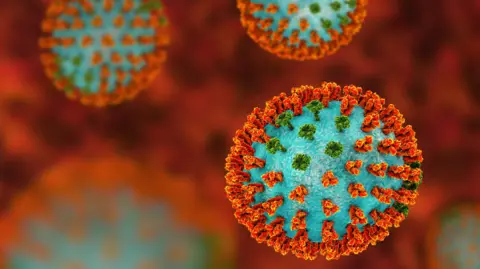
Seven mutations appeared in an H3N2 seasonal flu strain and led to a “rapid increase” in reports of mutated viruses, says Professor Derek Smith, director of the Center for Pathogen Evolution at the University of Cambridge.
 Getty Images
Unusually, this happened outside of flu season, in the middle of summer in the northern hemisphere.
“It’s almost certainly going to sweep the world, so from that point of view it’s something that’s going to happen quickly,” says Professor Smith.
In September, as children returned to school, the nights grew later, and temperatures began to drop, the number of cases increased.
Exactly what these mutations do is still being studied, but they likely help the virus evade some of the immunity we’ve developed over years of flu infections and vaccines.
The result is that the virus has an easier time infecting people and spreading – which is why the flu season is so early in the UK and other countries, including Japan.
If the virus can spread more easily, there’s no need to wait for more favorable winter conditions – when we spend more time indoors with the heat on and the windows closed – to start flu season.
“We are miles ahead,” says Professor Lewis. “I think it will be a strong flu season.”
If you remember your pandemic R numbers (that is, how many people each infected person passes the virus to), they suggest the new mutant has an advantage.
Seasonal flu usually has an R number of around 1.2, while the first estimate for this year is 1.4, Professor Lewis says.
So basically, if 100 people got the flu, it would increase to 120 in a typical year, and 140 this year.
The worst flu season in a decade?
“It’s very likely that this is going to be a bad flu season and it’s going to happen very soon – we’re already well into it,” says Professor Christophe Fraser, of the Pandemic Sciences Institute at the University of Oxford.
“There are indicators that this could be worse than some of the flu seasons we’ve had over the last 10 years.”
During a typical flu season, about one in five people become infected, but that figure could be higher this year, he warns.
But all these predictions remain surrounded by uncertainties.
Some are looking to Australia for clues, as it had the worst flu season on record this year, even though it didn’t deal with the same mutated H3N2 virus as us.
We know that the virus spreads very well among children in the germ fest that is the school playground.
But the immunity developed by a 10-year-old child will be very different from that of their grandparents, whose immune defenses may have been shaped by six times as many flu seasons.
Experts will therefore closely monitor the evolution of the virus which will begin to infect older groups in the coming weeks.
“It’s a meaner virus”
History suggests that the form of flu we are facing this year is more serious, particularly among older people.
There are several types of flu and you may have heard some names like H1N1 swine flu, which caused a pandemic in 2009, or H5N1, the flu that is currently killing birds around the world.
The new mutations occurred in a group of H3N2 flus.
“H3 is still a hotter virus, it’s a nastier virus, it has more of an impact on the population,” says Professor Lewis.
It’s worth remembering that some of us will get the flu and develop no symptoms, while others will get a sudden fever, body aches and exhaustion – but the virus can be deadly in older and more vulnerable groups.
Last year, nearly 8,000 people died from the flu, and during the 2022-2023 flu season, there have been nearly 16,000 deaths. The NHS is already expecting a difficult flu season.
So what can we do about it?
The clear advice is to get vaccinated against seasonal flu – the NHS in England has issued a ‘Flu SOS’, saying 2.4 million places for the vaccine will be available next week.
 Getty Images
Professor Lewis says this is “absolutely the most important year” to get vaccinated and “if your GP has called you, please get your flu vaccine as soon as possible”.
However, this year’s vaccine does not perfectly match the mutated virus.
The decision on the vaccine design was made in February to give enough time to produce the millions of doses needed – then the new mutant appeared in June.
“Some protection is better than no protection, but this year is likely to be one of the years where the level of protection is lower than years where the adequacy is better,” says Professor Fraser. “It’s not an ideal situation.”
The vaccine will still cause the body to produce antibodies that can recognize and latch on to the flu.
But the biggest benefits should be in reducing the severity of illness rather than preventing you from getting sick or slowing the spread of the virus.
And the flu vaccine protects against multiple strains of flu, each of which can potentially cause its own waves of infections.
“Whatever strains are circulating here this winter, we can be confident that the vaccine will still help to protect the most vulnerable people to some extent against developing severe disease and hospitalization,” said Dr Mary Ramsay, director of public health programs at the UK Health Security Agency.
Meanwhile, doctors have received advice reminding them that early antiviral treatment reduces the risk of flu-related complications.
Japan is also experiencing an early flu season and has closed schools to help contain outbreaks.
These are not Covid-style lockdowns, but short-term measures the country is using to disrupt the spread of the virus.
No one knows for sure what will happen in the coming months.
“This could all disappear next week,” says Professor Lewis, “but I don’t think it will.”