New Jurassic Pterosaur Unearthed in Germany


Paleontologists have described a new genus and species of early monofenestratan pterosaur based on a nearly complete and well-preserved fossil skeleton discovered in Bavaria, Germany.
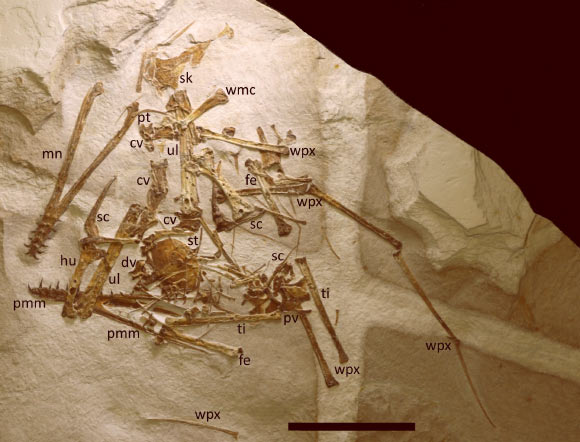
The holotype specimen of Laueropterus vitriolus seen in natural light. Image credit: DWE Hone, doi: 10.7717/peerj.21204.
Pterosaurs were the first vertebrates to fly under power, appearing around 210 million years ago and eventually branching out into forms ranging from sparrow-sized flyers to giant animals with wingspans rivaling small planes.
The newly described species belonged to a group of ancient pterosaurs called monofenestratans.
Appointed Laueropterus vitriolusit had a wingspan of approximately 1 m (3.3 ft), making it one of the largest members of this transitional group ever found.
“Early monofenestratans are a relatively new discovery in pterosaur evolution, first recognized in 2010,” said study author Dr David Hone, reader in zoology at Queen Mary University of London.
“Various analyzes have recovered these taxa both as a clade and as a grade between non-monofenetratans and pterodactyloids.”
“Some of the most derived taxa have been named pterodactyliforms and represent the clade of derived monofenestratans and pterodactyloids.”
The skeleton of Laueropterus vitriolus was found around 2007 in the Schaudiberg quarry of the Mörnsheim Formation.
The fossil is between 150 and 143 million years old (Late Jurassic era) and includes a large portion of the skull, jaws, spine and wings.
“The specimen is preserved on a thick slab of limestone that measures approximately 60 cm by 45 cm (2 feet by 1.5 feet),” Dr Hone said.
“The slab is mainly gray in color but with thick white bars perpendicular to each other and intersecting in places.”
“The pterosaur is generally very well preserved and undeformed, and thin elements such as the sternal plates clearly show the outlines of the elements below.”
Laueropterus vitriolus possessed a mixture of primitive and more advanced features, including a large skull with a single opening combining the nostril and antorbital fenestra – a characteristic of monofenestrat pterosaurs – but also relatively short wing bones more typical of earlier forms.
“Laueropterus vitriolus marks the fourth non-pterodactyloid monofenestratan pterosaur from the Mühlheim locality alongside Skiphosoura, Macrodactyland the ‘rhamphodactyl‘” Dr. Hone said.
“The only other record of this quality in the region is Propterodactylin the much older locality of Painten, so they are not only present in the newer beds, but are clearly much more common here.
“Hundreds of pterosaur fossils have been recovered from the traditional beds of Solnhofen to yield only Propterodactylbut with four non-pterodactyloid monofenestratan specimens at Mühlheim out of perhaps fewer than a dozen pterosaurs that have been recovered, this is a very notable presence.
The results were published online May 11 in the journal PeerJ.
_____
DWE Hone. 2026. A new early monofenestratan pterosaur from the Mörnsheim Formation, southern Germany. PeerJ 14:e21204; doi: 10.7717/peerj.21204


