New material could shield against radiation in next-gen space tech

When you purchase through links on our articles, Future and its syndication partners may earn a commission.

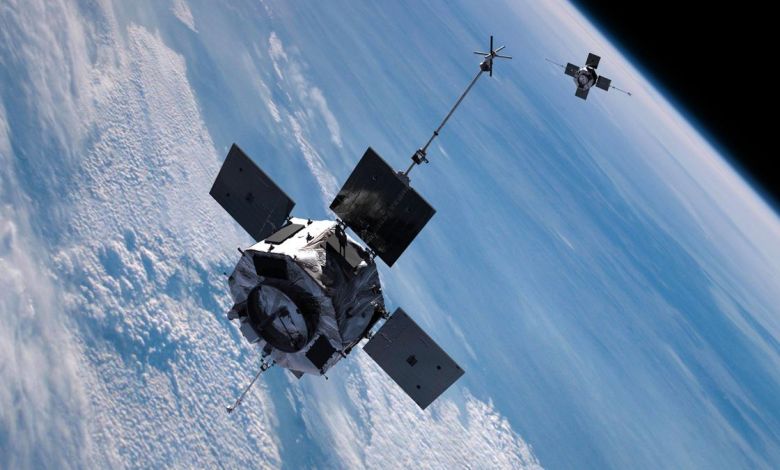
Various space technologies use or emit different types of radiation. A new study suggests a new material that could help shield this radiation, protecting instruments as well as humans. . | Credit: JHU/APL, NASA
Scientists have developed a new material that could protect humans and critical technologies from harmful radiation. It is thinner than a human hair and stretches like rubber.
Radiation is a major factor to consider when astronauts go into space – and it’s not just space radiation. There are a wide variety of technologies needed to reach space that involve radiation, including medical devices, semiconductors, power plants, and even spacecraft themselves. Often, this radiation is an integral part of how these technologies work, but the downside is that it can pose risks of damage or interference with other technologies nearby, as well as possible health risks to humans.
To get around this problem, researchers have developed a new stretchable and lightweight material that could protect space technologies from electromagnetic and neutron radiation. Researchers aim for this material to be a lighter option for protecting equipment and humans involved in spaceflight.
“This material represents a completely new concept in shielding technology: it is as thin as duct tape and as flexible as rubber, while simultaneously blocking electromagnetic waves and radiation,” said lead author Joo yong-ho of the Research Center for Extreme Environment Shielding Materials at the Korea Institute of Science and Technology. said in a statement.

The new material made from two different types of nanotubes protects against different types of radiation, which could protect both technologies and humans involved in the development of space technologies. | Credit: Korea Institute of Science and Technology
When we think of the dangers of space and radiation, we may think of space radiation, which permeates space and poses health risks to astronauts traveling in low Earth orbit and beyond. But other types of radiation are used in the technologies needed to explore space, which poses many other problems. Different types of radiation emitted between different technologies during the development or use of these technologies can cause various problems. For example, electromagnetic waves and neutron radiation from one technological element can cause the semiconductors of another element to malfunction.
To make things even more complicated, many humans are involved in spaceflight, beyond astronauts. From engineers to technicians, a variety of people could benefit from better radiation protection when dealing with the technologies they create for the space sector.
The new material was made with two different types of nanotubes: carbon nanotubes and boron nitride nanotubes. Carbon nanotubes are conductive, meaning electricity and heat can pass through them, and both types of nanotubes absorb and reflect electromagnetic waves. Boron nitride nanotubes, for their part, capture neutrons. Together, the two categories of nanotubes can work together to block 99.999% of electromagnetic waves and 72% of neutron radiation.
Although its effectiveness in blocking radiation and its extremely lightweight nature are the most compelling details of this material, its elasticity could bring even more benefits. The material can be stretched to double its length, and this flexibility allows it to be 3D printed. The researchers explored different 3D printed shapes with the material and found that when printed in a honeycomb shape, the structure improved its ability to shield against radiation by 15%.

Credit: Credit: Korea Institute of Science and Technology
Importantly, the team behind this new material suggests it could be a game-changer by blocking radiation without adding too much extra weight – a major advantage for space missions, as every ounce counts when propelling payloads beyond our planet. And the technologies that could benefit are wide-ranging, from satellites to space stations – and even protective equipment for those working in space and the space sector.
The development of this new material was described in a study published March 4 in the journal Advanced Materials.


