New particle mass measurement deepens quantum mystery


April 10, 2026
3 min reading
 Add us on GoogleAdd SciAm
New fundamental physics measurement deepens quantum mystery
New calculation helps reduce the mass of the W boson, one of the heaviest fundamental particles in the universe
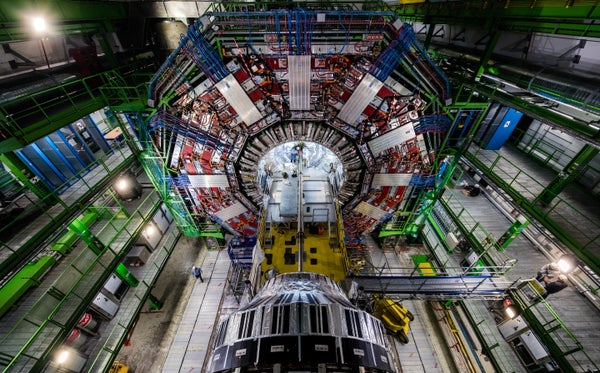
The Compact Muon Solenoid (CMS) detector of the Large Hadron Collider.
Physicists have measured the mass of one of the basic building blocks of the universe, the W boson particle. The new calculation, carried out at the Large Hadron Collider (LHC) near Geneva, could help solve a disturbing mystery about the mass of this particle.
About 80 times heavier than protons, W bosons are among the heaviest fundamental particles in nature, which cannot be broken down into smaller pieces. They carry the weak force, which allows other particles to transform from one type to another in processes such as the radioactive decay of uranium into lead and the nuclear fusion of hydrogen into helium.
A 2022 measurement of the mass of the W boson made by the Collider Detector at Fermilab (CDF) experiment at the Tevatron collider at the Fermi National Accelerator Laboratory (Fermilab) was the most precise to date. And it suggested that the mass differed significantly from the prediction of the Standard Model, the ruling theory of particle physics. If correct, it meant something strange was happening with the particles governing radioactivity and with the rules of physics.
On supporting science journalism
If you enjoy this article, please consider supporting our award-winning journalism by subscription. By purchasing a subscription, you are helping to ensure the future of impactful stories about the discoveries and ideas shaping our world today.
The 2022 measurement had been the most precise to date. The new measurement, however, almost matches its accuracy, but is in agreement with the standard model. Leaders of the new study, carried out as part of the LHC’s Compact Muon Solenoid (CMS) experiment, say it reassures them that their basic understanding of the W boson is probably on the right track. “While it would have been exciting to confirm the CDF result, what I really wanted was to publish a result that would stand the test of time,” says Kenneth Long, a physicist at the Massachusetts Institute of Technology and co-author of the new study. “I think today most physicists will rely on the Standard Model, and I think our measurements are a big reason why.”
However, the enigma is not yet entirely resolved. “While I commend CMS for its valiant efforts, any conclusions at this point are certainly premature,” says Ashutosh Kotwal, a physicist at Duke University who co-authored the CDF analysis. “Clearly, CDF and CMS cannot be correct.” The CDF team derived their mass measurement using six different methods and studied different ways the W boson might decay into smaller particles. “CMS, on the other hand, is still in its infancy, with its first release containing only one of these six methods,” says Kotwal.
The Standard Model has had enormous success in describing the world of fundamental particles, but scientists know it is not complete. This does not include, for example, the mysterious dark matter that physicists believe is omnipresent in the cosmos or the dark energy that appears to accelerate the expansion of the universe. If researchers can find a gap between the model’s predictions and reality, it could pave the way for extending the theory to more fully describe nature.
“I think we all expect the standard model to ‘collapse’ one day,” Long says. “But this measure means that one of the most tantalizing (and striking) clues that the standard model wasn’t working looks more like an experimental anomaly than a theoretical inadequacy. That means we have to keep looking more carefully and perhaps in different places to find these cracks.”
According to the new LHC measurements, the W boson weighs 80,360.2 ± 9.9 megaelectronvolts (MeV), or about 160,000 times the mass of the electron, which has about 0.5 MeV. This figure fits perfectly into the standard model predictions.
The LHC accelerates protons to near the speed of light, then smashes them together. The energy of the collision generates many new particles, sometimes including W bosons. The experiment cannot directly measure W bosons because they disappear after only 10– 24 seconds of existence. But they often decay into a pair of particles called a neutrino and muon (a heavier version of an electron).
The neutrino is almost as elusive as the W boson, but CMS can study muons very precisely. By carefully measuring the energy and momentum of muons produced in about 100 million collisions that would have created W bosons, the physicists arrived at their new mass estimate. The discovery was published April 8 in the journal Nature.
It’s time to defend science
If you enjoyed this article, I would like to ask for your support. Scientific American has been defending science and industry for 180 years, and we are currently experiencing perhaps the most critical moment in these two centuries of history.
I was a Scientific American subscriber since the age of 12, and it helped shape the way I see the world. SciAm always educates and delights me, and inspires a sense of respect for our vast and beautiful universe. I hope this is the case for you too.
If you subscribe to Scientific Americanyou help ensure our coverage centers on meaningful research and discoveries; that we have the resources to account for decisions that threaten laboratories across the United States; and that we support budding and working scientists at a time when the value of science itself too often goes unrecognized.
In exchange, you receive essential information, captivating podcasts, brilliant infographics, newsletters not to be missed, unmissable videos, stimulating games and the best writings and reports from the scientific world. You can even offer a subscription to someone.
There has never been a more important time for us to stand up and show why science matters. I hope you will support us in this mission.


