New report warns that China could overtake the US as top nation in space


A new report warns that ChinaThe rapid and relentless growth in the space sector will see the country overcome the United States in the “new space race” to become the main global space nation in as little as “five or 10 years”, according to experts.
The brutal warning comes less than two weeks after an audience of the Senate trade committee discussed the growing probability of China Beat the United States in a race to return humans to the moon. During these discussions, the former NASA administrator Jim Bridenstine Senators said that “it is very unlikely that the United States will beat the planned calendar of China”, unless the recent record reductions in the NASA budget is reversed.
The 112 -page document contains the most recent information on the various space assets and missions of China, including the country’s new space station, its growing satellite megacons and its plans to visit and colonize the moon.
“China is not only running to catch up – it establishes a rhythm, deregular and sometimes redefine what leadership on and above,” wrote researchers in the report. “The ancestry of China space – powered by a disciplined policy, strategic investments and radical technological gains – has fundamentally restarted the field in which global power is disputed.”
In relation: China builds a constellation of AI superordinators in space – and has just launched the first rooms
One of the most disturbing problems raised by the new report for the United States is the possibility that China is the first nation to return humans to the Moon, for the first time since 1972. While NASA Artemis missions have been delayed several timespartly due to recent problems with SpaceX capricious dishes rocketChina has continued to cross “major stages” on its astronaut establishment plan by 2030. These include Mapping of the lunar surface in record detail,, Historical lunar samples back on earth And Build their own oversized rockets. (NASA is currently aiming to land astronauts on the moon by 2027.)
China also plans to Build a fully operational moon baseequipped with An autonomous nuclear reactorFrom 2035. This could help the nation claim its claim on valuable lunar mining documents and give them the advantage in the race to possibly send humans to Mars, Live Science Sister site Space.com recently reported.
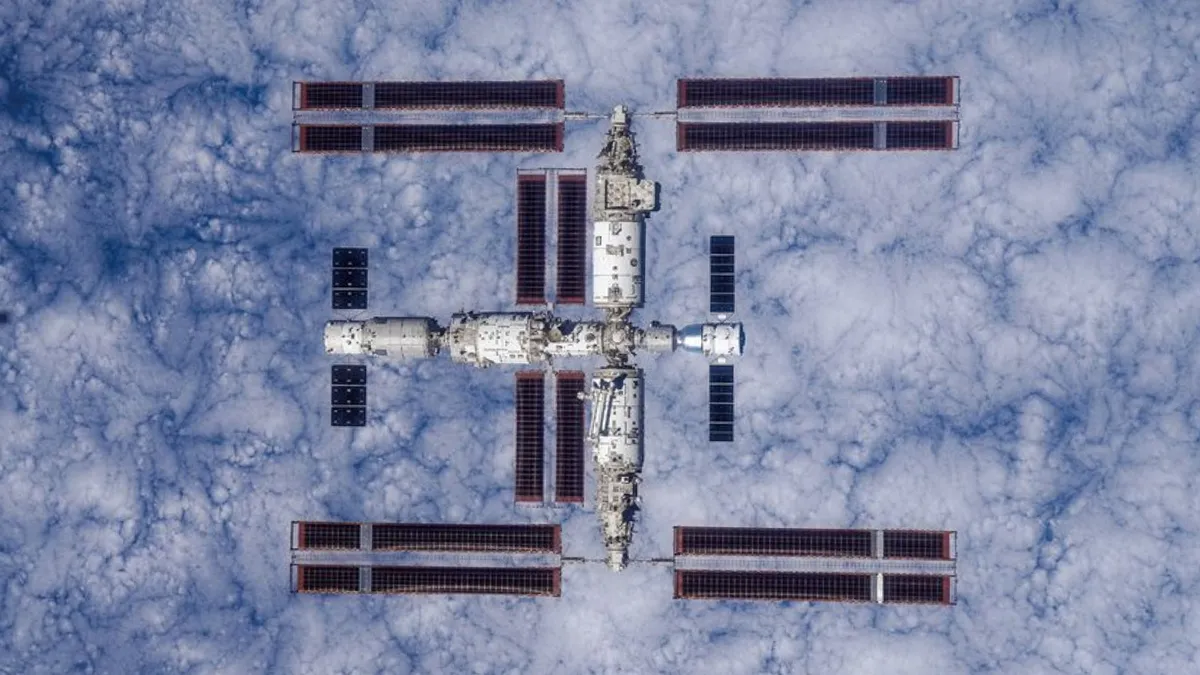
Another area where China is likely to dominate is in low orbit Tiangong space stationwhich will become the only large space station managed by the state being operating once the International Space Station (ISS) Declined at the end of this decade. (NASA does not intend to directly replace the ISS, although a The number of commercial companies pursues plans for their own stations.)

China also begins to Build its own satellite megaconstellations To compete with the rapid expansion “Starlink” network of SpaceX. He also plans to Build an orbital solar energy table and his Clean version of the James Webb space telescope in the near future.
In the field, China now has six different operational spaceports, which will allow the country to quickly increase the number of rockets it can launch in the years to come.
But perhaps the most alarming point for the United States is that the country simultaneously performs all these impressive tasks. In other words, “China lives its Apollo, the ISS and the commercial eras at the same time,” wrote the authors of the report.
In relation: Chinese astronauts make fuel and oxygen in space using “artificial photosynthesis” of the 1st to its activities
The secret of the recent success of China is (unsurprisingly) increased funding, in particular for commercial companies, which have received special government support to help China National Space Administration (CNSA). For example, the country invested $ 2.86 billion in its commercial space companies last year – more than 17 times the $ 164 million it spent in 2016, according to the report.
Another important factor was China’s desire to work with other nations to achieve its objectives, including Russia, India and Japan. This approach, nicknamed the “Space Silk Road” initiative, has seen China set up more than 80 projects with international partners so far “, eroding American influence”, wrote researchers.

The co-author of the report Jonathan RollAn analyst of space policies on Arizona State University, was particularly surprised by the speed with which the spatial capacities of China progressed since he properly studied the subject in the early 2020s: “I thought I had a fairly good reading on this subject when I ended up the higher school,” said Roll said Ars Technica. “”[But the fact] That almost everything had to be updated or had changed three years later, was quite frightening. “”
Meanwhile, American space ambitions were registered by the Trump administration, which has proposed to reduce the budget of NASA almost by halfPut several long -term missions in danger and create training impacts in the commercial space industry.
“The United States is still ahead today in many areas of space,” said Dave Cavossa, president of the commercial federation of space flights, in Ars Technica. “But the Chinese advance very quickly and ready to surpass ourselves in the next five to 10 years if we do nothing.”


