New ‘Transformer’ humanoid robot can launch a shapeshifting drone off its back — watch it in action


Look on it
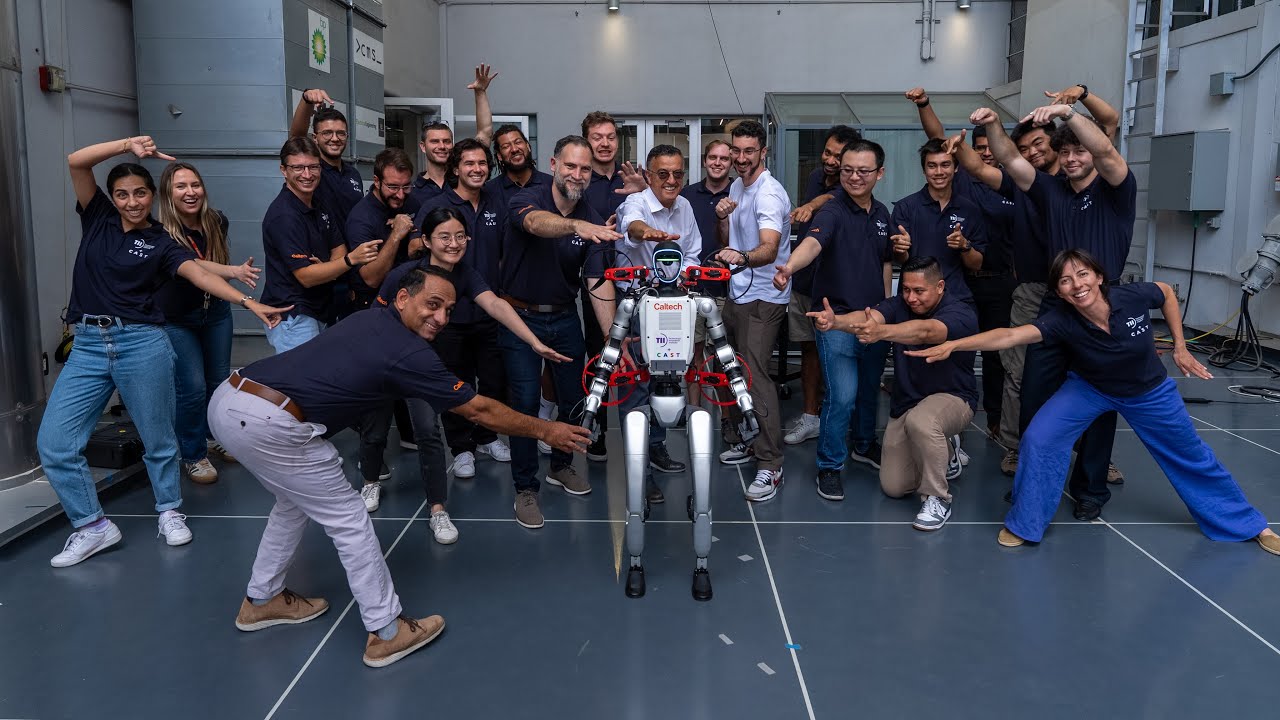
Caltech engineers have developed a multimodal robotic system: a humanoid robot with a transforming drone that launches on its back.
Sitting on the back of the humanoid robot, a Unitree G1 machine, the drone, called M4, can transform by switching between driving and flying modes. We’re not talking about Optimus Prime or Megatron here; instead, the drone-expelling robot looks more like Soundwave, a Decepticon who housed different mini-transformers, like drones, in his chest.

The humanoid can walk (although we’ve seen smoother movements) and he can climb stairs and make his way back to where he sent the drone, although at a much slower pace.
“Right now, robots can fly, robots can drive, and robots can walk. All of that is great in some scenarios,” Aaron Amesdirector of CAST and professor of aerospace and engineering at Caltech, said in a statement. “But how can we take these different modalities of locomotion and bring them together into one whole, so that we can excel in the advantages of all of these modalities while mitigating the disadvantages of each?”
The challenge here was how the team brought different robots together so that they could form a single system while still offering different functionality. The drone was built by a The CAST team led by Mory Gharib, while Ames and his laboratory configured the humanoid robot.

M4 is capable of reconfiguring its body (transforming itself) into several different types of movements: it can assess the environment it needs to enter and automatically select the most effective combinations of movements to maneuver. M4 can ride on four wheels, turn its wheels into rotors and fly, stand like a meerkat on two wheels, “walk” using its wheels as feet, use two rotors to help it climb steep slopes on two wheels, and also simply tumble towards its destination.
The M4’s ability to reuse its appendages as wheels, legs or thrusters is a key feature. When the M4 needs to fly, all four wheels fold up and the propellers lift the robot off the ground – or off the back of the humanoid robot, which leans forward when deploying the M4.
The overarching goal of this collaboration is to make these autonomous systems safer and more reliable. If we want to have robots all around us, Ames suggested, we need to work harder to make them reliable.
“We’re thinking about critical control for security, making sure we can trust our systems, making sure they’re secure,” Ames said in the release. “We have several projects that go beyond this one and look at all these different facets of autonomy, and these issues are really important. By having these different projects and facets of us working together, we’re able to tackle these much larger issues and really advance autonomy in a substantive and concerted way.”


