NIH head, still angry about COVID, wants a second scientific revolution


“This was not a claim involving people like Anthony Fauci,” she continued. “It was a demand of ordinary Americans, men and women who wanted our nation to excel in science rather than weaponize it.”
Things got a little strange. MAHA Institute moderators asked about the possibility of COVID-19 vaccines causing cancer and spoke favorably of the possibility of a lab leak. An audience member asked why alternative treatments aren’t being researched. A speaker who proudly announced that he and his family had never received a COVID vaccine was warmly applauded. Fifteen minutes of the afternoon were devoted to a novelist seeking funding for a satirical film about the pandemic that presented Anthony Fauci as a self-centered lightweight, vaccines as a sort of placebo, and Bhattacharya as the hero of the story.
The organizers also had an idea of who might give a hostile review to the whole thing, since Nature and Science journalists said they were refused entry.
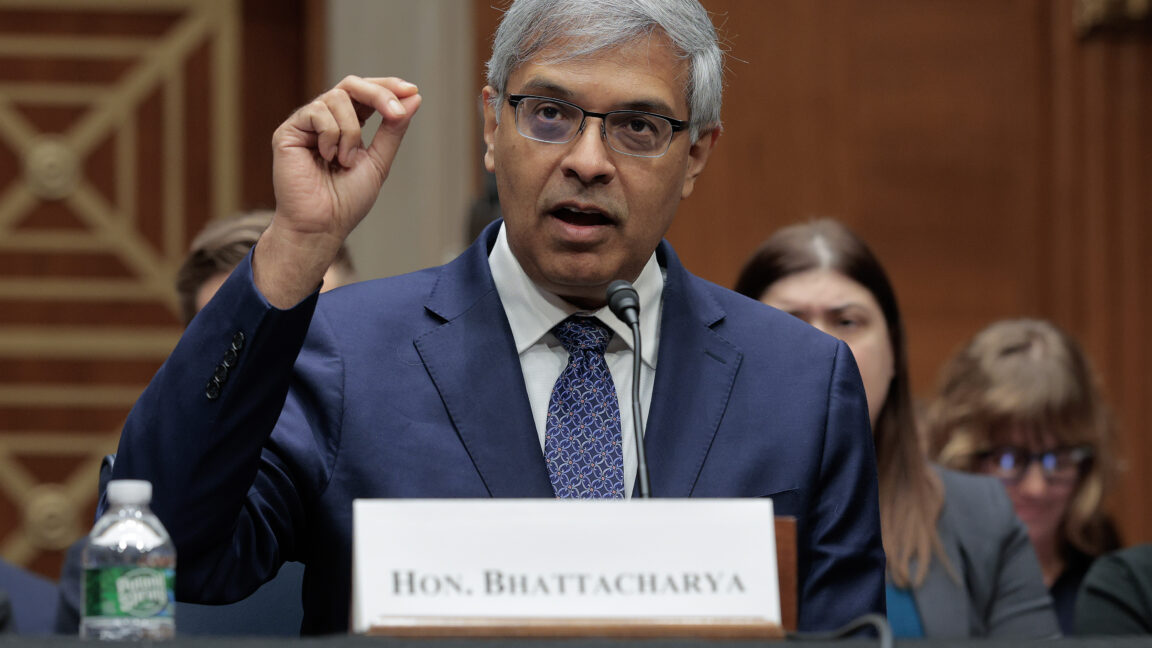
In short, this was not an event you would attend if you wanted to make serious improvements to the scientific method. But that’s exactly how Bhattacharya handled the issue, spending the afternoon not only justifying the changes he’s made at the NIH, but also arguing that we need a second scientific revolution—and that he’s just the person to make it happen.
Here is a detailed section of his introduction to the idea:
I want to launch the second scientific revolution.
Why this grandiose vision? The first scientific revolution that you had… very generally speaking, you had high ecclesiastical authority to decide what was true or false about physical and scientific reality. And the first scientific revolution essentially took… the power of creating truth out of the hands of the high ecclesiastical authority charged with deciding physical truth. We can leave aside the spiritual – that’s another thing – physical truth and put it in the hands of people with telescopes. It fundamentally democratized science, it took the power to decide what is true out of the hands of authority and put it in the hands of ridiculous geniuses and ordinary people.
The second scientific revolution is therefore very similar. The COVID crisis, if anything, was the crisis of the high scientific authority who had to decide not only a scientific truth like “plexiglass will protect us from COVID” or something like that, but also an essentially spiritual truth. How should we treat our neighbor? Well, we treat our neighbor as a simple biological hazard.
The second scientific revolution is therefore the replication revolution. Rather than using the measure of the number of papers we publish as a measure of success, what we will look at as a measure of the success of a scientific idea is: “Do you have an idea where other people [who are] looking at the same idea, you tend to find the same thing as you? » This is not just a simple reproduction of an article or an idea. It is a very vast science. This includes, for example, reproduction. So if two scientists disagree, it often leads to constructive solutions to move science forward – by deciding, well, new ideas can emerge from that disagreement.
This section, which appeared at the start of his first speech of the day, touched on themes that resurfaced throughout the afternoon: These people are angry at the way the pandemic has been handled, they are trying to use that anger to fuel fundamental change in the way science is conducted in the United States, and their plan for change has almost nothing to do with the issues that made them angry in the first place. Given this, organizing everything for the MAHA audience makes sense. They are a suddenly powerful political group that also wants to see a fundamental change in the scientific establishment, and is completely unconcerned about the lack of intellectual coherence.


