No, comet 3I/ATLAS hasn’t exploded — and no, that doesn’t mean it’s an alien spaceship


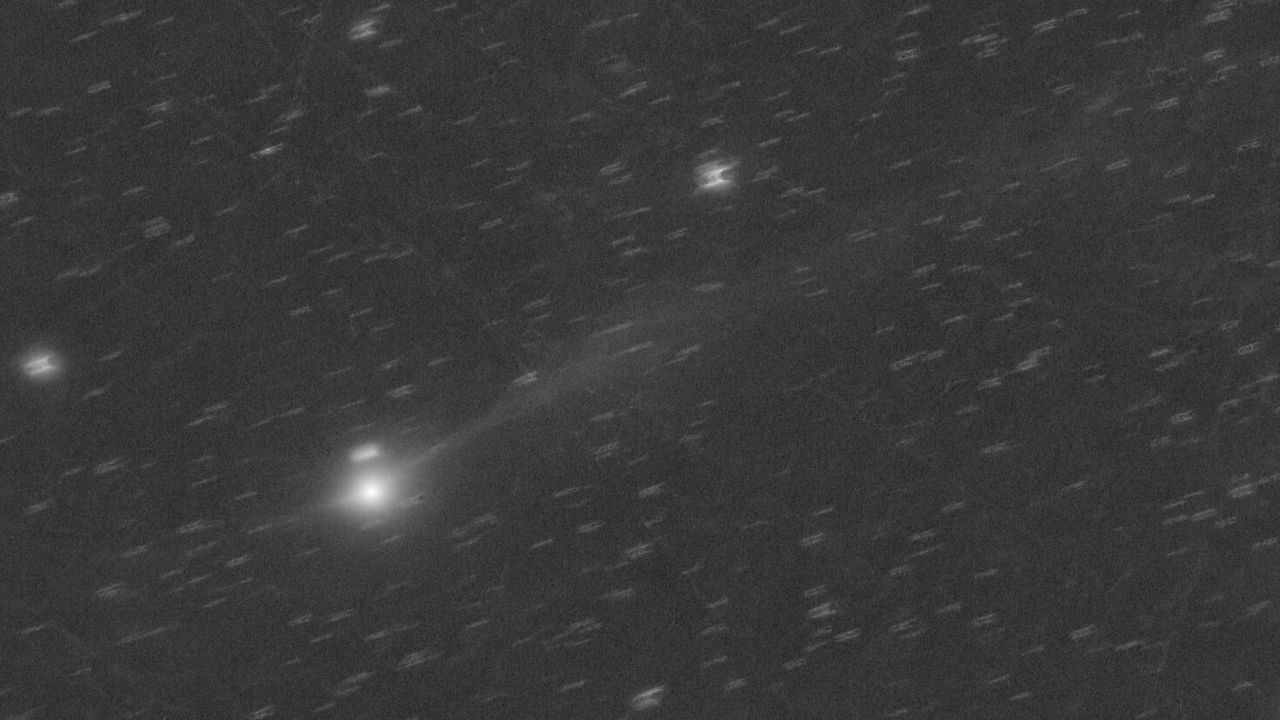
Comet 3I/ATLAS lovers don’t despair: Our favorite interstellar visitor probably didn’t just explode, says an expert after reviewing the latest observations.
Yesterday (November 10), Futurism reported that comet 3I/ATLAS may have broken into pieces after reappearing on the other side of the sun. The science and technology website cited the blog from Harvard University astrophysicist Avi Loebwho calculated that the comet had lost a lot of mass based on a Image 3I/ATLAS captured by two small telescopes in Spain on Sunday November 9.
However, Loeb’s assessments of 3I/ATLAS have come under scrutiny in recent days. He was once again using his blog to speculate that the comet could be an alien spacecraft. However, most researchers are convinced that it is a natural object and did not explode.
“All the images I have seen show a fairly ordinary and healthy-looking comet,” Qicheng Zhanga postdoctoral fellow at the Lowell Observatory in Arizona who studied the comet, told Live Science in an email. “There is no sign that the core has broken.”
Comet 3I/ATLAS recently disappeared (briefly) behind the sun, reaching its closest point to our star, known as perihelion, on Thursday, October 29. As he reappearsastronomers eagerly observe it to learn more about its composition. This is because comets heat up as they get closer to stars, causing the ice on their surfaces to sublimate into gas that researchers can then detect and study.
This newly released gas can blast across the comet’s surface in gargantuan jets, wrap around the comet’s body in a cloud called a coma, or be carried away in the comet’s long tail. All of these features are made brighter by the sun’s ionizing radiation, allowing even amateur astronomers to study the comet in good conditions.
From Earth’s perspective, the comet is currently rising higher and higher above the eastern horizon and, under favorable conditions, is visible through a small telescope (6-inch lens) across much of the northern hemisphere.
And everyone is sure to watch. Comet 3I/ATLAS has become a lightning rod for celestial speculation since its discovery in July, with Loeb and others suggesting that the comet – an interstellar visitor from beyond our solar system and thought to be more than 7 billion years old – maybe it’s an extraterrestrial probe.
However, most astronomers are convinced that the interstellar visitor is a natural comet from a unknown star system in the Milky Way. The natural origins of the comet should be a cause for enthusiasmno disappointment: 3I/ATLAS is only the third interstellar comet ever recorded, it is the most massive of its kind and potentially the the oldest comet ever seen.
In a picture Taken by amateur astronomers Michael Buechner and Frank Niebling on Sunday, November 9, jets appear to take off from the comet. This led Loeb to use an estimate of the amount of projected material and the corresponding mass of the comet to argue that it would have needed a much larger surface area than observed if it were a natural object.
Loeb’s assessment also states that the comet should have broken into at least 16 pieces. So if astronomers discover that it didn’t break up during future observations, Loeb thinks scientists will have to consider that it’s not a natural comet.
To put it mildly, astronomers disagree.
“I looked at Avi Loeb’s blog, and it looks like he just built a house of cards on top of his unfounded claim about comet acceleration, which was a blatant misinterpretation of the comet’s orbital parameters. Anyone who has ever calculated a comet’s orbit will immediately recognize it as flawed,” Zhang said.
Before his latest article, Loeb’s claims were already attracting strong criticism from astronomers. On Sunday, Jason T Wrightprofessor of astronomy and astrophysics at Penn State University, wrote on his blog that there was no indication that 3I/ATLAS was an extraterrestrial spacecraft, breaking down ten of Loeb’s claims about unnatural ” anomalies ” point by point. He also questioned Loeb’s expertise and criticized his publications and articles.
“In these articles and on his blog, he regularly betrays a misunderstanding of well-established concepts of planetary science, misinterprets the articles, and reaches erroneous conclusions,” Wright wrote.
3I/ATLAS will make its closest approach to Earth on December 19. Until then, expect many more new observations and claims – just take them with a grain of salt.


:max_bytes(150000):strip_icc()/Health-GettyImages-1213667588-ecf8a3ec66a24f949c17e7eb7e695686.jpg?w=390&resize=390,220&ssl=1 "4 Foods That Keep You Full Longer Than Eggs")
