Oceanic Fish Transitioned to Freshwater Multiple Times, Paleontologists Say


The Fish Supergroup Otophysi, known for their improved hearing, includes two thirds of the species of lively freshwater fish. Previously, it was thought that they were from fresh water before the rupture of the Supercontinent pangea, involving a gap of almost 80 million years between the origin and the oldest known fossil. However, the discovery of Maccognoi acronichthys – A newly described freshwater otophysane species that lived during the time of the upper Cretaceous – questions this vision.
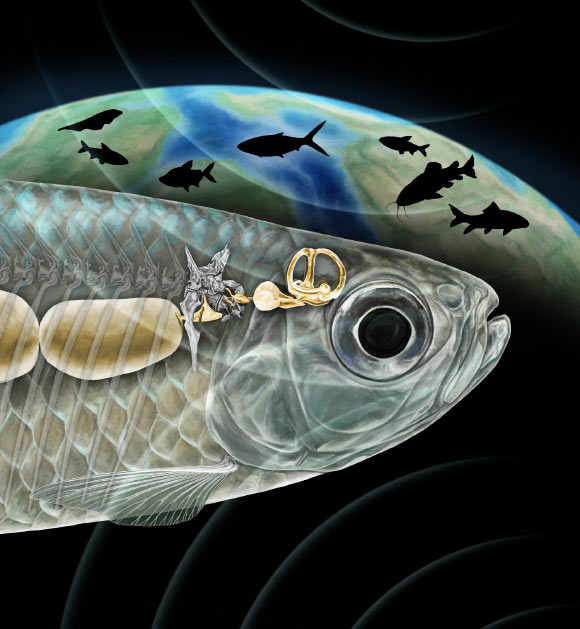
The reconstruction of the artist of the Weberian apparatus in Maccognoi acronichthys; The Weberian structure (gold bone in the center) appeared from a coast (represented in gray attached to several rear bones of the spine) and connect the air bladder from the fish (left) with the inner ear (right). Image credit: Ken Naganawa, University of California, Berkeley.
The ears that operate underwater require a different anatomy from that of the ears that detect the sound traveling in the air.
Many terrestrial vertebrates have evolved a structure similar to a tympanum which vibrates in response to sound waves.
This eardrum moves a range of Rube Goldberg type bones in the middle ear – in humans, maleus, inks and stages – which amplify the sound and prick the inner ear filled with liquid, which winds and eventually shakes up the hair that sends signals to the brain.
But the sound waves in the water pass through a fish, which has a density similar to the surrounding water.
Thus, the fish have developed a bladder filled with air – essentially a bubble – which vibrates in response to sounds crossing the fish.
These vibrations are transferred to rudimentary inner ear in most salt water fish, which limits their hearing to low notes less than around 200 Hz.
Otophysan fish, however, has developed bone “ “ “ bladder and the inner ear – a system called the Weberian device – to amplify and extend the frequency range that the ears can detect. Zebra fish, for example, can hear frequencies up to 15,000 Hz, not far from the limit of 20,000 Hz of humans.
Why these fish need to hear high frequencies is a mystery, although it can be because they live in various and complicated environments, rush rivers with static lakes.
“The reason MacCagnoi acronichthys is so exciting that he fills a gap in our Otophysans supergroup file, “said Professor Neil Banerjee, researcher at Western University.
“It is the oldest member of the group in North America and provides incredible data to help document the origin and early evolution of so many freshwater fish living today.”
MacCagnoi acronichthys lived at the end of the Cretaceous about 67 million years ago.
The authors captured micro-CT scanners of the 4 cm long fossil and examined its Weberian structure.
They also analyzed the genomes and the morphology of modern fish to revise the genealogy of freshwater fish, and also simulate the frequency response of the medium ear structure of fossil fish.
Their model suggests that, even 67 million years ago, Otophysan fish had an audition almost as sensitive as zebra fish today.
“We did not know if it was a fully functional Weberian device, but it turns out that the simulation worked,” said Dr. Juan Liu, paleontologist at the University of California in Berkeley.
“The Weberian device just has a little more output power, which means a lower sensitivity, compared to a zebra fish.”
“But the peak, the most sensitive frequency, is not too lower than that of zebra fish – between 500 and 1,000 Hz – which is not too bad at all and which means that the higher frequency audience should have been made in this old Otophysan fish.”
The discovery suggests that the transition of marine species to freshwater species occurred at least twice during the evolution of the Otophysans.
Researchers consider a new time of divergence for navy otophysans with freshwater species about 154 million years ago (late Jurassic era), after Pangea began to separate around 200 million years ago.
“The dinosaurs are quite exciting, so a lot of time and efforts have been focused on them, so we know a lot about what they were, but we have only scratched the surface when it comes to understanding the diversity of prehistoric freshwater fish,” said Don Don Brinkman, a preservative emeritus of the Royal Tyrell Museum.
“There is still so much that we do not know, and a fossil site here in Canada gives us the key to understanding the origins of groups that now dominate rivers and lakes around the world.”
An article describing the results was published on October 2 in the journal Science.
_____
Juan Liu and al. 2025. Marine origins and freshwater radiation from Otophysanes fish. Science 390 (6768): 65-69; DOI: 10.1126 / Science.adr4494


