Oklahoma lawmakers want free speech training after OU essay case

An Oklahoma student’s failure to pass an essay on gender roles captured the attention of millions across the country in November and sparked a wave of backlash among right-wing Americans.
Now, some Republican lawmakers say they are trying to change state law to protect students from possible bias based on political beliefs at state universities. The proposals would strengthen free speech training at state universities and punish institutions that fail to adopt certain grading criteria.
The two figures at the center of the controversy at the University of Oklahoma — instructor Mel Curth and student Samantha Fulnecky — are still feeling the effects of their story that made headlines across the country and created a national debate over free speech.
Curth said that while requiring such policies seems like common sense, such laws actually censor professors.
“It creates a slippery slope reducing the academic rigor of courses, devaluing the work that goes into the degrees earned by a university, and censoring a teacher’s First Amendment rights to free speech in his or her own classroom,” Curth said in his first public remarks since the essay controversy engulfed his life.
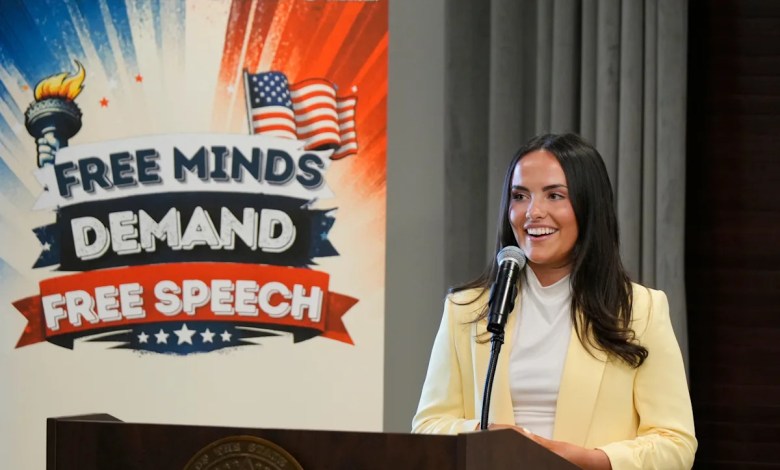
The state Senate overwhelmingly advanced House Bill 1726, which would require universities to develop a free speech training program for graduate instructors. The measure passed Wednesday, March 25, moments before Fulnecky addressed a small group of supporters at the Capitol who had gathered there to rally in support of free speech on campus.
More: Mel Curth appeals OU decision to remove her from teaching after writing

Samantha Fulnecky speaks March 25 at the Americans for Prosperity Oklahoma (AFP-OK) rally to defend free speech on the Oklahoma State Capitol campus.
Fulnecky, a junior at OU, gained notoriety after filing a complaint against Curth, who gave her a zero on an essay assignment in which she used her Christian beliefs to defend gender norms.
At the rally at the Capitol, she said she hoped her story could be a source of encouragement to others.
For many Republicans, Fulnecky’s case was an example of conservative censorship on college campuses. But many instructors, graduate students and people across the country felt the essay was poorly written and condemned any disciplinary action against Curth for the grading decision.
OU ultimately removed Curth from his teaching duties in December after the instructor said Fulnecky failed to use empirical evidence and called parts of his essay offensive.
What does SB 1726 do?
Along with free speech training, SB 1726 would require universities to teach graduate teaching assistants about classroom management, teaching practices, grading standards and student accommodations. It was authored by Sen. Julie Daniels, R-Bartlesville, and Rep. Chad Caldwell, R-Enid.
Daniels told The Oklahoman that after the murder of right-wing activist Charlie Kirk and the essay incident at OU, she discovered that many graduate programs don’t teach graduate assistants how to teach before assigning them classes. She said she drafted SB 1726 with help from both deans at OU and Oklahoma State University.
Daniels added that she believes the recent incidents could have been avoided with proper training.
“The training will protect the free exchange of ideas and respectful debate and disagreement between students and instructors,” she said. “This is the mark of a classic ‘liberal’ education in our republic.”
The bill passed 41-7 in the Senate and is headed to the House for consideration. Sen. Jo Anna Dossett was the only Democrat who voted in favor.
On the same day that SB 1726 advanced through the Senate, the Oklahoma chapter of Americans for Prosperity held a pro-free speech rally at which Fulnecky and other supporters spoke to a sparse audience.
Americans for Prosperity is a conservative advocacy group funded by the Koch network. The group is known as a large and well-funded counterpart to labor unions and progressive activist organizations.
A spokesperson for the group did not respond to a message seeking comment about the rally.
Since Fulnecky’s story became publicized late last year, Fulnecky said campus life has returned to normal. She said she sometimes notices mean looks, but it doesn’t bother her.
“It’s not necessarily easy to stand up for what you believe in, but it’s very necessary,” Fulnecky said.
Several bills addressing freedom of expression in universities
The free speech bill passed on March 25 is just one of several bills aimed at ensuring free speech at universities.
The Senate also passed a measure on March 25 that would direct the Oklahoma Free Speech Committee to develop free speech training to be completed by all freshmen.
“The real world is a marketplace of ideas,” said the bill’s author, Sen. Ally Seifried, R-Claremore. “When students are exposed to different points of view and encouraged to think for themselves, they are better prepared for life after graduation.”
During debate on the bill, Senate Minority Leader Julia Kirt, D-Oklahoma City, equated the training with trainings on diversity, equity and inclusion, which Republicans have not defined.
“What I find is that free speech seems to apply to some, but not all, issues when it comes to educating our students,” she said.
Daniels and Caldwell also authored House Bill 3700, which would prohibit students from being evaluated on their opinions and beliefs.
Caldwell serves on the Oklahoma State Regents’ Committee for Free Speech in Higher Education, which was created by law in 2022 from a measure authored by Rep. Enid. He told The Oklahoman that’s where House Bill 3700 came from.
“It should be a baseline level of protection that every student should know that they will not be negatively affected if they have a different personal opinion than their professors,” Caldwell said.
The measure would direct state regents to withhold public funds from any institution that does not adopt this policy.
More: Stay informed about Oklahoma politics. Sign up for the Capitol Report newsletter
Caldwell said he met with the OU administration before the drafting situation unfolded and was already planning to introduce the bill. He added that in his opinion, if the policy had been in place at OU, the situation could have been avoided.
Curth said she believes in a student’s right to fair grading processes, but she fears the bill will instead be used to justify violating instructors’ First Amendment rights to grade assignments however they see fit. She added that she feared the bill would encourage bad actors to hold university funding hostage to “justify substandard work.”
“Furthermore, there are growing tensions between academic and scientific consensus and the political beliefs of many Americans, and I fear that this bill will further justify the anti-intellectualism and censorship of academics, historical hallmarks of the rise of authoritarianism,” Curth said.
Caldwell said he didn’t think the bill would impact most professors because he didn’t think many of them were grading students unfairly. Those who are should not be teaching in Oklahoma, he added.
“It really shouldn’t be a conservative or liberal deal,” Caldwell said. “We should not want our students to benefit if they have a point of view that agrees with that of their professors, but neither should they be negatively affected if they have a difference of opinion.”
This article originally appeared on Oklahoman: Former OU instructor Mel Curth speaks out as GOP advances campus speech laws.


