Oligocene-Period Fossils Provide Evidence of Pollination Interaction between Flowers and Bumblebees


Paleontologists have detected fossil flowers and 24 million years of bees from the late Oligocene of Enspel, Germany, and have identified a new species of Linden, Tilia MagnasePalaas well as two new species of bumblebees, Bombus (Kronobombus) Messegus And Bombus (Timebombus) Paléociter. The presence of the same pollen of Tilia in the flowers and adhering to the outside of the Bourdons provides direct proof of their interaction and the role of Bombus As a pollinator for Tilia by at least the late oligocene and persistent so far.
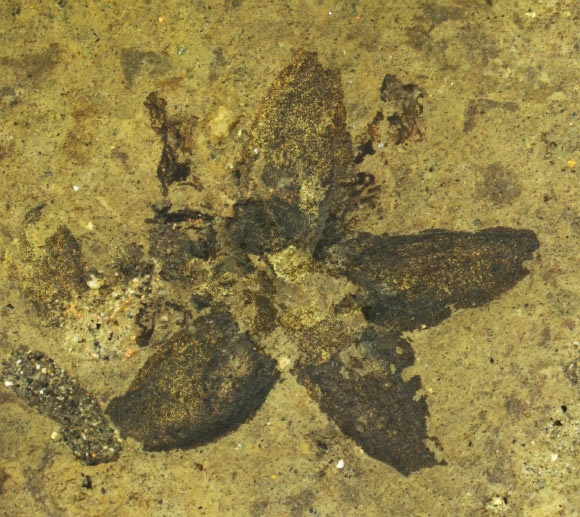
Tilia MagnasePala. Image credit: Christian Geier.
“We have examined hundreds, even thousands of fossil flowers and insects for pollen in the hope of understanding the evolution of flowers, flower visitors and pollination,” said Dr. Friðgeir Grímsson, researcher at the University of Vienna.
“These microscopic pollen grains were made visible using UV and blue light, then extracted individually, either in flower tufts or insect hair using a very small fine needle in a mini-invasive procedure.”
After meticulous cleaning of pollen grains, they were analyzed using high -resolution and electronic microscopy.
Some of the flowers examined came from the Linden tree, and many Bourdons had visited Linden Flowers before drowning in an old volcanic and fossilized lake.
“The newly discovered Linden flowers have been named Tilia MagnasePala“Said Christian Geier, doctoral student at the University of Vienna.
“Two new species of Bumble Bee have also been named: Bombus (Kronobombus) Messegus And Bombus paleociter (Timebombus). “”
The fossils were found during excavations in the sediments of the lake of the old volcanic lake near Enpel in Rhineland-Palatinate, Germany.
“”Tilia MagnasePala Flowers are the first of the genus of the European continent to be recorded and described according to the palynological criteria-that is to say the science of pollen, “said the researchers.
“The fossil bumblebees are among the oldest representatives of their genre; A single species of Colorado, the United States, is older. ”
“It is the first time in the world that a fossil flower and its pollinated bees are described in the same sediments and directly linked to each other using pollen,” said Geier.
“This type of research has great potential to shed light on our knowledge of the pollinators of the past.”
The fossil file gives an overview of dynamic developments in the past: changes due to climate change, extinction of species and evolutionary adaptations.
The analysis of fossil groups and plant groups makes it possible to draw conclusions on their behavior and their response to environmental changes.
“In our study, we were able to identify a certain degree of constancy of flowers in the bumblebees we have studied,” said Geier.
“This means that they visit only one type of plant during a single flight.”
“Results like these are important to better understand the delicate interaction and the resilience of today’s ecosystems.”
The study was published today in the journal New phytologist.
_____
Christian Geier and al. 24 million years of pollination interaction between the European flowers of Linden and the Bourdons. New phytologistpublished online on September 22, 2025; Doi: 10.1111 / NPH. 7053