A Lone Wolf Outsmarted Hunters in the Black Forest and Then Vanished

The article Lone Wolf Outwitted Hunters in the Black Forest Then Disappeared appeared first on AZ Animals.
Quick take
-
THE Black Forest Wolf evaded hunters for almost a month.
-
THE inability to track and kill the wolf living in the Black Forest led the authorities to decide not to renew the permit for its slaughter.
-
THE majority of 180 reported encounters were non-threatening.
-
There is only four wolves that call the Black Forest home.
It is not uncommon to see wolves in various regions of Germany. As a rule, these wolves are more afraid of people than people. But one wolf, known as GW2672m, showed atypical behavior. He wasn’t afraid of people or dogs. Therefore, after several reports of close encounters, a permit was issued to shoot the wolf.
For almost a month, the hunt for GW2672m was on. To the surprise of many, the wolf proved more resourceful than expected. As a result, the Black Forest wolf escaped culling and its current whereabouts are unknown.
Wolf escapes slaughter after escaping hunters in Black Forest
Over the past decade, a few wolves have started to live in the Black Forest. A peculiar wolf living in the Black Forest appeared in early 2026, in and around Baden-Württemberg, Germany. At first, this observation was a novelty. But after weeks of reports that the wolf was coming uncomfortably close to residents and their dogs in and around Baden-Württemberg, a total of more than 180 animals, authorities took steps to allay fears. Authorities said the wolf, known as GW2672m, would be put down.
In January 2026, authorities announced that a permit would be issued to kill GW2672m. While the majority of the wolf’s encounters with humans were classified as non-threatening, many believed that as GW2672m became more comfortable around people, these encounters would change.

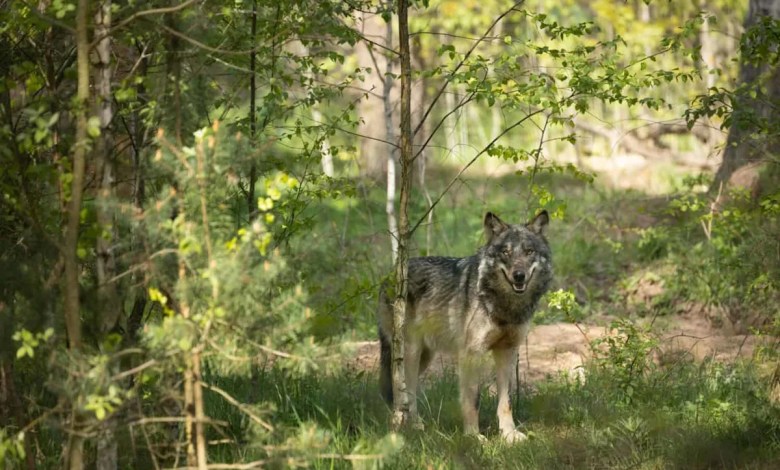
GW2672m, similar to this wolf, has been the subject of more than 180 reports of close encounters in and around the Black Forest, prompting authorities to issue a permit for its cull.
©Menno Schaefer/Shutterstock.com
(Menno Schäfer/Shutterstock.com)
As of February 18, 2026, the permit became active. Professional hunters were hired to track down and kill GW2672m. However, this meant that hunters had a lot of territory to cover to find a wolf. The Black Forest region covers more than 2,320 square miles. With only a small number of wolves known to pass through the Black Forest and an even smaller number living there, finding a wolf, let alone GW2672m, would be like finding a needle in a haystack.
As March approaches, reports of sightings of GW2672m have declined significantly. As the permit deadline approached, no one could locate GW2672m. For this reason, the wolf avoided being killed and conservationists rejoiced at this news.
Why the authorities did not renew the hunting license
GW2672m frequently approached people walking their dogs in and around Baden-Württemberg near the Black Forest. This left many people worried about how comfortable the wolf was around people. But as March approached, GW2672m disappeared. Many are therefore wondering if the permit that had been issued by the authorities earlier in 2026 would be renewed.

After GW2672m escaped hunters for the duration of the active permit period, authorities did not renew the felling permit.
©Richard Juilliart/Shutterstock.com
(Richard Juilliart/Shutterstock.com)
The permit, initially issued on February 18, 2026, was only active until March 10, 2026. As GW2672m was not seen in early March, authorities saw no need to extend the permit. They thought GW2672m was looking for a mate during mating season. With no known female wolves in the Black Forest, authorities concluded that GW2672m may have been stalking dogs in heat. This caused him to approach dogs and their owners in uncomfortable ways.
Although GW2672m made its presence known in Baden-Württemberg, it did not attack anyone. This likely also had some influence on the permit not being renewed beyond its initial March 10 expiration.
What caused the disappearance of wolves in Germany?
Wolves have been part of the Earth’s landscape for thousands of years. For part of this time, dogs coexisted with humans. Depending on cultures, some feared wolves, while others worshiped them.

Wolves were almost eradicated from Germany in the late 1800s, with the last wolf killed in 1904.
©Richard Juilliart/Shutterstock.com
(Richard Juilliart/Shutterstock.com)
Over time, cultures that found wolves a nuisance managed to reduce wolf populations to a fraction of their former numbers. In some areas, wolves have disappeared. One such country was Germany, where wolves were declared extinct in the early 1900s.
Germany considered wolves a threat to livestock. Thus, thanks to legal programs, wolves were systematically killed throughout the 19th century. The last wolf killed on German soil was in 1904. At that time, wolves were considered extinct in the country.
Wolves are returning to the Black Forest in small numbers
After wolves disappeared from Germany, it took more than a century for the first pair to return to the country in the late 1990s. These wolves would eventually lead others in the northwest region of the country to enter and form packs.
The Black Forest region in the southwest of the country did not see a return of wolves until much later. The first known wolf to return to the Black Forest did so only in 2015.

There are only four wolves living in the Black Forest.
©Michal Ninger/Shutterstock.com
(Michal Ninger/Shutterstock.com)
Over the years, there has been some excitement about wolf sightings in the area. By 2023, many were wondering if a pack was forming, given the appearance of a wolf in camera trap footage that clearly showed she was actively breastfeeding. This did not happen as no packs were found the following year.
Today, only four wolves live in the Black Forest. While GW2672m has made its presence known over the past few months, it has now retreated into the depths of the forest, or perhaps even crossed the borders of the countryside, and has not been seen in over a month.
Is wolf hunting legal in Germany?
Until December 2024, wolves were considered “strictly protected” due to their status as an endangered species in Europe. That month, the Council of Europe decided to relax protection for wolves, classifying them as “protected.” This allowed countries in Europe to take action and authorize wolf hunting, if they wish.
At the end of 2025, Germany adopted an amendment to the wolf hunting ban, allowing their hunting with an appropriate permit. These permits allow wolf hunting between July 1 and October 31.

Between July 1 and October 31, wolf hunting can be legally permitted in Germany.
©ambquinn/Shutterstock.com
(ambquinn/Shutterstock.com)
Conservationists have sounded the alarm by allowing wolf hunting across Germany because wolf populations have not rebounded at the same rate across the country. In the Black Forest region of southwest Germany, only four individual wolves are known to inhabit this territory. Conversely, in northwest Germany, at the start of 2025, there were 54 known wolf packs. There is a staggering population difference between the two regions.
This gap in wolf populations in Germany is recognized throughout Europe. For this reason, wolf populations were not considered “recovered.” Yet, as conservationists point out, politicians consider entire countries to have recovered because of the political pressure they face from farmers and ranchers who continue to lose livestock as wolf populations rise. Environmentalists say that if Germany implemented wolf deterrent measures that have proven successful in countries like Austria and Switzerland, livestock losses would be significantly reduced.
The role of wolves in livestock loss
It is undeniable that in regions where wolf populations are returning, the risk is greater for the livestock of ranchers and farmers. Due to livestock losses in recent years, some politicians and those who rely on livestock for their livelihood welcome the change in law allowing wolf hunting.

As the wolf population has increased in Germany, so have the killings and injuries of livestock.
©Rudmer Zwerver/Shutterstock.com
(Rudmer Zwerver/Shutterstock.com)
In Germany, grazing livestock suffer much greater losses than larger livestock. In particular, sheep and goats are most often targeted by wolves, accounting for 91.1% of livestock losses in 2024. While these figures have continued to increase since the return of wolves to Germany in the early 2000s, it is only more recently that several thousand heads of livestock have been killed or injured each year across the country. These figures include:
-
2022: Around 4,400 head of livestock killed or injured
-
2023: Around 5,700 head of livestock killed or injured
-
2024: Around 4,300 head of cattle killed or injured
Farmers, ranchers and ranchers are compensated for proven losses caused by wolves. This represented $27.2 million in reimbursements in 2024. With the ability to hunt wolves from July to October, many believe the number of wolf attacks will decrease and therefore less money will have to be paid.
In countries around the world, wolf populations are increasing thanks to conservation efforts that have allowed them to return to their ancestral lands. The return of wolves has sparked debates about the need for their conservation and the need for population control measures. These same arguments led to the hunting of a single wolf in the Black Forest, although there was no evidence of an attack. Luckily for the wolf, he escaped. However, if he is located during the hunting season in Germany, he or one of the three other wolves that inhabit the Black Forest may not be so lucky.
The article Lone Wolf Outwitted Hunters in the Black Forest Then Disappeared appeared first on AZ Animals.


