Online bettors mint money on Elon Musk’s misses


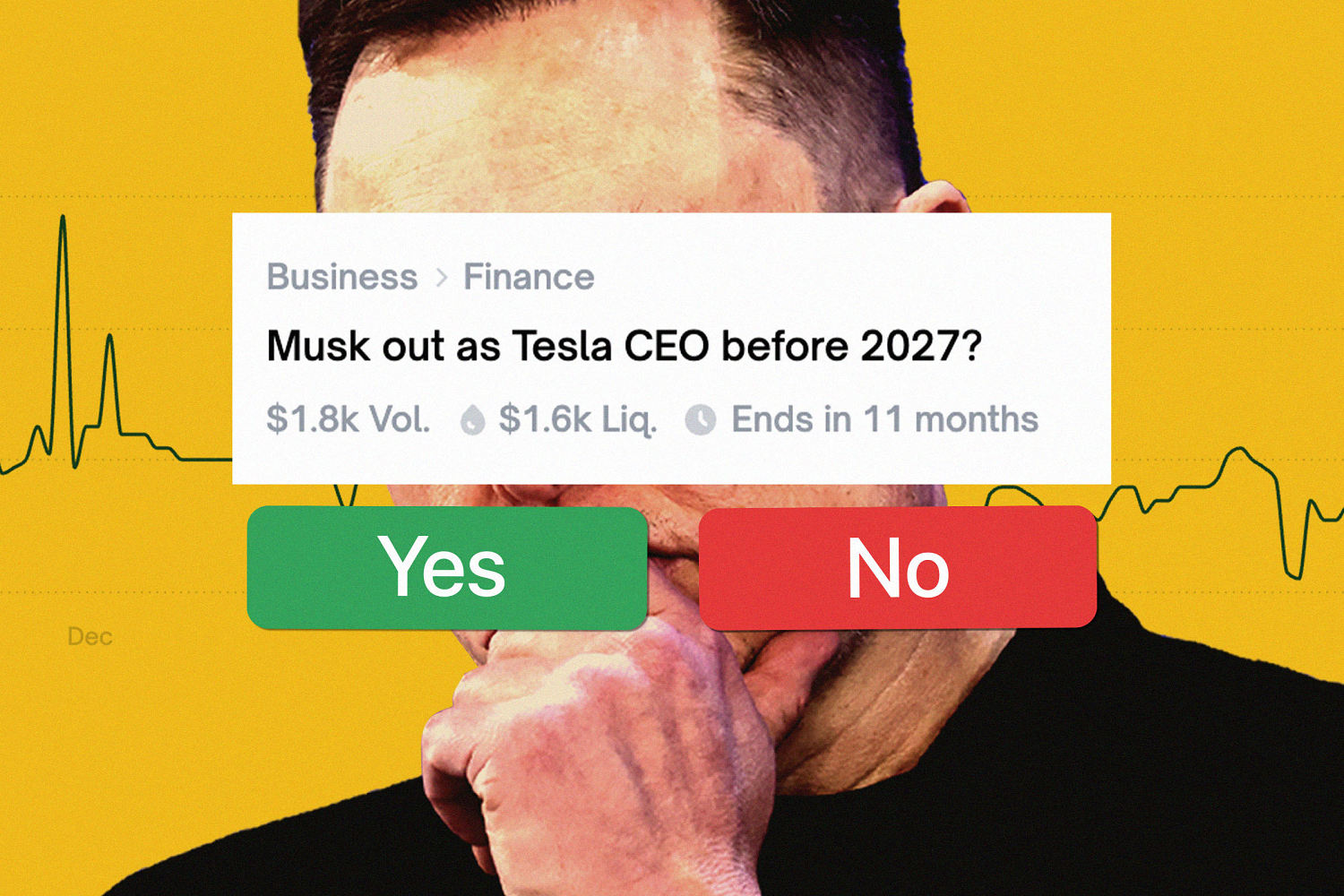
There is a popular saying among fans of tech billionaire Elon Musk: never bet against him.
But in the booming world of online prediction markets, some people are not only betting against Musk, but also making big winnings doing so.
On prediction sites Kalshi and Polymarket, some punters are winning tens of thousands of dollars betting that Musk will fail to realize his many ambitious – but so far unrealized – plans, including a robo-taxi service in California and a third political party in the United States.
Musk, CEO of Tesla and SpaceX, has for years issued sweeping public statements on social media, podcasts and earnings calls. His record is notoriously spotty, with his broken promises about self-driving cars becoming a meme in their own right. His car service in California still has humans in charge, and his idea for a political party seems dormant. And yet he also oversaw the creation of reusable, self-landing rockets and the meteoric rise of Tesla.
Today, the accuracy of his boasts is being tested in real time as prediction markets grow in popularity.
David Bensoussan, a Polymarket user whose account is No. 51 on the site’s all-time earnings rankings (what many call a “whale” for their big bets) as of Friday, said he didn’t believe Musk when, during a breakup with President Donald Trump last summer, he threatened to form a new political party. So he bet almost $10,000 that Musk wouldn’t follow through. He made a 10% return while Musk did not.
Bensoussan said he was not a fan of Musk and took some pleasure in winning bets against those who might have been won over by the tech baron.
“He has a strong fan base, so if I can help them get some of their money back, I’m always happy to do that,” he said in a telephone interview from Europe, where he is based.
This wasn’t the only time Bensoussan bet against Musk. He correctly bet that Musk would not buy the MSNBC cable channel after mulling the idea, that Musk would leave his post at the White House in May, and that Tesla would fail to launch a new version of its “Full Self-Driving” software – one that would not require human supervision – before Musk’s target date of December 31.
“He has poor impulse control,” Bensoussan said.
“He has a habit of exaggerating deadlines, saying he’s going to do incredible things and attaching more immediacy than what his intention may necessarily be,” he said.
This is the opposite of the prevailing attitude among Musk’s friends and fans, who often repeat some version of: “You should never bet against Elon.” Peter Thiel, a billionaire technology investor and friend of Musk, used the phrase in late 2024 as Musk prepared to begin his difficult tenure in the White House.
Musk, the world’s richest person, did not respond to a request for comment, but he scoffed at his predictions.
“Now, certainly, I’m sometimes a little optimistic,” he said at Tesla’s 2024 shareholders’ meeting, provoking laughter from the audience. “I’m not completely lacking in self-awareness. But if I wasn’t optimistic, this wouldn’t exist, this factory wouldn’t exist.”
In total, Bensoussan bet on 12 prediction markets linked to Musk or Tesla and made more than $36,000 on bets that ended on Friday. He bets primarily on political topics – correctly betting that then-President Joe Biden would not resign from office, for example – and made $1.4 million in profits at any given time on Polymarket, where the bets are made public. He describes himself as a “PhD dropout” with a master’s degree in political science.
Prediction markets have seen renewed interest since 2024, when a federal appeals court cleared the way for “event contracts” such as betting on election results. Polymarket and Kalshi, the two largest platforms, have since become more widespread by announcing partnerships with Dow Jones, CNBC and the National Hockey League.
Markets have come under increased scrutiny as they have allowed betting on global conflicts, including Trump’s threats against Greenland. A Polymarket bet on toppling Venezuela’s president has fueled concerns about possible insider trading, and November’s midterm elections could spark more interest in the websites.
Musk appears to be a fan of prediction markets and has frequently posted about it on X. His artificial intelligence company, xAI, has integrations with Kalshi and Polymarket.
Polymarket and Kalshi highlight dozens of Musk-related topics at any given time, far surpassing interest in other public figures such as Vice President JD Vance. Only Trump is the subject of more prediction markets, according to NBC News research. As of Thursday, there were 53 prediction markets on Polymarket related to Musk or his companies and 46 on Kalshi.
Musk-related betting topics are varied. People are not only betting on whether Musk will deliver on promises like self-driving cars, but they are also betting on how many times he will tweet in a week, whether he will become a billionaire this year, and whether he will buy a major sports team.
Both Kalshi and Polymarket have employees responsible for creating new markets, although they also say that ideas often come from the site’s users themselves.
New ways to bet on Musk appear almost daily. After Musk posted on X on January 16 that it would be a “good idea” to buy Irish airline Ryanair amid a feud with its CEO, Kalshi and Polymarket began betting on his success.
“Markets like things where there’s a lot of news happening, and more than anyone I can think of, on any given day there’s almost always something happening with Elon Musk,” said Koleman Strumpf, an economics professor at Wake Forest University who studies prediction markets.
Strumpf said prediction markets convey different information than the traditional stock market, providing a sort of reality check on all predictions.
“What these markets can potentially provide is a really good way to discipline people who make claims,” he said.
The stock market has forgiven Tesla in recent years as the company missed deadlines and experienced weakening vehicle sales. Tesla remains the world’s most valuable automaker by market capitalization, with a stock price far higher than its profits alone might indicate. Over the past year, Musk has tried to reassure investors by shifting the company’s focus toward robo-taxis and humanoid robots.
But prediction markets are both more skeptical and more detailed about what to expect from Tesla. Bets on Kalshi on Friday indicated a 14.5% chance that Tesla would launch its humanoid robot, Optimus, this year.
On rare occasions, the Polymarket and Kalshi markets appear to contradict each other. On Friday, Polymarket showed a 68% probability that Tesla would launch unsupervised “fully autonomous driving” by June 30 — something Musk said he thought would be delivered by the end of 2025. But on Kalshi, a similar market showed a 100% probability, after Musk said a day earlier that he was removing human safety monitors from robotaxis in Texas.
The difference appears to be in the fine print of how the two sites define “unsupervised.” A video on social media showed a driverless robo-taxi being followed by another Tesla vehicle, and under Polymarket’s rules, a mode of driving that requires a human “on site” to “remain ready to intervene” is not considered “unsupervised.” The language on Kalshi was different – although on both sites the comments sections were filled with arguments about the results.
A Kalshi spokesperson said Friday that the company finalized the deal based on reports from Bloomberg and Reuters.
Polymarket did not respond to requests for comment. Unlike Kalshi, Polymarket does not resolve disputes alone. Instead, the final say goes to anonymous holders of a digital token known as UMA. Token holders can take up to four days to vote on how to resolve a market.
Musk helped fuel prediction markets about him. This month, after Kalshi posted an article on X about Musk’s lawsuit against OpenAI, Musk responded: “What are the chances?” The Kalshi account responded with a link to its website, which Musk then shared with his 232 million followers.
At one point, Musk may have cost his fans money in a prediction market by intervening. Last June, when Polymarket gave Tesla only a 14% chance of launching a robot taxi service that month, Musk posted on X that it was a “money-making opportunity.” The odds on Polymarket have almost tripled to around 40%. But the rules of the market were very specific: A robotaxi service only counted if it was open to the general public, and the service Musk launched that month in Austin, Texas, was by invitation only.
“He tweeted that it would be free money, and he didn’t even read the rules, and then he had some people burned,” said Max, a Polymarket whale based in the Netherlands who followed the incident and later posted about it at length on X.
Max, who spoke on the condition that he be referred to only by his first name for privacy reasons, verified with NBC News that he had access to two Polymarket accounts with combined profits of more than $490,000. These accounts made dozens of bets on Musk-themed prediction markets. In one bet, betting that Musk would leave his post at the White House last May, the odds were so unfavorable that he turned $363 into $5,866.
Max said he was 23 years old and studying medicine at university while devoting three to four hours a day to Polymarket and related research. When faced with a Musk-themed prediction, he said his default position was to bet against Musk.
“There are a lot of Elon Musk fans, and they tend to bet in his favor, and if you’re a little more skeptical or rational, you would kind of know that his predictions aren’t going to come true,” he said in a phone interview.
“So I think it’s always better to bet against him, just because he always exaggerates things.”


