OpenAI’s latest Codex update builds the groundwork for its upcoming super app

Last month, following a report by The Wall Street JournalOpenAI has confirmed that it is working on a desktop super app that will combine ChatGPT, its Codex coding agent, and the Atlas web browser into one cohesive experience. OpenAI is not releasing this application today. Instead, it features a major Codex update that significantly expands what this software can do. However, the new release offers a glimpse of what OpenAI hopes to build with its latest effort.
“We are building the super application in the open,” Thibault Sottiaux, head of Codex, said during a press briefing organized by OpenAI. “This release is aimed at developers. In the future, we will expand it to a wider audience.” Meanwhile, the latest version of the Codex offers developers versatile AI agents that can operate on a “larger surface area”, while being more proactive. In practice, this translates into a multitude of new capabilities, starting with computer use.
Agents inside Codex can interact with other applications on your PC. When you invite one of OpenAI’s models, you can name a specific program or let it determine the best app for the job. Using a computer is available in competing applications like Claude Cowork, but where OpenAI thinks Codex offers an advantage in this area is in the “secret sauce” it has built to allow an agent to run an application without bogging down your entire system, so you can work in tandem. At the same time, OpenAI is releasing 111 new plugins for Codex that combine skills, application integrations, and Model Context Protocol server connections to give Codex more ways to gather context and use the tools developers depend on for their work.
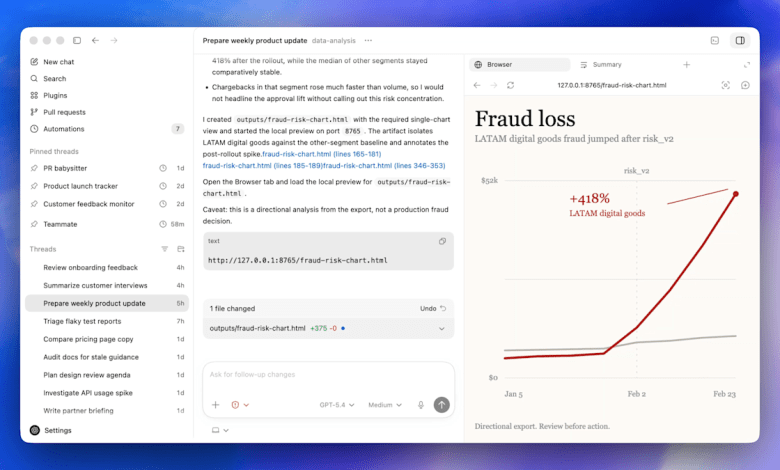
The company has also added a built-in browser, with a commenting system that lets you invite Codex to make changes to specific parts of a web page or web application you create. In the demo presented by OpenAI, a member of the Codex team used this tool to ask Codex to change the margins of a chart so that the y-axis is not cut off. Complementing this is integrated image generation. Codex can use gpt-image-1.5 to create product concepts, mockups, front-end designs, and even assets for simple games. It also allows Codex to use screenshots to verify that it is on track with a user request.
With today’s update, OpenAI is also previewing two memory features. The first allows the Codex to recall the context of previous tasks to inform how it handles future prompts. According to OpenAI, over time this will allow Codex to process requests faster and to a higher standard. The app will also use the collected context to suggest proactive actions. For example, at the start of your day, it might suggest responding to a comment a colleague left on a draft Google Doc you wrote.
If you want to try the updated Codex for yourself, OpenAI is starting to roll out the new version to desktop app users logged in with their ChatGPT account. Using a computer is first available to macOS users, with availability for people in the EU and UK to follow soon. Likewise, Brits and Europeans will have to wait to try the memory features OpenAI has integrated into Codex.


