Paleontologists Identify New Species of Flat-Headed Herbivorous Dinosaur


A new genus and species of Hadrosaurides dinosaurs who lived during the Cretaceous period in what is today new-mexic was identified and appointed by paleontologists from the United States and the Slovak Republic.
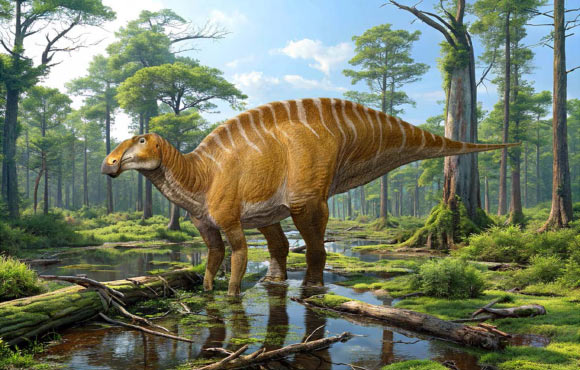
Reconstruction of the life of Ahshislesaurus Wimani Based on the holotype and closely related species. Image credit: Sergey Krasovskiy.
“Hadrosauridae, A Family of Large Herbivorous Dinosaurs, Were Among the Most Abundant Dinosaurs of Late Cretaceous Earthscreen Ecosystems of the Western Interior Basin of North America for About 20 Million Years,” Said Montana State University Paleontologist Sebastian Dalman and his colleagues from Harrisburg University, Penn State University, New Mexico Museum of Natural History and Pavol Jozef Šafárik University.
“This group, commonly known as” duck beake “dinosaurs, was one of the most diverse and successful dinosaurs groups during the Cretaceous.”
“In the last 20 years of the Cretaceous, the Hadrosaurides have obtained a global distribution and were present in Africa, Antarctica, Asia, Europe and North and South America.”
Appointed Ahshislesaurus WimaniThe new species of Hadrosaurid lived at the end of the Cretaceous, about 75 million years ago.
The fossilized bones of the dinosaur were found in the layers of the Kirtland formation in the Wilderness Ah-Shi-Sle-Pah, which is located in the county of San Juan, in New Mexico, between Chaco Canyon and Wilderness de-Na-Zin.
“The holotype specimen consists of an incomplete diagnostic skull, several isolated cranial elements, notably the right judgal, the quadrate, the dental and the overfoil, and a series of articulated cervical vertebrae,” said the researchers.
“In addition to the holotype, several specimens of the same layers can also belong to this newly identified species, including a well -preserved left dental and a partial skeleton, as well as two humeri, one belonging to a large adult and the other to a minor.”
In previous studies, Ahshislesaurus Wimani was mentioned at KritosaurusA younger genre of Hadrosaurid Saurolophin of Kirtland’s training.
The two species are relatively closely linked within the subfamily of Hadrosaurid Saurolophinae.
However, according to phylogenetic analysis, they represent two distinct groups which were present at the Campanian age of Cretaceous in the south of Laramidia.
“Stratigraphically younger Kritosaurus is a member of the Kritosaurini Clade which includes several Northern Laramid species, “said scientists.
“In addition, phylogenetic results suggest that the clade that includes Ahshislesaurus And NaashoibitosaurusAs well as two nameless species in the south of Laramidia, divided from Kritosaurini at the end of the Campanian (75 million years ago). »»
According to the team, with Naashoibitosaurus,, Ahshislesaurus Forms a potentially new group of Hadrosaurides de Saurolophine with a flat head.
“This clade suggests that the Saurolophins were a taxonomically diversified group, which, in the last 20 years of the Cretaceous, was among the dominant herbivorous dinosaurs in southern Laramidia,” said the authors.
“Recognition of a new Hadrosauride species of New Mexico also provides additional evidence of the Latitudinal variation in Hadrosauride fauna during the Cretaceous higher than Laramidia.”
The team’s document will be published in the New Mexico Museum in Natural History and Sciences.
_____
Sebastian Dalman and al. 2025. A new Hadrosaurid Saurolophin (Ornithischia: Hadrosauridae) from the Upper Cretaceous (Campanian) Hunter Wash Member, Kirtland Formation, San Juan Basin, New Mexico. New Mexico Museum in Natural History and Sciences 101


