Paleontologists Unveil New Species of Plesiosaur


Paleontologists have identified a new unusual genre and species of plesiosaur plesiosauroid divergement early of an almost complete skeleton found in the Schist of Posidonia Lower Jurassic of Holzmaden, Germany.
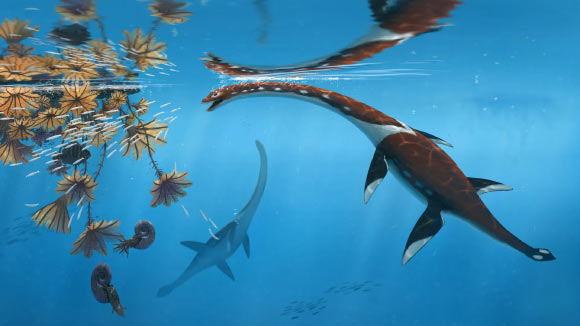
Reconstruction of the life of Longicollum Plesionects. Image credit: Peter Nickolaus.
Newly identified species, Longicollum Plesionectslived in the first seas jurassic about 183 million years ago.
The sea reptile had a length of about 3.2 m with a collar 1.25 m long and a tail 81 cm long.
His skeleton with leftover soft tissue fossilized was originally excavated in 1978 from a career in the Posidonia shale, Holzmaden, Germany, but its unique anatomical characteristics have only been fully recognized by a complete scientific analysis.
“This specimen has been in collections for decades, but previous studies have never fully explored its distinctive anatomy,” said Dr. Sven Sachs, paleontologist at Naturkunde-Museum Bielefeld.
“Our detailed examination has revealed an unusual combination of skeletal characteristics which clearly distinguish it from all the plesiosaurs previously known.”

Skeleton of Longicollum Plesionects. Scale bar – 30 cm. Image credit: S. Sachs and D. Madzia, DOI: 10.7717 / Peerj. 19665.
Longicollum Plesionects is particularly significant because it represents the oldest known plesiosaur in the Holzmaden region.
“This discovery adds another play to the puzzle of the evolution of marine ecosystems during a critical period of the history of the earth,” said Dr. Daniel Madzia, paleontologist at the Polish Academy of Sciences.
“The early period of the Toarcian where this animal lived was marked by significant environmental changes, including a major anoxic anoxic event which affected marine life in the world.”
The discovery shows that the Posidonia shale – already famous for its exceptionally preserved fossils – contained a diversity of sea reptiles even greater than that previously recognized.
“The Posidonia shale in Holzmaden previously gave five other plesiosaur species, including representatives of the three main plesiosaur lines,” said the authors.
“This new addition cements the status of training as one of the most important windows in the world in marine life Jurassic.”
The results appear online in the newspaper Peerj.
_____
S. Sachs and D. Madzia. 2025. An unusual plesiosauroid diverging early by the lower jurassic posidonia shale of Holzmaden, Germany. Peerj 13: E19665; DOI: 10.7717 / Peerj. 19665


