Paperclip-sized spacecraft could visit a nearby black hole in the next century, study claims


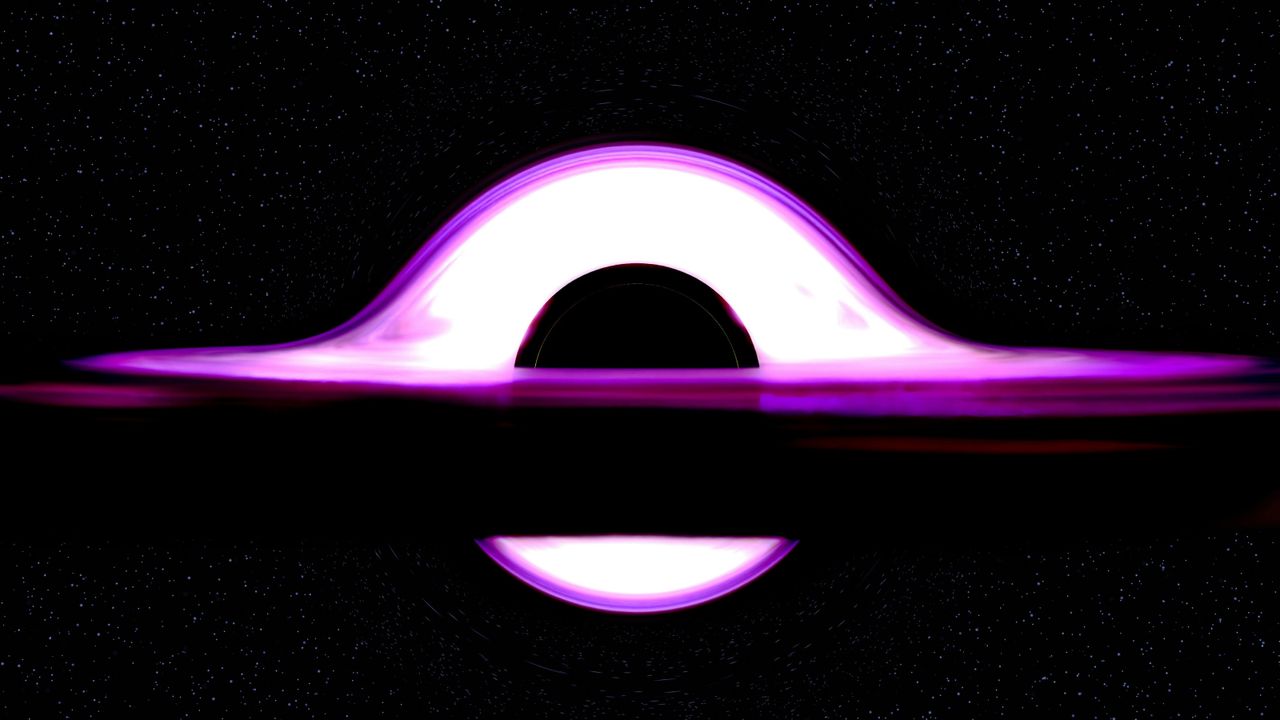
An astrophysicist made an ambitious proposal on the way in which humanity could probe the extreme physical of black holes – by sending a spacecraft either than a trombone to our closest.
The spaceship, no heavier than a gram and propelled to a third of the speed of light According to the plan, by lasers on earth, would collect information on a break near space-time over the next century.
Posted on August 7 in the journal iscienceThe plan made by the astrophysicist Cosimo Bambi At Fudan University in Shanghai, China contains many things on the sites: the most crucial, it is based on technology that does not yet exist and is based on the search for a black hole close to the earth (which has not yet occurred). However, Bambi insists that it is always worth planning.
“It may seem really crazy, and in a sense closer to science fiction”, he said in a press release. “But people have said that we will never detect gravitational waves Because they are too weak. We did it – 100 years later. People thought we would never observe the shadows of black holes. Now, 50 years later, we have Images of two. “”
In relation: See the rarest black hole type of the universe developing a star in a superb animation
Black holes were born from the collapse of giant stars and develop by constantly gorging gas, dust, stars and other black holes in the stars formation galaxies that contain them.
The ruptures of space-time are regions of space where the equations of Einstein General theory of relativity (which describe the functioning of gravity) weaken, which makes them exciting targets for scientists in search of a unified theory of gravity and physics of particles.
But the sending of a spacecraft to a black hole would first require finding a fairly close to us. Currently, the closest black hole to our planet is 1,500 light years, far away, Too much distance for humanity to send a job to make a job.
In fact, any black hole seated beyond the 50-light year distance will probably make the mission of Bambi impossible, but it points to the new gravitation Microlensage techniques which make possible the discovery of smaller and nearby black holes. If we are found closer, ideally in the 25 light years of us, it could become a target.
“There have been new techniques to discover black holes,” explains Bambi. “I think it is reasonable to expect that we can find one nearby during the next decade.”
If we find a black hole close enough, the next challenge is to get there. For this, Bambi offers the development of a nanocrat sporting a sail of 108 square feet (10 square meters), propelled to 224 million MPH (360 million km / h) from an explosion of laser light at high power to close the distance in about 70 years.
Once there, the Nanocraft would release a probe to approach the black hole while it remains in orbit, bringing the data collected on earth. Bambi stresses that today laser power would probably cost more than one dollars billion, but that costs could decrease as technology improves.
“We don’t have technology now,” he said. “But in 20 or 30 years, we could.”


