People Held Glacier Funerals in Iceland to Mourn Environmental Loss — a Ritual That Could Help Us Face Ecological Grief


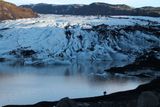
On a cloudy morning in August 2019, around 100 people climbed the side of an Icelandic mountain to say a final goodbye to a glacier. Okjökull, or Ok, once stretched across the summit, but is now reduced to a lifeless expanse of ice – glaciologists had declared it “dead” several years earlier.
Iceland’s prime minister gave a speech, locals shared their stories of drinking the glacier’s meltwater, and the crowd erected a bronze plaque to commemorate Ok’s passing, like a tombstone. It looked to the future and said in part: “We know what is happening and what needs to be done. Only you know if we have done it.”
The ceremony was very much like a funeral, complete with a mourning party. But what does it mean to mourn a glacier, a charred forest or a collapsed ecosystem?
What is ecological mourning?
These questions are becoming increasingly urgent as communities around the world grapple with environmental loss. Courtney Howard, a Canadian doctor who studies health threats from climate change, considers glacier funerals and other similar rituals expressions of “ecological mourning,” a term she helped popularize, according to a report published in The Lancet.
“It’s a normal human reaction to disturbing changes in the world we love,” Howard said. Discoversimilar to more familiar forms of grief. “It’s really the natural consequence […] “biophilia” – that is, a love of nature. This often manifests itself as “solastalgia”, a feeling of homesickness for a place that still exists but has changed dramatically.
When she experienced her first ecological loss in 2009, after witnessing rapid environmental change in the High Arctic, Howard had no words to describe what she was going through. She suspects many people feel the same way but have difficulty conceptualizing the experience. It’s important to manage these emotions, she said, just as we would after a cancer diagnosis or the death of a loved one.
Glacier funerals offer a way to overcome fear, frustration, and grief toward more productive outcomes. Another group of researchers writing in Climate change explains how these funerals can help transform climate anxiety into collective reflection and turn grief into action, a public message and even hope.
Learn more: Why are 6,000 year old artifacts suddenly resurfacing?
Expressing Climate Greif
On the other hand, Howard added, it’s difficult for her to tackle environmental issues until she resolves the ecological grief that arises within her. His life was upended again by climate change in 2023, when wildfires ravaged the land around his home in Yellowknife, the capital of the Northwest Territories. Shortly thereafter, that year’s Global Tipping Points report was released, detailing the latest irreversible trends in Earth’s climate system.
“I tried to read it while the smoke was still swirling, but I couldn’t,” she said. Discover.
It took several months before she felt ready to review the report, and even then, her grief remained unfinished. To cross the finish line, he needed his own ritual.
A year after the wildfires, Howard, a dance graduate, and two other local dancers gathered in the burned forest outside Yellowknife to film an impromptu dance. Against a backdrop of blackened trees and dusty earth, their anguished postures capture a deep despair, but also a crucial step toward healing.
“It helped me confront and manage my emotions about the wildfires in a way that I definitely hadn’t done before,” Howard said. “I remember waking up the next day feeling so much better.”
Other glacier funerals
In much of secular Western society, our ceremonial muscles have atrophied. Even if we are accustomed to the funerals of other humans, it will seem to many odd and perhaps unnecessary to extend the same treatment to landscapes.
Yet “when we look at human civilization across time and space, ceremonies are a part of it,” Howard said. “We don’t tend to keep things that aren’t useful to us.”
After Ok’s commemoration in 2019, other ice funerals followed. One took place the same year for the Pizol Glacier in Switzerland, another in 2020 for the Clark Glacier in Oregon and yet another in 2021 for the Ayoloco Glacier in Mexico. In 2024, as the rate of glacier disappearance accelerated, two Rice University anthropologists created a “glacier cemetery” near Reykjavík, marked by fifteen carved ice tombstones.
For Howard, these practices provide a powerful antidote to the despair that climate change so often evokes, as well as the loneliness of facing ecological grief alone. “It brings us into the community,” she said. “This is what we need if we want to change the systems that lead to this destruction.” »
Learn more: As glaciers retreat, powerful volcanoes could erupt more frequently across the planet
Article sources
Our Discovermagazine.com editors use peer-reviewed research and high-quality sources for our articles, and our editors review the articles for scientific accuracy and editorial standards. See the sources used below for this article: