Peru’s chaotic presidential election : NPR

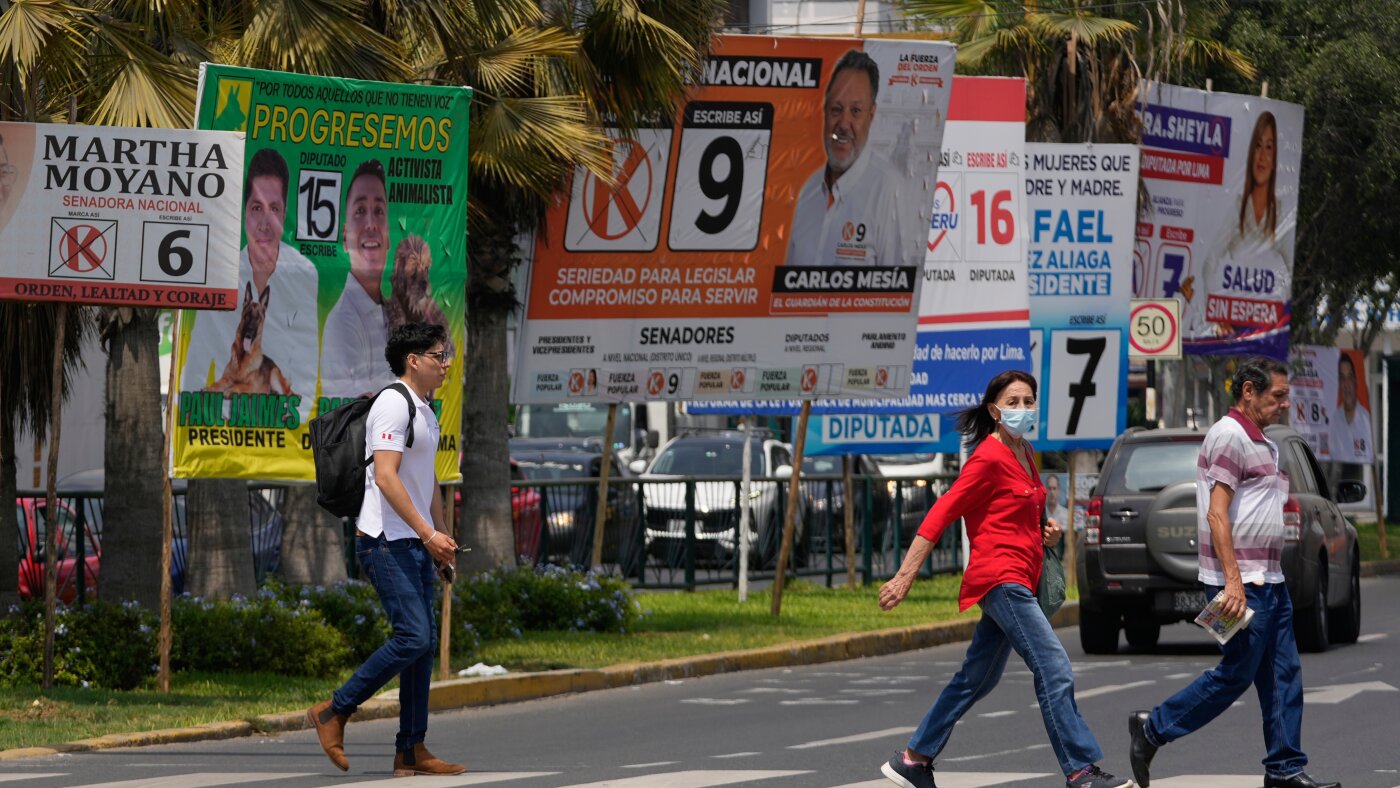

Pedestrians walk past campaign signs for presidential and congressional candidates ahead of weekend elections in Lima, Peru, April 10, 2026.
Martin Mejía/AP
hide caption
toggle caption
Martin Mejía/AP
LIMA, Peru — Even given Peru’s recent political chaos, Sunday’s elections are likely to sow confusion and frustrate the Andean nation’s 27 million voters.
A record 35 candidates are vying for the presidency – the country’s ninth leader in almost as many years, reflecting deep political instability. Voters will face a giant-sized ballot paper featuring photos of the candidates and party symbols, a long-standing practice in a society historically marked by low literacy levels.
Many of them are unknowns and barely register one percent support. But, faced with the widespread anger of the entire political class, even the handful of candidates with well-established profiles are unable to gain momentum.
This means that a June runoff election between the two main candidates is all but inevitable.
Leading the pack, but only just, is Keiko Fujimori, the daughter of the late, disgraced 1990s strongman Alberto Fujimori.
She walked a tightrope between hiding in her father’s legacy of crushing hyperinflation and the Shining Path — Maoist insurgents who killed an estimated 30,000 Peruvians — while distancing herself from his gross human rights violations and kleptocracy.
Yet even though she consistently scores around 10 percent, that figure could be both her electoral threshold and ceiling, with many Peruvians blaming her and her party for their country’s current political turmoil.

Peru’s three main presidential candidates (left to right): Rafael López Aliaga (Renovación Popular), Carlos Álvarez (País para Todos), and Keiko Fujimori (Fuerza Popular) at election rallies in April 2026.
CONNIE France,ERNESTO Benavides/AFP via Getty Images
hide caption
toggle caption
CONNIE France,ERNESTO Benavides/AFP via Getty Images
It all started in 2016, when Keiko, as he is known here, lost the presidential election, but his party, the Popular Force, won the majority of seats in Congress, paving the way for a decade of instability, including the dismissal of several ministers and presidents.
A recent poll found that 54% of Peruvians said they would not vote for her under any circumstances. Despite this, she is still likely to reach a fourth consecutive round – having done so in 2011, 2016 and 2021 – although she could be beaten again in this final round.
Behind her is a group of half a dozen other candidates, all in the mid- to high-single digits, any of whom could, with a little late push, advance to the runoff.
Among them, we can cite Rafael Lópeza Aliaga, the former ultra-conservative mayor of Lima, sometimes nicknamed “the Peruvian Trump”. He has previously made baseless allegations of imminent electoral “fraud” and issued death threats against the head of ONPE, Peru’s electoral agency.
The field also features Carlos Álvarez, a Fujimori ally better known for parodying politicians than proposing policies – underlined by his difficulty answering basic questions in recent debates.
Then there is Ricardo Belmont, an octogenarian left-wing populist whose long career has been marked by repeated sexist, homophobic and xenophobic remarks.
Polls show that the vast majority of Peruvians want fresh blood in their politics, that is to say, candidates with no connection to the current congress. He has passed several laws allegedly favorable to organized crime and has a disapproval rating close to 90%.
“It is based on the certainty that high-level corruption fueled a decade of political instability and that a tacit alliance of political leaders bent on impunity and state looting allowed organized crime to flourish in the streets,” says Samuel Rotta, who heads the anti-corruption group Accion Civica, explaining citizens’ disgust with the political class.
This is not surprising in a society plagued by an epidemic of extortion, with a record homicide rate and where the number of Peruvians suffering from food insecurity has doubled, from 25% before the pandemic to 51% today according to the World Food Program.
On Sunday, the Peruvians will have the opportunity to change course. But with a large field of candidates all struggling to get out of the single-digit field, a runoff election is almost certain.


