Physicists think they’ve solved the muon mystery


A new approach
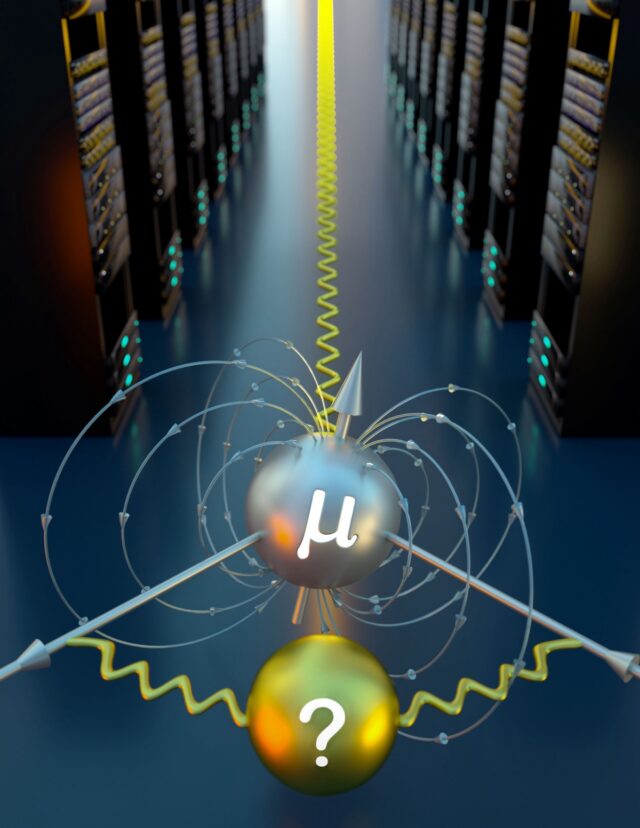
Supercomputer simulations reveal the effect of the strong nuclear force on the muon’s magnetism.
Credit: University of Wuppertal
Supercomputer simulations reveal the effect of the strong nuclear force on the muon’s magnetism.
Credit: University of Wuppertal
The latter measurement focuses on intense force effects, particularly “vacuum hadronic polarization,” which arises when quarks and gluons interact within the framework of the theory of quantum chromodynamics (QCD). The authors took a hybrid approach, combining powerful large-scale computer simulations with experimental data.
“The old methodology involved collecting thousands of experimental results and reinterpreting them to get the single number, the magnetic moment of the muon,” Fodor explained. “Our approach was completely different. We divided space-time into very small cells, a lattice, and then we solved the Standard Model equations on that basis. There was an enormous amount of theory, mathematics, programming, computer knowledge and computer architecture behind this calculation.”
It took 10 years to do these complicated calculations, but when they were done. Fodor et al. found that their results agreed with the standard model to within half a standard deviation and up to 11 decimal places. This is the most precise calculation ever made, accurate to the part per billion. Although the results do not completely rule out the possibility of new physics such as a fifth force, they further limit the areas in which new physics could lurk.
“People ask me how it feels to make this discovery and, to be honest, I feel a little sad,” Fodor said. “When we started calculating this quantity, we thought we would have a good and reliable calculation for a new fifth force. Instead, we found that there was no fifth force. We found very precise proof not only of the Standard Model, but also of quantum field theory, which is the basis on which the Standard Model was built.”
Nature, 2026. DOI: 10.1038/s41586-026-10449-z (About DOIs).


