Pinot noir’s popularity has medieval roots


March 24, 2026
2 min reading
 Add us on GoogleAdd SciAm
Pinot Noir’s Hold on People’s Taste Buds is Surprisingly Long
An analysis of ancient grape seed DNA reveals the first known case of humans in France deliberately cloning plants, including for Pinot Noir.
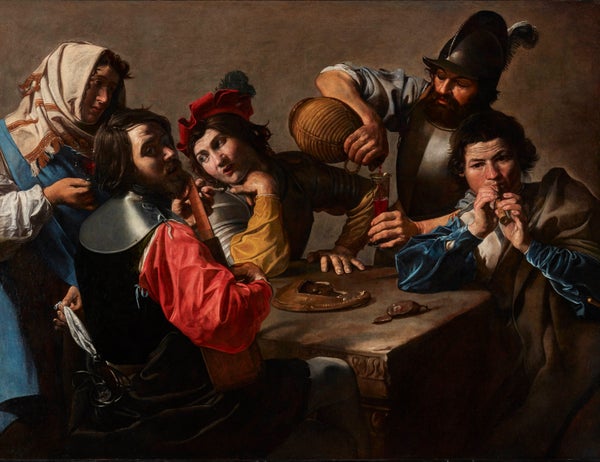
The concert, by Valentin de Boulogne, around 1615.
Heritage Art/Heritage Images via Getty Images
“In wine there is truth”, to quote a proverb cited by Pliny the Elder, the truth about humans, of course. Wine has been a staple of human consumption for thousands of years: it is depicted in the frescoes of Pompeii and celebrated in epic poems such as the Iliad and the Odyssey. It was found inside the tomb of King Tutankhamun and in traces on 9,000-year-old Chinese pottery and was described in the Bible. But despite wine’s ubiquity and enduring popularity, scientists have struggled to determine exactly when and how humans first made this beverage as we might recognize it today.
And now a new study of ancient grape seeds found across France adds to the mystery, revealing that humans have been consuming at least one grape variety for hundreds of years. The research was published Tuesday in the journal Natural communications.
The researchers analyzed the DNA of nearly 50 wild and domestic grape seeds collected from archaeological sites, mainly across France. The pips dated from about 2,300 BCE to 1,500 CE, or from the Bronze Age to the end of the Middle Ages, a period of almost 4,000 years.
On supporting science journalism
If you enjoy this article, please consider supporting our award-winning journalism by subscription. By purchasing a subscription, you are helping to ensure the future of impactful stories about the discoveries and ideas shaping our world today.
Comparing the DNA of these seeds and that of modern grape varieties revealed a “very surprising” discovery, explains Ludovic Orlando, lead author of the study and research director of the Toulouse Center for Anthrobiology and Genomics at the University of Toulouse in France. Some ancient grapes had been cloned.
Beginning in the mid-Iron Age (around 500 BCE), some grape seeds had the same or very similar DNA. This meant that winemakers in what is now France had to move from domesticating wild grapes to directly propagating them, that is, cloning vines by taking plant cuttings to create new groves. The results shed light on the history of wine in France, a region world-famous for its wine, as well as across the world.
Interestingly, one of the cloned grape samples dating back to medieval times was “genetically identical” to Pinot Noir, a grape variety widely grown today around the world, Orlando says.
“We found the same plant 600 years ago, in the 15th century,” says Orlando, “the century of Joan of Arc.” This means that not only has Pinot Noir remained popular for centuries, but people have loved it so much that they haven’t changed it much in all that time. “They kept it as it was, propagated in clone form – in photocopy form – for centuries, literally,” he says.
As for whether today’s Pinot Noir wine tastes like what medieval knights minted at the French royal court in Paris, the grape’s DNA can’t reveal much about flavor. Wine is a multifaceted product linked to the grape variety, the fermentation process, the environment and additives.
“Wine is a complex biocultural product,” explains Orlando. But DNA can shed light on certain aspects, like sugar content and grape size. Ultimately, there is much to learn about the history of wine and, as Pliny the Elder wrote, about us.
“Wine and grapes are organic and cultural. Think about your favorite wine or my favorite wine: it says something about you, as well as your culture,” says Orlando.
It’s time to defend science
If you enjoyed this article, I would like to ask for your support. Scientific American has been defending science and industry for 180 years, and we are currently experiencing perhaps the most critical moment in these two centuries of history.
I was a Scientific American subscriber since the age of 12, and it helped shape the way I see the world. SciAm always educates and delights me, and inspires a sense of respect for our vast and beautiful universe. I hope this is the case for you too.
If you subscribe to Scientific Americanyou help ensure our coverage centers on meaningful research and discoveries; that we have the resources to account for decisions that threaten laboratories across the United States; and that we support budding and working scientists at a time when the value of science itself too often goes unrecognized.
In exchange, you receive essential information, captivating podcasts, brilliant infographics, newsletters not to be missed, unmissable videos, stimulating games and the best writings and reports from the scientific world. You can even offer a subscription to someone.
There has never been a more important time for us to stand up and show why science matters. I hope you will support us in this mission.


:max_bytes(150000):strip_icc()/Health-GettyImages-1169322229-ff1658cf7d0a4714a7272ae9b995d122.jpg?w=390&resize=390,220&ssl=1 "8 Ways to Soothe A Tanning Bed Rash Naturally")