Why a January Heat Wave Is Breaking Records across the South


January 8, 2026
2 min reading
 Add us on GoogleAdd SciAm
January feels more like summer in some US states. Here’s why
A high pressure area is causing record heat in parts of the United States, made worse by climate change.
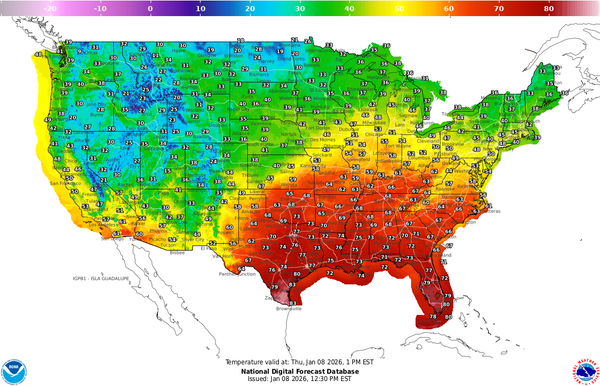
A map of forecast temperatures for the contiguous United States on January 8, 2026.
It’s January, which usually means heating bills rise as the temperature drops. But for some people in the southern United States, the demand will be for more air conditioning, as temperatures climb 20 to 35 degrees Fahrenheit (11 to 19 degrees Celsius) above average — and even to record highs in some places.
The unusual heat is coming from an area of high pressure moving across the eastern United States, drawing warm air from the south and record warm waters from the Gulf of Mexico.
The first records began to occur due to the weather system on Tuesday, with a high of 82 degrees F (28 degrees C) in Houston, Texas, 74 degrees F (23 degrees C) in Tulsa, Oklahoma, and 81 degrees F (27 degrees C) in Baton Rouge, Louisiana.
On supporting science journalism
If you enjoy this article, please consider supporting our award-winning journalism by subscription. By purchasing a subscription, you are helping to ensure the future of impactful stories about the discoveries and ideas shaping our world today.
Large swaths of the eastern United States will experience temperatures well above average – and some could set records. In Texas’ Rio Grande Valley, temperatures could even reach 90°F (mid-30°C). Brian Hurley, a meteorologist with the National Weather Service’s Weather Prediction Center, says 31 stations across this area could set or come close to records. “It’s important,” he said.
The nights will be particularly warmer than normal, a sign of global warming. Nighttime minimums are increasing twice as fast as daytime maximums, according to Climate Central, a nonprofit research and news organization.
Climate Central’s Climate Shift Index tool calculates that the high temperatures seen during this January heat event were made 1.5 to five times more likely due to climate change, depending on the day and location.
The system follows a heat wave that swept across the southern United States late last year; The December 25, 2025 average high temperature for the contiguous United States was the warmest Christmas day on record, by a margin of three degrees F (1.7 degrees C). This may not seem like much, but it’s a lot of money to set a record, especially over such a large area.
This last heat will be short-lived; a cold front will cross the United States ahead of a low pressure system. Temperatures after the front should return to normal.
It’s time to defend science
If you enjoyed this article, I would like to ask for your support. Scientific American has been defending science and industry for 180 years, and we are currently experiencing perhaps the most critical moment in these two centuries of history.
I was a Scientific American subscriber since the age of 12, and it helped shape the way I see the world. SciAm always educates and delights me, and inspires a sense of respect for our vast and magnificent universe. I hope this is the case for you too.
If you subscribe to Scientific Americanyou help ensure our coverage centers on meaningful research and discoveries; that we have the resources to account for decisions that threaten laboratories across the United States; and that we support budding and working scientists at a time when the value of science itself too often goes unrecognized.
In exchange, you receive essential information, captivating podcasts, brilliant infographics, newsletters not to be missed, unmissable videos, stimulating games and the best writings and reports from the scientific world. You can even offer a subscription to someone.
There has never been a more important time for us to stand up and show why science matters. I hope you will support us in this mission.


