ALMA Detects Heavy Water in Planet-Forming Disk around Distant Protostar


Astronomers using the Atacama Large Millimeter/submillimeter Array (ALMA) have detected doubly deuterated water (D2O), or “heavy water”, in the protoplanetary disk around V883 Orionis, a protostar located 1,300 light years away in the constellation Orion. This detection reveals that some of the water found in comets – and perhaps even on Earth – is older than the disk star itself, providing a revolutionary insight into the history of water in our own solar system.
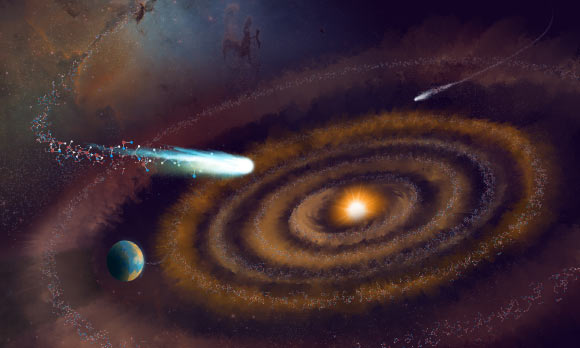
This artist’s impression shows the evolution of heavy water molecules as they were observed in giant molecular clouds, a planet-forming disk, and comets – before they finally reached Earth. Image credit: NSF / AUI / NRAO of NSF / P. Vosteen / B. Saxton.
The water may have been brought to Earth via cometary and/or asteroid impacts, tracing the pristine material left behind by the protoplanetary disk from which our solar system originated.
However, it is not clear whether the water ice on these bodies formed primarily, for example, in the protoplanetary disk phase, or whether it is much older and originates from the parent molecular cloud.
“Our detection demonstrates beyond doubt that the water observed in a planet-forming disk around V883 Orionis must be older than the central star and formed in the early stages of star and planet formation,” said Dr Margot Leemker, an astronomer at the University of Milan.
“This represents a major advance in understanding the journey of water through planet formation and how this water made its way to our solar system, and perhaps to Earth, through similar processes.”
The chemical fingerprint of heavy water shows that these water molecules survived the violent processes of star and planet formation, traveling billions of miles through space and time before ending up in planetary systems like ours.
Instead of being destroyed and reformed within the disk, most of this water is inherited from the earliest, coolest stages of star formation, a cosmic legacy that may also be present on Earth today.
“Until now, we didn’t know whether most of the water in comets and planets formed freshly in young disks like V883 Orionis, or whether it was ‘virgin,’ coming from ancient interstellar clouds,” said Dr. John Tobin, an astronomer at the NSF National Radio Astronomy Observatory.
“Detection of heavy water, using sensitive isotopologue ratios (D2OH2O), proves the ancient heritage of water and constitutes the missing link between clouds, disks, comets and, ultimately, planets.
“This discovery is the first direct evidence of interstellar travel of water, from clouds to the materials that form planetary systems, unchanged and intact.”
The team’s paper was published this week in the journal Natural astronomy.
_____
Mr.Leemker and others. Pristine ice in a planet-forming disk revealed by heavy water. Nat Astronpublished online October 15, 2025; doi: 10.1038/s41550-025-02663-y


