Pulsing Magma in Earth’s Mantle Drives Tectonic Plates Tearing Africa Apart


Magma’s impulses tear Africa
The chemical fingerprints of volcanic rock offer clues of what is happening in the mantle under the area where three rift zones meet in East Africa
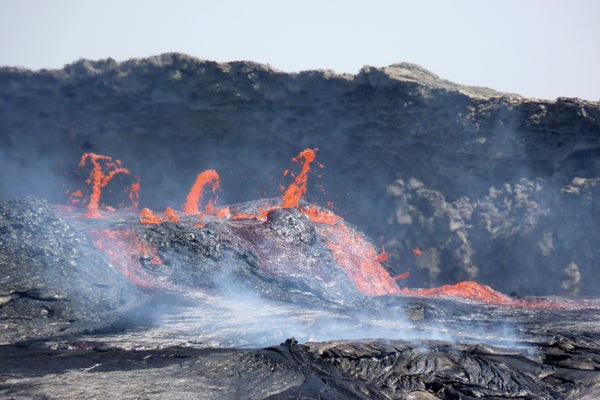
The active lava flows pouring from the Erta Ale volcano to Afar, Ethiopia.
Dr Derek Keir, University of Southampton / University of Florence
A place in East Africa called the Afar triangle marks the meeting point of three rift zones – lines where the crust of the earth is apart. Researchers were not exactly sure what motivates this rifting, but a new study in Nature geoscience suggests that it is caused by rhythmic pulses of land rock from the bottom below the surface.
Scientists proposed for the first time in the 1970s that a warm increase in the material of the Earth’s mantle, known as the panache, occurred below this place. Since then, the researchers have debated the question of whether a single plume, several smaller “plumelets” or something else completely removes the plates. Emma Watts, a geochemist at the University of Swansea in the land of Wales, wanted to settle the question, so she and a team of geophysicists, geochemists and computer scientists have put their heads and found a probable response.
“The more I look at it, the more I see that you must have all the pieces of the puzzle to see the overview,” she said.
On the support of scientific journalism
If you appreciate this article, plan to support our award -winning journalism by subscription. By buying a subscription, you help to ensure the future of striking stories about discoveries and ideas that shape our world today.
The team analyzed 130 rock samples from volcanoes from the Afar region. The chemical signatures of each sample helped scientists collect the movement of land rock below the surface of the earth: the researchers calculated the concentrations of elements such as lead and cerium, which can indicate whether a deep coat material has increased upwards, as well as the relationships of different isotopes which came from each of the slightly varied reserves in the coat.

Image of the microscope of a thin ribbon of one of the volcanic rocks from afar, in Ethiopia.
Dr Emma Watts, University of Southampton / Swansea University
After having compared their data to calculation models of various permutations of mantle plumes, the researchers discovered that the best explanation of their observations is a single plume which moves upwards in the pulses. The impulses seem to exert variable pressure which grows on each rift area differently, depending on how the rift moves and the thickness of the crust on each side. The Faille of the Red Sea of the AFAR triangle of the triangle has impulses which move further along the rift area and which are more frequent than those of the main Ethiopian of the slower saddle in the western part of the triangle.
“Rifting rates really control what we see in the panache,” says Watts. “What we think is that [the Red Sea Rift is] Spread faster …, so it has more space to move, and it is more easily stretched. »»
The relationship between the movement of the mantle and the geochemical fingerprints is “exciting because it suggests that geophysics and geochemistry can be married to deduce geodynamic processes on a large scale”, explains Catherine Rychert, geophysicist to the oceanographic institution of Woods Hole, which was not involved in this research.
This is one of the first known examples of a dynamic mantle plume that responds to the tectonic plates above, so more research is necessary to confirm the observation, says Rychert. Watts hopes that this technique could be used in other rift systems and that more data of this system could give researchers a more precise view of what is happening deep below the surface of the earth.


